
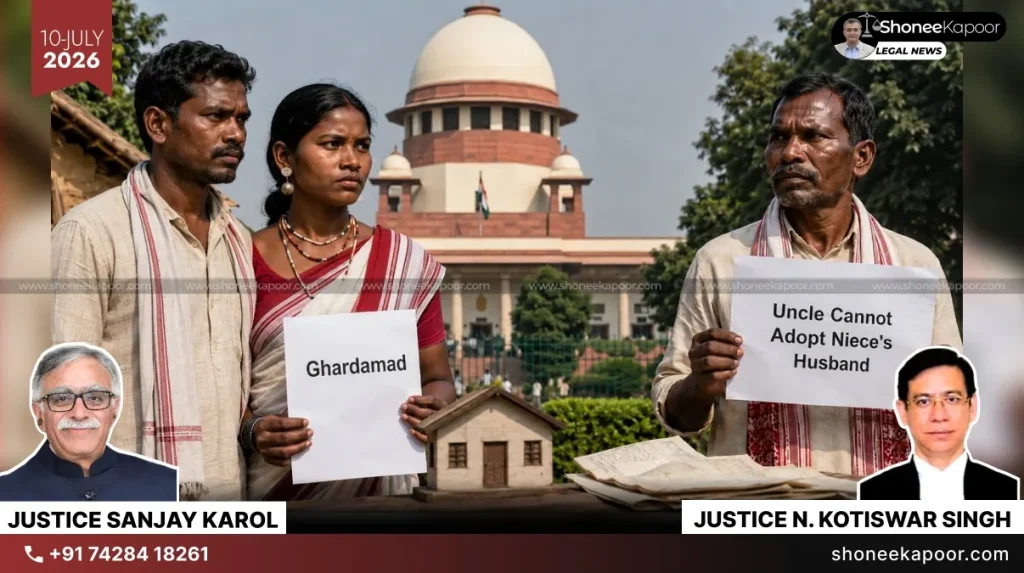
Can a daughter claim Oraon tribal property by calling her husband a Ghardamad? Supreme Court says No. Custom must be proved, not presumed. The Court held that an uncle-in-law’s alleged adoption of a niece’s husband as Ghardamad was not established under Oraon tribal custom.
NEW DELHI: The Supreme Court has allowed an appeal in a tribal property dispute and reversed the findings of three courts. The case was about whether a son-in-law could claim land rights as ghardamad under local custom.
The judgment was delivered by Justice Sanjay Karol, with Justice Nongmeikapam Kotiswar Singh on the Bench. The Court said that custom cannot be accepted only because one side says it exists.
The Court relied on the settled rule that:
“All customs of which the courts do not take judicial notice must be clearly proved to exist, the onus of establishing them being upon the parties relying upon their existence.”
The dispute arose within a family over inheritance of land. One side claimed that daughters had no share under the local custom. The other side claimed that the son-in-law had become ghardamad and therefore had rights in the property.
After checking the evidence, the Supreme Court found that there was no clear proof of partition in the family. It also found that the witnesses supporting the ghardamad claim were inconsistent on important facts.
On daughters’ rights, the Court accepted the evidence and held:
“Hence, as proven, daughters do not get any right or share in the property.”
The Court accepted that a ghardamad may get property from his father-in-law if the custom is proved. It observed:
“It appears from all the testimonies that the custom of a son-in-law(ghardamad) acquiring a right in the property of his father-in-law is proved.”
But this did not decide the case in favour of the contesting side, because the alleged adoption was not by the father-in-law. The Court said:
“It is nowhere established that an uncle-in-law can adopt his niece’s husband as his ghardamad within the prevalent customary law.”
The Court also rejected the claim based on the alleged lease or partition document. It said:
“It is also well established that a partition can be affected only amongst people who have shares between them.”
The Supreme Court made the main legal position clear:
“Those who allege a custom must be the one to prove it.”
The Court said that property rights cannot be taken away by vague claims of custom. A custom must be specifically proved, and the person claiming benefit from it must show that it applies to the facts.
Finally, the Supreme Court held that the wider custom claimed in the case was not proved. Therefore, the nearest male agnate would inherit the property.
The appeal was allowed, and the judgments of the Trial Court, First Appellate Court and High Court were set aside.
EXPLANATORY TABLE: LAWS AND PROVISIONS INVOLVED
| Law / Section | Purpose | How It Applied In This Case |
| Article 136, Constitution of India | Gives Supreme Court power to interfere in exceptional cases through special leave jurisdiction. | The Court used this power to interfere despite concurrent findings of three courts, because the findings on custom and inheritance were legally flawed. |
| Section 100, CPC | Deals with Second Appeal before High Court on substantial questions of law. | Supreme Court said once High Court framed a substantial question of law, it had to properly decide it, not avoid it merely because lower courts had concurrent findings. |
| Section 48, Evidence Act, 1872 | Allows courts to consider opinions of persons likely to know about existence of a custom. | Used while explaining how tribal/local customs must be proved before court. |
| Law on Customary Rights | A custom must be ancient, certain, reasonable, continuous and properly proved. | The Court held that a person claiming property through custom must prove that custom clearly. Vague claims are not enough. |
| Law on Lease Deed | A lease deed only gives leasehold rights; it does not transfer ownership/title. | The Court held that the alleged lease deed could not confer title in the property. |
| Law on Partition | Partition can happen only between persons who already have a share in the property. | Since the person claiming through partition had no proved share, the alleged partition could not create title. |
CASE DETAILS
- Case Title: Bejla Oraon v. Kali Das Oraon & Ors.
- Court: Supreme Court of India
- Jurisdiction: Civil Appellate Jurisdiction
- Neutral Citation: 2026 INSC 672
- Case Number: Civil Appeal Arising out of SLP (C.) No. 23458 of 2024
- Bench: Justice Sanjay Karol | Justice Nongmeikapam Kotiswar Singh
- Date of Judgment: 09 July 2026
KEY TAKEAWAYS
- Property rights cannot be snatched by merely shouting “custom”. Whoever claims a custom must prove it with clear evidence.
- Supreme Court reminded that courts cannot presume inheritance rights on vague family claims, emotions or informal arrangements.
- Three courts had accepted the claim, but Supreme Court reversed them because the legal foundation itself was weak.
- A lease deed or so-called partition cannot create ownership when the person claiming under it had no proven share in the property.
- Male inheritance rights cannot be defeated unless the opposite side proves a valid legal or customary right. The burden is on the claimant, not on the man defending his property.
This Could Change Your Case-Get FREE Legal Advice-Click Here!
Disclaimer: The views and opinions expressed in this article are those of the Indian courts and do not necessarily reflect the official policy or position of “ShoneeKapoor.com” or its affiliates. This article is intended for informational and educational purposes only. The content provided is not legal advice, and viewers should not act upon this information without seeking professional counsel. Viewer discretion is advised.