
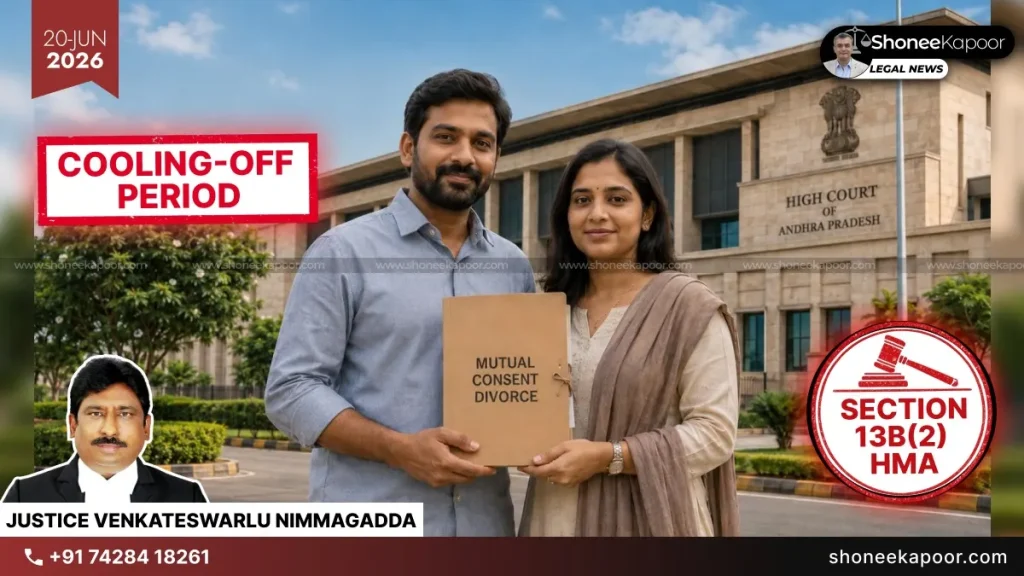
Can a dead marriage be kept alive only because of procedure? The Andhra Pradesh High Court held that law does not require preservation of a matrimonial bond that has irretrievably broken down.
AMARAVATI: The Andhra Pradesh High Court at Amaravati, through Justice Venkateswarlu Nimmagadda, gave relief to a husband and wife who wanted early divorce by mutual consent after settling all disputes between them.
The petitioners had challenged the order of the Family Court, Prakasam District, Ongole, which refused to advance their mutual consent divorce case before completion of the six-month cooling-off period.
The couple got married on 04 December 2022 at Ongole and had a daughter on 02 September 2023. Later, matrimonial disputes arose between them, and they started living separately for about one year.
They filed a petition under Section 13-B of the Hindu Marriage Act, 1955, seeking divorce by mutual consent. The Family Court took the petition on file on 12 January 2026 and posted it to 13 July 2026 because of the statutory six-month waiting period.
After this, both parties requested the Family Court to take up the matter earlier. They said all disputes had already been settled, including permanent alimony, property distribution, child welfare, and criminal cases.
As per the settlement, the husband agreed to pay Rs.62 lakhs to the wife and their minor daughter towards their share and permanent alimony. House plots had also been settled in their favour. The wife also agreed to withdraw the criminal cases filed against the husband.
However, the Family Court rejected their request. It said there was no sufficient urgency to waive the cooling-off period and that the waiting period was meant to give both parties time to reconsider and attempt reconciliation.
The couple then approached the High Court. Their counsel argued that the purpose of the cooling-off period had already been served because both parties had consciously settled all issues and decided to part ways.
The High Court relied on the Supreme Court judgments in Amit Kumar vs. Suman Beniwal and Amardeep Singh vs. Harveen Kaur. The Court noted that the six-month cooling-off period under Section 13-B(2) is “not mandatory but directory” and can be waived in suitable cases.
The High Court found that the husband and wife had settled all disputes voluntarily. The settlement covered permanent alimony, custody and welfare of the minor child, and distribution of properties. The Court also noted that there was-
“No possibility of reconciliation.”
The Court said the purpose of Section 13-B(2) is to give parties a reasonable chance to rethink and explore reunion. But when both parties have already settled everything and clearly decided to separate, keeping the matter pending would serve “no useful purpose.”
The Court further observed that forcing the couple to wait would only result in “prolonging the agony and hardship” of the parties.
The High Court also said that the law does not force parties to preserve a matrimonial bond which has already broken down and where reunion is not possible.
Finding the settlement “voluntary and genuine,” the High Court allowed the civil revision petition and set aside the Family Court’s order dated 12 April 2026.
The Family Court at Ongole was directed to take up the matter and pass appropriate orders for dissolution of marriage by mutual consent as expeditiously as possible.
EXPLANATORY TABLE: LAWS AND PROVISIONS INVOLVED
| Law / Provision | Meaning | How Applied In This Case |
| Article 227, Constitution of India | High Court’s supervisory power. | Used to challenge Family Court order. |
| Section 13-B, Hindu Marriage Act, 1955 | Mutual consent divorce provision. | Parties sought divorce by consent. |
| Section 13-B(2), Hindu Marriage Act, 1955 | Six-month cooling-off period. | Held directory, not mandatory. |
| Civil Revision Petition | Challenge to lower court order. | Filed against refusal to advance case. |
| Amardeep Singh vs. Harveen Kaur, AIR 2017 SC 4417 | Cooling-off period can be waived. | Relied on for waiver principle. |
| Amit Kumar vs. Suman Beniwal, (2023) 17 SCC 648 | Waiver allowed in settled cases. | Relied on to avoid needless delay. |
CASE DETAILS
- Case Title: Husband & Wife vs. State
- Court: High Court of Andhra Pradesh at Amaravati
- Case Number: Civil Revision Petition No.1405 of 2026
- Judgment Date: 04.05.2026
- Bench: Hon’ble Sri Justice Venkateswarlu Nimmagadda
- Counsels:
- For Petitioners: Mrs. Ayesha Azma S
- For Respondent: Not mentioned in the PDF
KEY TAKEAWAYS
- Mutual consent divorce should not become a forced waiting game when both sides have settled everything.
- A man should not be kept trapped in a dead marriage only because of procedural delay.
- Once alimony, child welfare, property and criminal cases are settled, prolonging litigation serves no real purpose.
- The six-month cooling-off period is directory, not mandatory; courts can waive it in genuine cases.
- Law must help parties move on with dignity, not preserve a marriage where reconciliation is impossible.
This Could Change Your Case-Get FREE Legal Advice-Click Here!
Disclaimer: The views and opinions expressed in this article are those of the Indian courts and do not necessarily reflect the official policy or position of “ShoneeKapoor.com” or its affiliates. This article is intended for informational and educational purposes only. The content provided is not legal advice, and viewers should not act upon this information without seeking professional counsel. Viewer discretion is advised.