
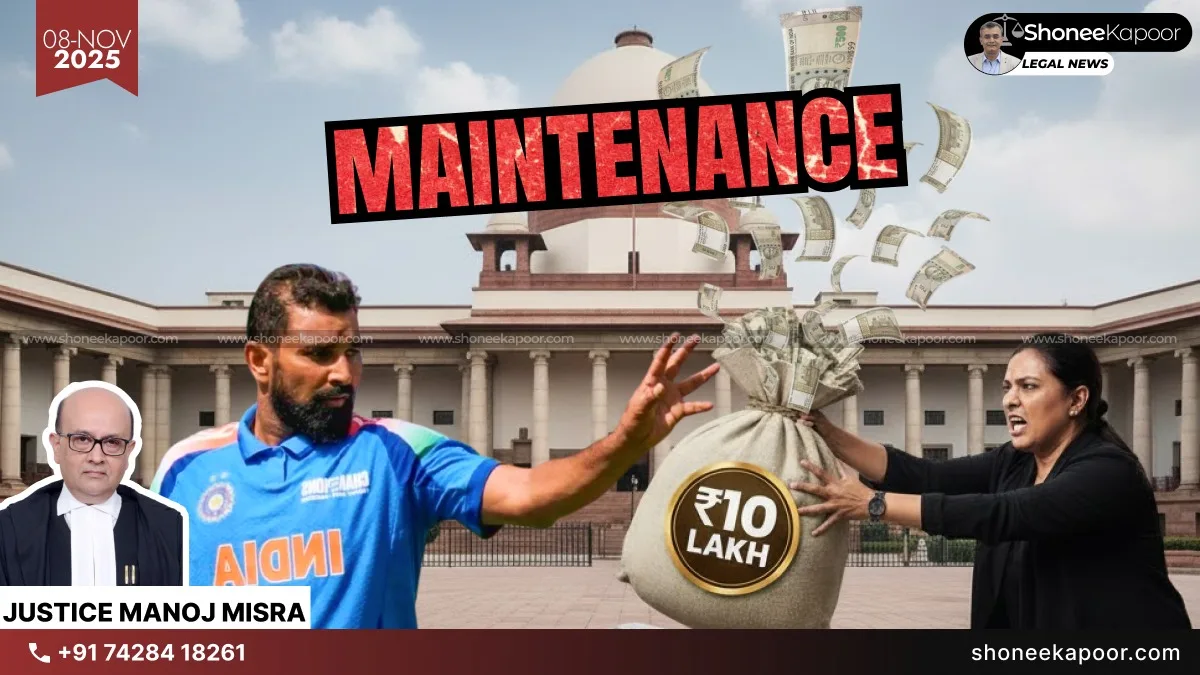
Mohammed Shami’s Wife Moves Supreme Court Seeking ₹10 Lakh Monthly Maintenance: “He Lives Like a Star, Why Should We Live Like Strangers?”

Written and analysed by Vaibhav Ojha
Head Of Legal CommunicationsMohammed Shami Wife claims Shami’s net worth crosses ₹500 crore; says their daughter shouldn’t be “forced into a budget life while father lives lavishly”, that is when Supreme Court steps in.
NEW DELHI: In a long-running domestic violence and maintenance case between Indian cricketer Mohammed Shami and his wife Hasin Jahan, the Supreme Court of India has issued notices to Mohammed Shami and the State of West Bengal on a petition filed by his wife, Hasin Jahan seeking a monthly interim maintenance of ₹10 lakh for herself and their minor daughter.
The amount currently stands at ₹4 lakh per month, a figure fixed by the Calcutta High Court in July 2025, which directed the husband, Shami to pay ₹1,50,000 to his wife and ₹2,50,000 to their daughter, pending final disposal of the domestic violence proceedings.
Challenging this order, the petitioner-wife argued that the High Court failed to consider Shami’s actual financial status and the standard of living she and her daughter were accustomed to during the marriage.
A bench of Justices Manoj Misra and Ujjal Bhuyan, while issuing notice, also questioned the petitioner: “Is the existing amount of ₹4 lakh per month not sufficient?” However, the Court agreed to examine the need for enhancement after hearing Shami’s response.
Facts if the Case
Indian cricketer Mohammed Shami and his wife Hasin Jahan were married on April 7, 2014, in Kolkata according to Muslim personal law. A daughter was born to them in July 2015. This was the wife’s second marriage; she also has two daughters from her previous marriage who have lived with her since before this dispute.
Breakdown of Dispute:
In March 2018, the relationship turned publicly hostile when Hasin Jahan accused Shami of physical abuse, mental cruelty, and marital infidelity. Posted screenshots of alleged extramarital conversations on social media, triggering national attention.
Following this, she filed a detailed complaint, leading to: Jadavpur Police Station. Charges invoked were 498A (cruelty), 328 (poisoning), 307 (attempt to murder), 376 (rape), 325 (hurt), and 34 IPC. The police later filed a chargesheet, and the criminal trial is still pending.
Maintenance Proceedings Under Domestic Violence Act: After leaving the matrimonial home, the wife filed an application under section 12 of The Protection of Women from Domestic Violence Act, 2005 seeking interim monetary relief totaling ₹10 lakh/month, broken down as:
- Wife: ₹7,00,000 to maintain lifestyle comparable to marriage
- Minor Daughter: ₹3,00,000 to match schooling & social environment of children of national cricketers
Orders Passed by Lower Courts:
- Trial Court (Magistrate, Alipore): Wife has some income; thus, maintenance reduced ₹1,30,000/month
- Calcutta High Court (July 2025): Maintenance must reflect husband’s income and marriage lifestyle thus maintenance was set up to ₹4,00,000/month (₹1.5L wife + ₹2.5L daughter)
The High Court based its conclusion partly on:
Shami’s Income Tax Return, which reflected:
- Annual Income: ₹7.19 crore
- Estimated monthly resources: ₹60 lakh+
- His career as an A-listed Indian international cricketer, central BCCI contract holder, IPL earnings, endorsements, and commercial assets.
Why Has the Wife Now Approached the Supreme Court?
The wife argues that:
- ₹4 lakh/month does not reflect Shami’s real income, lifestyle, or the standard their daughter is entitled to.
- The daughter must not “grow up in a financially inferior environment” while the father enjoys a luxury public lifestyle.
- Maintenance must ensure social parity, especially because:
- Cricketers’ families typically access: Elite private schooling, Grooming programs, Coaching academies, Travel & activity standards far above normal middle-class benchmarks
Position Before the Supreme Court:
The matter was listed before a Bench of Justices Manoj Misra and Ujjal Bhuyan, which has:
- Issued notice to Shami and the State of West Bengal
- Asked the wife to clarify why ₹4 lakh/month is inadequate
- Sought financial disclosure and expenditure justification
Court’s Findings
While enhancing the interim maintenance from ₹1.3 lakh to ₹4 lakh per month, the Calcutta High Court held that the determination of maintenance must reflect the standard of living that the wife and child were accustomed to during the marriage and cannot be reduced to a mere survival allowance.
The Court observed that the fact of marriage and the paternity of the child were not in dispute, and that the materials on record, including the criminal case under Section 498A IPC and allied offences, showed a prima facie domestic relationship accompanied by allegations of domestic violence. Therefore, the wife was entitled to seek interim monetary relief under the Protection of Women from Domestic Violence Act, 2005.
On Standard of Living:
The High Court emphasized that maintenance must be “fair, reasonable, and consistent with the lifestyle enjoyed during the marriage.” It held:
“The petitioner wife who has remained unmarried and is living independently with the child is entitled to a levelled maintenance that she enjoyed during her continuance of marriage which reasonably secures her future as well as that of the child.”
This principle applies especially when the husband’s income is substantial and well-documented, as in this case, where the Court relied on Shami’s Income Tax Return showing an annual income of approximately ₹7.19 crore.
On Claims That the Wife Must Be Self-Sufficient: Shami argued that the wife had independent earning capacity. The Court rejected using this as a complete bar to maintenance:
“Even if the wife is earning some amount of money, it is not sufficient to rule out her application for monetary relief.”
“The question is not whether she earns, but whether her income allows her to live with dignity.”
This aligns with the Supreme Court’s rule in Rajnesh v. Neha, which the Court explicitly referenced.
On “Equalization of Wealth”: Shami argued that the wife was attempting to equalize wealth, which is prohibited. The Court acknowledged the principle from Rinku Baheti v. Sandesh Sharda but clarified: “While equalization of wealth is impermissible, awarding very low maintenance that does not match the standard of living of the parties is also not acceptable.”
Thus, the Court walked a middle path:No luxury equalization, but no forced financial downgrade, especially for the child.
On Allegations of Adultery / Questioning Character: Shami’s side suggested that the wife was living an “independent lifestyle” and therefore not entitled to relief. The Court refused to consider media reports and public perception as evidence:
“The personal life of both parties has been under the vigil of media, but such publications cannot have any legal value unless supported by material on record.”
Thus, the Court held that character allegations were irrelevant at the interim stage.
Final Interim Direction by High Court:
“A sum of ₹1,50,000 per month to the petitioner-wife and ₹2,50,000 per month to the daughter would be just, fair, and reasonable to ensure financial stability for both, until disposal of the main application.”
This created the current ₹4,00,000/month order now challenged before the Supreme Court.
Supreme Court’s Observations
When the matter came before the Bench of Justice Manoj Misra and Justice Ujjal Bhuyan, the Court did not immediately accept the plea for enhancing the interim maintenance to ₹10,00,000/month. Instead, the Bench expressed reservation and sought justification for the increase.
The Bench asked the petitioner’s counsel:
“The High Court has already granted ₹4 lakh per month. How is it insufficient? Explain the necessity for enhancement.”
Supreme Court’s Concern About Excessive Maintenance Claims:
The Bench indicated that:
Maintenance must reflect genuine needs not lifestyle inflation or aspirational expenditure. The Court signaled the core legal principle that: Maintenance ensures dignity, not luxury. This aligns with established Supreme Court rulings such as:Rinku Baheti v. Sandesh Sharda (2024) maintenance cannot be used to “match” the husband’s wealth.
Bhagwan Dutt v. Kamla Devi (1975) – maintenance is for “a life of dignity, not lavishness.”
Thus, by asking why ₹4 lakh was not enough, the Supreme Court implicitly reinforced that: The mere fact that the husband is wealthy does not automatically entitle the wife to higher maintenance.
Supreme Court’s Stand on Financial Disclosure: The Court made clear that before considering an increase that Actual, document-backed expenses of the wife and child must be demonstrated. This means: No enhancement will be granted on emotional or lifestyle-based arguments alone the wife must prove specific educational, medical, and upbringing costs not broad claims of “lavishness”
By questioning the necessity of ₹10 lakh/month, the Bench has:
- Put the burden of proof entirely on the wife. Held the existing ₹4 lakh/month as a reasonable benchmark unless disproven
- Sent a clear signal that exaggerated monetary demands will face judicial scrutiny
The Supreme Court’s stance recognizes that:
- High earnings alone do not justify high maintenance
- The wife must prove need, not just the husband’s capacity.
Explanatory table of sections/case laws cited in the judgement
| Law / Case | Provision / Legal Principle | What the Law Requires | How the Court Applied It (Calcutta High Court) |
| Section 12 & 20 of the Protection of Women from Domestic Violence Act, 2005 | Monetary relief to be adequate, fair and consistent with the standard of living enjoyed during the marriage. | Court considers standard of living, financial capacity of husband, needs of wife & child, and social environment. | High Court held that maintenance cannot be merely subsistence-level when the husband earns in crores; ordered ₹4 lakh/month to reflect marital lifestyle. |
| Section 23 PWDV Act (Interim Relief) | Courts may grant interim monetary relief based on prima facie material. | No detailed evidence required at interim stage; only credible domestic relationship + allegations. | Criminal FIR + domestic relationship were undisputed; prima facie entitlement to interim relief was affirmed. |
| Income Disclosure Principle (from Rajnesh v. Neha, (2021) 2 SCC 324) | Both parties must file Affidavits of Assets & Liabilities. Maintenance must be realistic and reflect lifestyle. | Maintenance assessed based on monthly income, expenses, liabilities, schooling, rent, social needs. | Court relied on Income Tax Return showing ~₹7.19 crore annual income, holding Shami able to pay more. |
| Rinku Baheti v. Sandesh Sharda, 2024 SCC OnLine SC 3801 | Maintenance is not wealth equalization. Husband is not required to match wife’s lifestyle after separation. | Court must avoid ordering maintenance to “equalize wealth” or punish the earning spouse. | HC agreed no wealth-equalization, but said very low maintenance disproportionate to Shami’s income is also unacceptable. |
| Bhagwan Dutt v. Kamla Devi, (1975) 2 SCC 386 | Maintenance ensures moderate and dignified living, not luxury, not poverty. | Court assesses both: husband’s means + wife’s reasonable needs. | HC held ₹1.3 lakh was too low given earnings & child’s needs; increased to ₹4 lakh. |
| Zahir Abdullah v. Oman Abdullah, 2023 SCC OnLine Del 5321 | Wife’s earning capacity does not bar her from maintenance. | Wife may be earning, but if income is insufficient to maintain dignity, she may still claim relief. | Wife’s alleged earnings not proven sufficient → Maintenance upheld. |
| Section 498A IPC + Related Charges in Jadavpur P.S. Case No. 82/2018 | Existence of a domestic relationship & allegations of cruelty support DV Act jurisdiction. | FIR/chargesheet act as prima facie indicators of domestic violence for interim relief. | Court accepted prima facie allegations + charge sheet → enabled interim maintenance grant. |
Case Details
| Case Title | Hasin Jahan v. State of West Bengal & Anr. (Opposite Party No. 2: Mohammed Shami) |
| Court | Supreme Court of India |
| Type of Matter | Special Leave Petition (SLP) filed against the Calcutta High Court interim maintenance order |
| Challenged Order | Calcutta High Court Order dated July 1, 2025 in CRR 656 of 2023, enhancing maintenance to ₹4,00,000/month |
| Stage Before Supreme Court | Notice issued; replies awaited from Mohammed Shami and the State of West Bengal |
| Supreme Court Bench | Justice Manoj Misra and Justice Ujjal Bhuyan |
| Petitioner (Before SC) | Hasin Jahan (Wife) |
| Respondents | State of West Bengal & Mohammed Shami (Husband) |
| Counsel for Wife | Senior Advocate Shobha Gupta; Advocates Deepak Prakash, Sriram Parakkat, Divyangna Mallik |
| Key Relief Sought | Increase interim maintenance to ₹10,00,000/month (₹7 lakh to wife + ₹3 lakh to daughter) |
| High Court Order Under Challenge | Maintenance fixed at ₹1,50,000/month to wife + ₹2,50,000/month to daughter = ₹4,00,000/month total |
| Original Claim (Trial Court) | ₹10,00,000/month (₹7L for wife + ₹3L for child). Trial Court granted ₹1.30L; HC enhanced to ₹4L |
| Basis of Wife’s Appeal | Shami is a high-net-worth national cricketer; daughter must receive lifestyle comparable to children of elite cricketers |
| Supreme Court’s Current Position | The Court has not increased maintenance; instead, it has questioned why ₹4L/month is insufficient and sought justification |
| Next Procedural Step | Counter-affidavit by Shami + filing of income and expenditure statements → final interim reconsideration hearing |
Disclaimer: The views and opinions expressed in this article are those of the Indian courts and do not necessarily reflect the official policy or position of “ShoneeKapoor.com” or its affiliates. This article is intended for informational and educational purposes only. The content provided is not legal advice, and viewers should not act upon this information without seeking professional counsel. Viewer discretion is advised.
Related Articles

Legal Risks Men Face In Modern Relationships In India: 498A, Maintenance, False Promise To Marry, Live-In Cases & DV Act
Modern relationships can expose Indian men to criminal cases, maintenance claims, DV Act proceedings, false promise t...
Why More Men Are Afraid Of Marriage Today: Law, False Cases, Maintenance Fear & The Indian Courtroom Reality
Indian men are not afraid of marriage. They are afraid of one-sided legal risk, false 498A/85 BNS cases, maintenance ...

8 Court Judgments Every Man Should Know in India Before 498A, Maintenance, Custody or Divorce Hits
From arrest protection in 498A (85 BNS) cases to maintenance disclosure, child visitation, DV residence rights and fo...
Relevant Judgements
Can an NRI Husband Be Forced to Pay Maintenance in India? Supreme Court Rules Explained for Overseas Indian Men
Living abroad does not automatically protect an NRI husband from maintenance claims in India.But can Indian courts pa...
Share Your Thoughts
Comments are moderated before publication.