
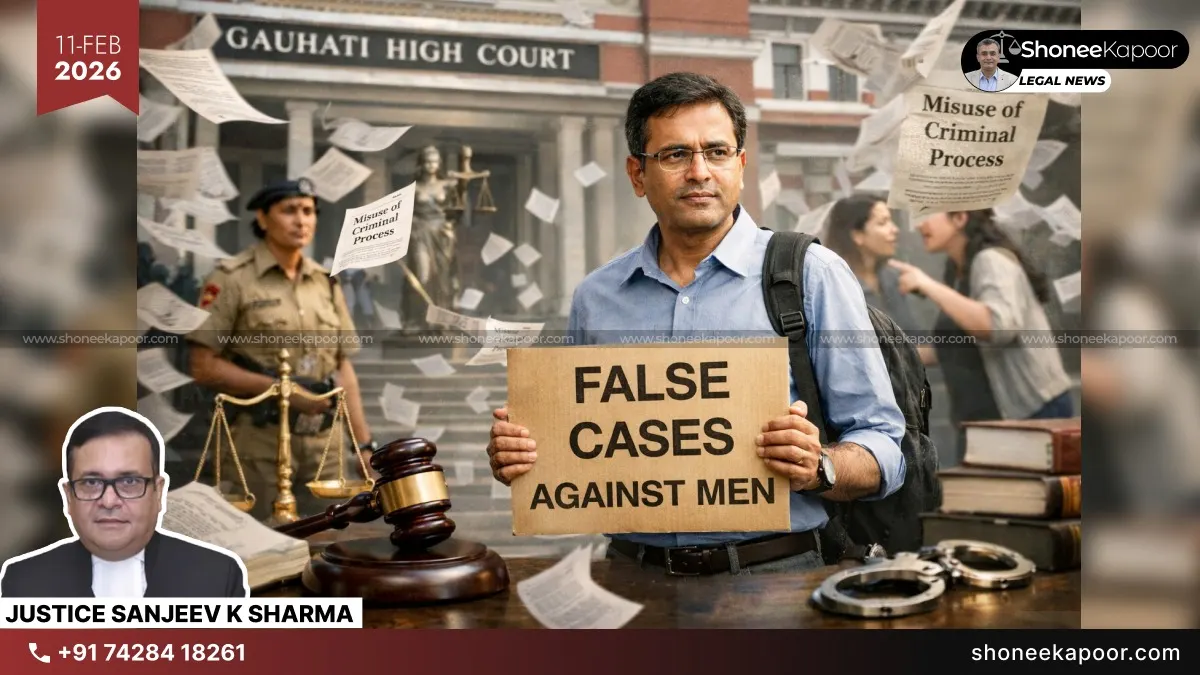
Mere Touching Is Not Outraging Modesty Of A Woman: Gauhati High Court Quashes Section 354 IPC Case Against IIT Professor, Flags Misuse of Criminal Process

Curated by NEWS DESK
Editorial DeskThe Gauhati High Court ruled that simple physical contact, without criminal force or assault, does not attract Section 354 IPC. The Court quashed the FIR and trial against an IIT professor, noting possible abuse of legal process.
ASSAM: The Gauhati High Court has delivered an important judgment clarifying the legal limits of Section 354 of the Indian Penal Code (IPC), which deals with assault or use of criminal force to outrage the modesty of a woman. In a relief to an IIT professor, the Court ruled that mere touching, without the legal ingredients of “force” or “assault”, cannot amount to an offence under Section 354 IPC.
The matter was heard by Justice Sanjeev Kumar Sharma, who carefully examined the definition of “force” under Section 349 IPC. The Court made it clear that criminal law requires specific elements to be satisfied before a person can be prosecuted for outraging modesty.
The Court categorically held, “mere touching” does not amount to the use of force to constitute an offence under Section 354 of the Indian Penal Code (IPC), which deals with assault or the use of criminal force intended to outrage a woman’s modesty.
While analysing the statutory framework, the Court referred to Section 349 IPC, which defines “force” as causing motion, change of motion, or cessation of motion to another person’s body. It emphasized that simple physical contact, by itself, does not automatically become criminal force.
The Court clearly observed:
“Mere touching would not or could not be brought in within the ambit of the definition of force as defined under Section 349 IPC.”
Further, the High Court explained that in criminal law, “assault” refers to gestures or actions that create a reasonable fear of immediate physical harm. Even when physical contact takes place, it must still satisfy the requirement of criminal force in order to attract Section 354 IPC.
After reviewing the FIR and the complainant’s statement, the Court found that the essential ingredients of assault or criminal force were missing. It noted that the only allegation was that the professor held the complainant’s hand.
The Court recorded:
“As far as the facts of the present case are concerned, as reflected in the FIR as well as in the statement of the victim… the allegation is that the petitioner held the hand of the complainant/victim. No motion, change of motion or cessation of motion was caused to the person of the complainant/victim. Further, there is nothing in the contents of the FIR or the statement of the victim attributing any act on the part of the petitioner as would qualify as a gesture or preparation so, as to be termed as an assault.”
The background of the case shows that the complainant, a woman entrepreneur from Ahmedabad, had approached the IIT Guwahati professor for mentorship related to her startup. According to her complaint, during a car ride in Guwahati in 2022, the professor allegedly made certain comments which she found uncomfortable and repeatedly held her hand while looking at her palm. It was also alleged that he stopped near a temple and asked her to join hands for offering prayers before starting the journey.
Based on these allegations, the police registered an FIR under Section 354 IPC and later filed a charge sheet. A magistrate court took cognisance of the offence, and criminal proceedings were initiated against the professor. He subsequently approached the Gauhati High Court seeking quashing of the FIR, the charge sheet, and the ongoing trial.
Apart from examining the legal requirements of Section 354 IPC, the High Court also looked into the sequence of events leading to the criminal complaint. The Court noted that the same allegations had earlier been raised in a departmental inquiry. That inquiry, conducted with participation from both sides, had concluded that the allegations were baseless. The criminal FIR was filed around two and a half months after the inquiry ended.
The Court made a strong observation in this regard:
“It does prima facie appear that due to the unfavourable result in the departmental proceedings, the complainant has sought to lodge the FIR after two and a half months thereafter with a view to wreck vengeance upon the petitioner which itself is an abuse of the process of the Court.”
Taking into account both the legal analysis and the surrounding circumstances, the Gauhati High Court concluded that no offence under Section 354 IPC was made out on the material available. Accordingly, it quashed the FIR, the charge sheet, and the pending criminal proceedings before the magistrate.
Explanatory Table Of Laws And Sections Involved
| Law & Section | Purpose | How Applied in This Case |
| Section 354 IPC | Punishes assault or criminal force against a woman with intent to outrage modesty | FIR registered alleging hand-holding amounted to outraging modesty; High Court held ingredients not satisfied |
| Section 349 IPC | Defines “Force” as causing motion, change of motion, or cessation of motion | Court held no motion or restraint caused; mere touching not “force” |
| Section 350 IPC | Defines “Criminal Force” | Since Section 349 not satisfied, criminal force could not arise |
| Section 351 IPC | Defines “Assault” as gesture causing apprehension of criminal force | No gesture or preparation causing fear of immediate harm found |
| Section 164 CrPC | Recording of victim’s statement before Magistrate | Victim’s statement examined; no allegation establishing assault or mens rea |
| Section 482 CrPC | Inherent powers of High Court to quash proceedings | Court exercised inherent powers to quash FIR and trial |
| Article 226 Constitution of India | Extraordinary writ jurisdiction | Referred in precedent regarding quashing frivolous proceedings |
Important Precedents Referred
- Naresh Aneja @ Naresh Kumar Aneja v. State of UP & Another (2025) 2 SCC 604
- Raju Pandurang Mahale v. State of Maharashtra (2004) 4 SCC 371
- Attorney General v. Satish (2022) 5 SCC 545
- Dilip Uttam Lomate v. State of Maharashtra & Others, 2019 Supreme (Bom) 828
- Pradeep Kumar Kesarwani v. State of Uttar Pradesh and Another, 2025 Supreme (SC) 1667
- Mohammad Wajid v. State of U.P., 2023 SCC OnLine SC 951
Case Details
- CASE TITLE: VK v. State of Assam & Anr.
- CASE NUMBER: Crl. Petition No. 362 of 2024
- NEUTRAL CITATION: 2026:GAU-AS:1523
- COURT: The Gauhati High Court (High Court of Assam, Nagaland, Mizoram and Arunachal Pradesh)
- BENCH: Hon’ble Mr. Justice Sanjeev Kumar Sharma
- DATE OF JUDGMENT: 05.02.2026
- PETITIONER: VK (IIT Professor, Guwahati)
- RESPONDENTS: State of Assam & Respondent No. 2 (Complainant)
- COUNSELS:
- For the Petitioner: Mr. Z. Kamar, Senior Advocate
- For the State: Mr. D.P. Goswami, Additional Public Prosecutor, Assam
- For Respondent No. 2: Mrs. D. Borpujari, Legal Aid Counsel
- LOWER COURT PROCEEDINGS: PRC No. 69/2024 pending before the Judicial Magistrate First Class (JMFC), Kamrup at Amingaon
- POLICE CASE DETAILS: North Guwahati Police Station Case No. 51/2023 under Section 354 IPC
Key Takeaways
- Mere physical contact is not automatically a criminal offence under Section 354 IPC; force must legally involve motion, restraint, or physical compulsion.
- Criminal law requires clear proof of intent (mens rea); vague allegations without demonstrable intent cannot justify prosecution.
- Courts must examine surrounding circumstances carefully, especially when allegations follow an unsuccessful departmental inquiry.
- Section 354 IPC cannot be stretched to criminalise every uncomfortable interaction; strict statutory ingredients must be satisfied.
- The judgment reinforces that reputation and career cannot be destroyed on weak, exaggerated, or retaliatory allegations — due process and legal standards must prevail.
This Could Change Your Case-Get FREE Legal Advice-Click Here!
Disclaimer: The views and opinions expressed in this article are those of the Indian courts and do not necessarily reflect the official policy or position of “ShoneeKapoor.com” or its affiliates. This article is intended for informational and educational purposes only. The content provided is not legal advice, and viewers should not act upon this information without seeking professional counsel. Viewer discretion is advised.
Related Articles
Delhi’s Crime Drop Didn’t Happen by Chance: How Our Men’s Rights Legal Activism Challenging Misuse, Forced Policing Reform (2024–2025)
Delhi’s improved crime metrics followed sustained legal pressure through RTIs, police engagement, and strategic litig...
Legal Mistakes Men Make During Divorce: Costly Errors That Destroy Cases
Costly legal mistakes Indian men make during divorce, maintenance, custody, 498A/BNS cruelty cases and evidence colle...
Delhi Judge Aman Sharma Suicide Case: Real Truth Exposed With Timeline
Full timeline of Delhi Judge Aman Sharma suicide case, family allegations, FIR under BNS Section 108, legal position ...
Share Your Thoughts
Comments are moderated before publication.