
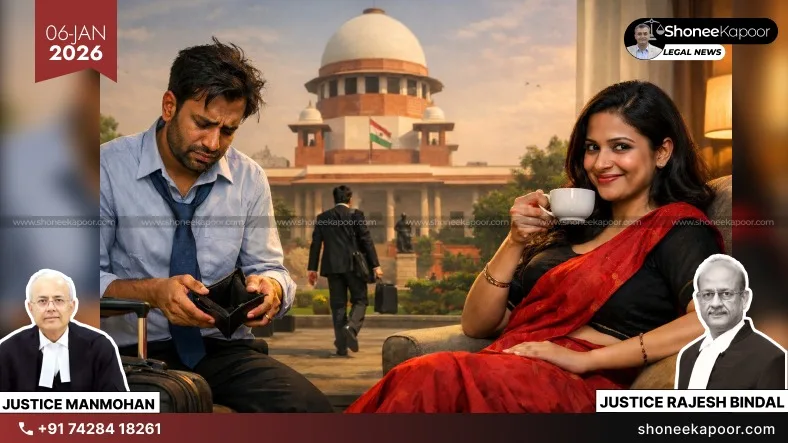
The Supreme Court transferred a husband’s restitution case from Madhya Pradesh to Rajasthan solely on the wife’s convenience. This order once again highlights how Indian matrimonial law routinely ignores the hardship, cost, and legal disadvantage faced by husbands.
New Delhi: The Supreme Court of India has allowed a transfer petition filed by the wife, thereby shifting a matrimonial Supreme Court Transfers Husband’s Case to Wife’s City Again: How Indian Men Lose Jurisdictional Fairness in Matrimonial Litigation case initiated by the husband from Ujjain, Madhya Pradesh, to Bhilwara, Rajasthan.
The matter arose out of proceedings instituted by the husband under Section 9 of the Hindu Marriage Act, 1955, seeking restitution of conjugal rights. As expressly recorded by the Supreme Court, the case was “filed by the respondent-husband for restitution of conjugal rights under Section 9 of Hindu Marriage Act, 1955,” reflecting that it was the husband who first approached the court in an attempt to restore the marital relationship.
However, the wife approached the Supreme Court seeking transfer of this case to her parental place. The Court noted that, the present petition has been filed by the petitioner–wife seeking transfer of Casefrom Ujjain to Bhilwara, Rajasthan.
Despite the fact that the husband had already initiated proceedings in a competent court, the Supreme Court observed that “though service of the respondent is complete, however no one has put in appearance on his behalf”. In practical terms, this often happens because husbands are already financially and emotionally drained by parallel litigation, travel costs, and repeated court dates.
After hearing only the wife’s side, the Court stated,
“After hearing the learned counsel appearing for the petitioner-wife, in our opinion, a case is made out for transfer of the petition filed by the respondent-husband under Section 9 of the Hindu Marriage Act, 1955”
The main reason accepted by the Court was that
“the petitioner-wife claims to be permanently residing at her parental home at Bhilwara, Rajasthan, with no independent means of income or support to travel to Ujjain to attend the proceedings initiated by the Respondent and is entirely dependent, on her family”.
Additionally, the Court noted that four more cases are pending at Bhilwara, Rajasthan.
The order further directed that
“Records shall be sent promptly by the Court where proceedings are pending to the transferee Court”.
It also added that
“In case video conferencing facilities are available in the transferee Court, the parties may be permitted to appear through video conferencing on non-effective dates of hearings”, and that “wherever possible the cases may be assigned to one court and effort can be made to fix these cases on a single day so that the parties are not required to attend court on multiple dates”.
Finally, the Court concluded, and accordingly allowed the Transfer Petition.
This order once again reinforces a harsh legal reality, even when a husband initiates proceedings to restore a marriage, he is expected to travel, adjust, and bear litigation hardship, while the wife’s convenience is treated as decisive. There is no recorded consideration of the husband’s financial capacity, professional obligations, or access to justice.
The consistent pattern in transfer jurisprudence shows that matrimonial litigation in India continues to operate on an assumption that inconvenience to men is acceptable, routine, and legally invisible, while inconvenience to women is treated as sufficient ground to shift entire proceedings across states.
The husband who approaches the court seeking restitution of conjugal rights already faces social stigma and prolonged legal battles. When such cases are transferred across states, the process itself becomes punitive. This order, though legally consistent with precedent, once again demonstrates how procedural discretion disproportionately operates against men in Indian matrimonial law, reinforcing a system where access to justice for husbands becomes increasingly conditional and costly
Explanatory Table: Laws & Sections Involved
| Law & Section | Purpose | Effect on Husband |
| Section 9- Hindu Marriage Act, 1955 | Restitution of conjugal rights | Husband’s case shifted before hearing on merits |
| Article 139A- Constitution of India (Transfer of Powers) | Transfer of cases between courts | Used only for wife’s convenience |
| Family Courts Act, 1984 – Jurisdiction Provisions | Governs family court jurisdiction | Husband forced to litigate in another State |
| Supreme Court Directions on Video Conferencing | Allows remote court appearances | Procedural relief, does not cure transfer prejudice |
Case Summary
- Case Title: Honey vs Yogesh, T.P. (Civil) No. 2666 of 2025 and T.P. (Crl.) No. 841 of 2025
- Court: Supreme Court of India
- Jurisdiction: Civil Original Jurisdiction
- Date of Order: 19 December 2025
- Bench: Hon’ble Mr. Justice Rajesh Bindal and Hon’ble Mr. Justice Manmohan
Counsels
- For the Petitioner (Wife):
- Mr. Rishi Tutu, Advocate
- Mr. Aman Jha, AOR
- Mr. Kshitij Mayank, Advocate
- Mr. Srijan Sahu, Advocate
- For the Respondent (Husband):
- Ms. Srishti Mishra, AOR
- Mr. Sumeet Mishra, Advocate
Key Takeaways
- Wife’s convenience continues to override husband’s hardship in matrimonial transfers.
- A legally filed case by the husband can be shifted without examining his financial or professional constraints.
- Multiple cases in the wife’s location are treated as justification, encouraging forum shopping.
- Courts rarely assess whether repeated transfers weaken the husband’s ability to pursue justice.
- Such orders reinforce the perception that Indian matrimonial law presumes men must absorb cost, travel, and delay without complaint.
This Could Change Your Case-Get FREE Legal Advice-Click Here!
Disclaimer: The views and opinions expressed in this article are those of the Indian courts and do not necessarily reflect the official policy or position of “ShoneeKapoor.com” or its affiliates. This article is intended for informational and educational purposes only. The content provided is not legal advice, and viewers should not act upon this information without seeking professional counsel. Viewer discretion is advised.