
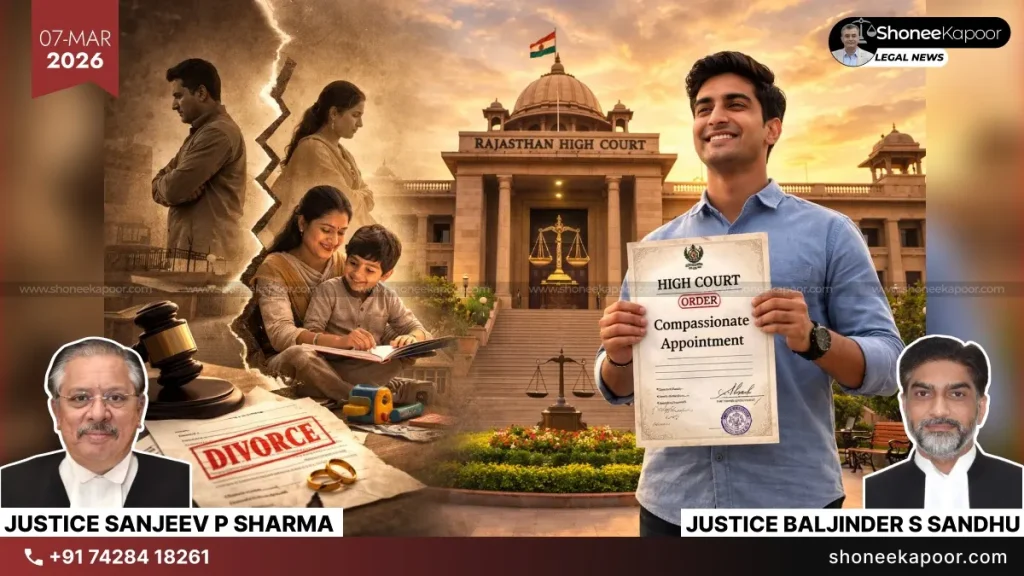
Can divorce between parents, living with the mother, or the father’s second wife getting a job defeat a son’s claim for compassionate appointment?
The Rajasthan High Court said no, holding that the legal status of a son cannot be negated on such grounds.
JODHPUR: A Division Bench of the Rajasthan High Court comprising Acting Chief Justice Sanjeev Prakash Sharma and Justice Baljinder Singh Sandhu dismissed the State Government’s appeal and upheld the right of a son to compassionate appointment after the death of his father, a government employee.
The petitioner had applied for compassionate appointment soon after his father’s death in 2006 and within the prescribed time. However, the department asked him to obtain a succession certificate, and even after he obtained it, his application was not considered. He then approached the High Court, where a Single Judge allowed his petition in 2017.
The State challenged that order and argued that the petitioner’s parents were divorced and he had been living with his mother, so he was no longer dependent on his father. It was also argued that the petitioner was now about 39 years old and therefore should not be given the appointment.
Rejecting these arguments, the High Court held that divorce between parents cannot take away the legal relationship between a father and his son. The Bench observed:
“Merely because divorce had taken place between the parents, the status of the petitioner as a son of the deceased government servant cannot be negated. The denial of compassionate appointment to the petitioner on this ground was clearly untenable.”
The Court also criticised the department for demanding a succession certificate despite there being no dispute about the petitioner’s relationship with the deceased employee. The Bench observed:
“It is not disputed that the petitioner was the legitimate son of the deceased government servant; hence, seeking a succession certificate from him was absolutely unwarranted.”
The State had also argued that the second wife of the deceased employee had already received an appointment. Rejecting this contention, the Court clarified:
“She secured regular appointment under the widow quota and, therefore, such appointment cannot divest the petitioner of his independent right of appointment under the Rules of 1996.”
The judges further noted that the petitioner had applied within a month of his father’s death, and the delay occurred due to administrative reasons and prolonged litigation. The Court stated:
“It is strange to note that although the petitioner had applied within almost a month of the death of his father and was within the eligible age for appointment, but however, the petitioner has been denied his legitimate claim by the respondent-department on absolute frivolous grounds.”
“Denying the benefit to the petitioner on this ground would be unjustified.”
Finding no error in the earlier decision of the Single Judge, the Rajasthan High Court dismissed the State Government’s appeal and upheld the petitioner’s right to compassionate appointment.
The situation also reflects a larger reality in many divorced families where a father may live separately while the child grows up with the mother, yet after the father’s death the same child legally becomes a “dependent” entitled to claim service benefits and compassionate employment, highlighting how the law recognizes the legal status of the son irrespective of the actual relationship during the father’s lifetime.
Explanatory Table: Laws, Rules, And Provision Involved
| Law / Rule / Provision | Purpose | How Applied in This Case |
| Rajasthan Compassionate Appointment of Deceased Government Servant Rules, 1996 | Provides job to family of deceased employee. | Basis for petitioner’s claim for compassionate appointment. |
| Rule 2(c) – Definition of “Dependent” | Defines eligible dependents. | Court held son remains dependent despite parents’ divorce. |
| Compassionate Appointment Scheme (Service Law Principle) | Immediate financial support to family. | Court said benefit cannot be denied on technical grounds. |
| Administrative Fairness in Service Law | Prevents arbitrary decisions by authorities. | Court criticised department for rejecting claim on frivolous grounds. |
| Succession Certificate Requirement (General Legal Procedure) | Establishes legal heir where disputes exist. | Court held certificate demand was unnecessary since sonship was undisputed. |
Case Details
- Case Title: State of Rajasthan & Ors. vs Ashish Saxena & Ors.
- Court: High Court of Judicature for Rajasthan at Jodhpur
- Case Number: D.B. Special Appeal (Writ) No. 640/2018
- Neutral Citation: 2026:RJ-JD:10238-DB
- Date of Judgment / Order: 25 February 2026
- Bench:
- Acting Chief Justice Sanjeev Prakash Sharma
- Justice Baljinder Singh Sandhu
- Counsels:
- For Appellants: Mr. Praveen Khandelwal, AAG
- For Respondents: Mr. Varda Ram Choudhary and Mr. Naresh Kumar Kumhar
key Takeaways
- A divorced father often lives separately while the child grows up with the mother, yet after the father’s death the same child suddenly appears as a “dependent” to claim the government job meant for compassionate support.
- Compassionate appointment is meant to help families actually dependent on the deceased employee, not to create claims from a father who had little or no support from the child during his lifetime.
- Divorce often disconnects fathers from their children, yet after the father’s death the system still treats the child as automatically dependent for government benefits.
- The law recognizes the legal status of a son despite family disputes, allowing even a child who lived entirely with the mother to claim rights linked to the father.
- This reflects a harsh reality for many divorced fathers—during life they may receive no support from their children, yet after death their service benefits and entitlements are still claimed.
This Could Change Your Case-Get FREE Legal Advice-Click Here!
Disclaimer: The views and opinions expressed in this article are those of the Indian courts and do not necessarily reflect the official policy or position of “ShoneeKapoor.com” or its affiliates. This article is intended for informational and educational purposes only. The content provided is not legal advice, and viewers should not act upon this information without seeking professional counsel. Viewer discretion is advised.