
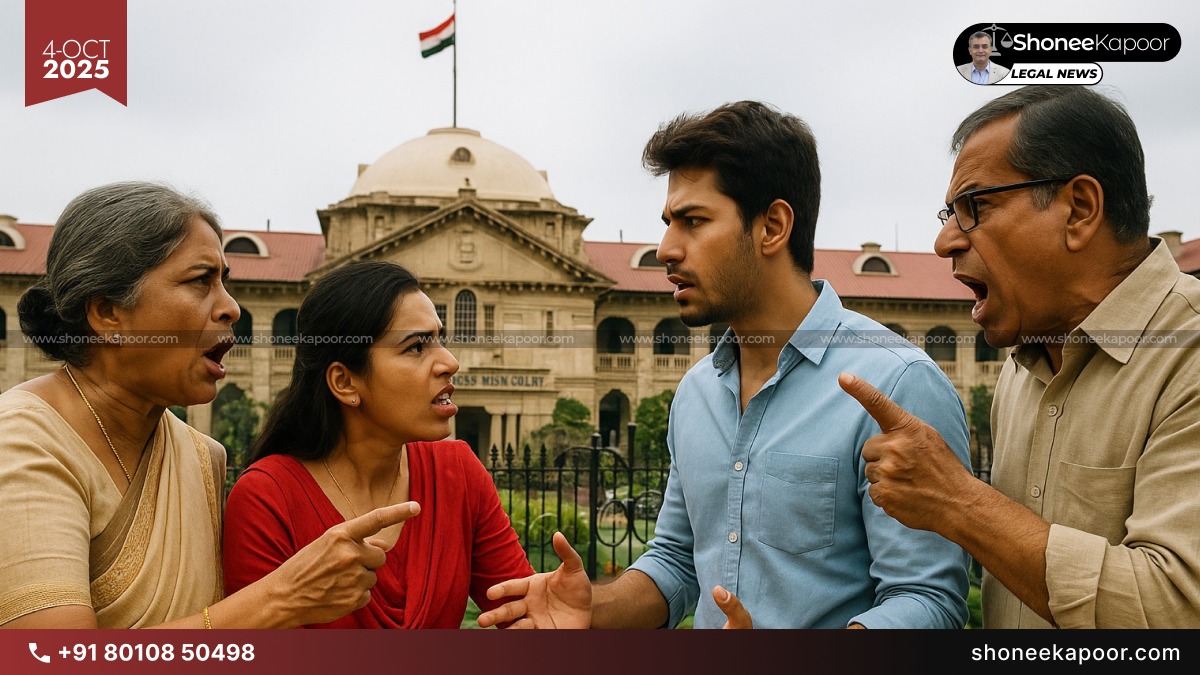
The Allahabad High Court ruled that everyday quarrels and emotional outbursts in marriage don’t amount to abetment of suicide under Section 306 IPC. The court discharged the wife and her parents, calling the husband’s death a tragic result of ordinary marital discord, not criminal intent.
Matrimonial Fights: The Allahabad High Court has clearly stated that normal fights between husband and wife, or casual remarks made in anger, cannot be treated as a reason to accuse someone of driving their spouse to commit suicide.
The Court said that:
“Matrimonial discord and differences in domestic life are quite common and if due to this reason either husband or wife commits suicide then it cannot be held that due to their abetment deceased committed suicide.”
This important judgment came from the bench of Justice Sameer Jain, who allowed the criminal revision filed by Rachana Devi and her parents. They were accused of abetting the suicide of Rachana’s husband in Auraiya district.
According to the case details, the FIR was filed by the deceased man’s father on November 14, 2022, alleging that his son died by suicide because of harassment and humiliation from his wife and in-laws. The couple had married about seven years earlier, but disputes started soon after.
Rachana had even filed a criminal case against her husband and his family under laws related to cruelty, assault, intimidation, and dowry. Although both sides reached a settlement later, she did not withdraw the case, which kept tensions alive.
The FIR further stated that on November 8, 2022, Rachana’s parents visited the couple’s home and insulted the deceased. It was alleged that they angrily told him, “Why don’t you die?” Just five days later, on November 13, 2022, he was found dead by suicide.
After the investigation, the police filed a charge sheet under Section 306 IPC (abetment of suicide). The trial court in Auraiya accepted the charges and, on October 19, 2023, rejected the discharge plea of Rachana and her parents. This meant they would have to face a full trial. Dissatisfied, they approached the High Court for relief.
Before the High Court, the defence lawyers argued that the allegations were vague and had no strong evidence. They explained that fights and quarrels between husband and wife happen in almost every marriage, and these cannot be seen as an act of abetment.
The lawyers pointed out that even the witnesses mentioned only normal disputes, not any deliberate attempt to push the deceased to suicide. The so-called statement made in anger by the in-laws could not legally be considered as instigation.
However, the State and the complainant (the deceased man’s father) argued that there was enough material to continue the trial. They said the accused had constantly harassed and humiliated the man, which forced him to end his life.
After hearing both sides, Justice Jain carefully examined the evidence and came to the conclusion that there was no intention or clear proof that the accused provoked the suicide.
The Court relied on important Supreme Court judgments like Ramesh Kumar v. State of Chhattisgarh, which says that instigation must involve active provocation and not merely casual or angry remarks.
The Court also referred to Swamy Prahaladdas v. State of M.P. and Amalendu Pal v. State of West Bengal, which highlight that normal household disputes do not amount to abetment of suicide.
The High Court further explained that there must be mens rea, or a guilty mind, to hold someone guilty under Section 306 IPC.
It said,
“If a husband or wife, or their relatives, are harassed or quarrel in the ordinary course of domestic life, without an intention to provoke suicide, the offence under Section 306 IPC cannot be said to be made out.”
The judge found that neither the FIR nor the witness statements proved any criminal intention from the accused. Thus, the High Court held that the trial court had made a mistake in rejecting their discharge plea. The Court then allowed the revision, canceled the Auraiya court’s October 19, 2023 order, and officially discharged Rachana Devi and her parents from the case.
This ruling once again makes it clear that while marital issues and emotional conflicts can be painful, they cannot automatically become criminal cases unless there is solid proof of deliberate instigation or cruelty that directly leads to suicide.
EXPLANATORY TABLE OF ALL LAWS & SECTIONS MENTIONED
| Section / Law | Act | Explanation (in simple Indian English) | Application in This Case |
| Section 306 IPC | Indian Penal Code, 1860 | Punishes anyone who “abets” the commission of suicide. For conviction, there must be proof that the accused intentionally instigated, aided, or conspired to make the victim take his/her life. | Police filed charge sheet under this section against wife and her parents for allegedly provoking the husband’s suicide. |
| Section 107 IPC | Indian Penal Code, 1860 | Defines “abetment of a thing.” It means instigating, engaging in conspiracy, or intentionally helping someone to do a wrongful act. | Referred indirectly because Section 306 requires proof of “abetment” as per this definition. |
| Section 498A IPC | Indian Penal Code, 1860 | Deals with cruelty by husband or his relatives towards a wife. Covers harassment, physical or mental cruelty, and dowry demands. | Mentioned in the background – wife had earlier filed this section against her husband and in-laws. |
| Supreme Court Precedent: Ramesh Kumar v. State of Chhattisgarh (2001) | — | Court held that “instigation” means active provocation or encouragement to commit suicide; casual remarks cannot be treated as abetment. | Relied upon by Allahabad HC to discharge the accused. |
| Supreme Court Precedent: Swamy Prahaladdas v. State of M.P. (1995) | — | SC said that a statement made in anger or without deliberate intention cannot amount to abetment to suicide. | Used to support finding that the words “Why don’t you die?” said in anger do not amount to instigation. |
| Supreme Court Precedent: Amalendu Pal v. State of West Bengal (2010) | — | SC ruled that routine domestic quarrels cannot be treated as abetment to suicide unless there is clear intention to push the person to end life. | Strengthened the High Court’s reasoning. |
| Mens Rea (Legal Principle) | — | Latin for “guilty mind”; a person must have intention or knowledge of wrongdoing to be held criminally liable. | The Court said mens rea was missing in this case — no proof of intention to provoke suicide. |
Case Title: Rachana Devi and 2 Others vs State of Uttar Pradesh and Another
- Court: High Court of Judicature at Allahabad
- Case No.: Criminal Revision No. 5794 of 2023
- Date of Judgment: 8 September 2025
- Court No.: 82
- Citation: 2025 AHC 2084511 (A.F.R.)
Bench: Hon’ble Justice Sameer Jain
Counsels
| Party | Name of Counsel |
| For the Revisionists | Sri Manoj Kumar Patel |
| For Opposite Party No. 2 | Sri Anand Pati Tiwari |
| For the State (AGA) | Sri Kunwar Tejendra Bahadur |
Background / Case Summary
- FIR Date: 14 November 2022
- Police Station: Dibiyapur, District Auraiya
- Case Crime No.: 683 of 2022
- Sections Invoked: Section 306 IPC (abetment of suicide)
- Trial Court Case: Sessions Trial No. 828 of 2023 (State vs Rachana Devi and Others)
- Impugned Order: 19 October 2023 by Sessions Judge, Auraiya (rejecting discharge under Section 227 CrPC)
Facts of the Case
- The deceased was the husband of revisionist no. 1 Rachana Devi; revisionist nos. 2 & 3 were her parents.
- The father of the deceased (O.P. No. 2) lodged an FIR alleging:
- Rachana Devi and her parents used to insult and humiliate his son.
- Rachana Devi filed a false case under Sections 498-A, 323, 504, 506 IPC and Sections 3/4 D.P. Act.
- On 8 Nov 2022 the in-laws insulted and abused the deceased and allegedly said “why he not die”.
- On 13 Nov 2022 the husband was found dead by suicide.
- The police filed a charge sheet under Section 306 IPC; the Sessions Court refused to discharge the accused, leading to this revision.
Arguments by Revisionists
- False Implication: They claimed the deceased and his family had actually tortured Rachana Devi, compelling her to file a dowry harassment case.
- Matrimonial Disputes ≠ Abetment: Frequent quarrels between spouses cannot be treated as instigation to suicide.
- No Mens Rea or Direct Instigation: Independent witnesses only confirmed routine domestic disputes.
- Words in Anger: Even if “why he not die” was uttered, it was a casual remark in a heated moment.
Arguments by State and O.P. No. 2
- Asserted that the revisionists frequently tortured and insulted the deceased.
- Cited statements of witnesses that on 8 Nov 2022 the in-laws instigated him to die, making out a prima facie case under Section 306 IPC.
Court’s Analysis
- Scope of Discharge: Referred to Captain Manjit Singh Virdi v. Hussain Mohammed Shattaf (2023) 7 SCC 633 — discharge is justified if no prima facie offence exists.
- Definition of Abetment: Examined Sections 306 & 107 IPC and Laxmi Das v. State of W.B. (2025 SCC OnLine SC 120).
- Meaning of Instigation: Cited Ramesh Kumar v. State of Chhattisgarh (2001) 9 SCC 618 — words uttered in anger do not amount to instigation.
- Mens Rea Essential: No material showed intent to drive the deceased to suicide.
- Matrimonial Discord Common: Relied on Kamaruddin Dastagir Sanadi v. State of Karnataka (2024 SCC OnLine SC 3541) that domestic quarrels are routine and not instigation.
- Casual Remarks Insufficient: Followed Swamy Prahaladdas v. State of M.P. (1995 Supp (3) SCC 438) — “go and die” uttered in heat of moment does not reflect mens rea.
- No Compulsion Shown: Cited Amalendu Pal alias Jhantu v. State of W.B. (2010) 1 SCC 707 — harassment must be so intense that suicide is the only option, which was absent here.
Findings
- No Mens Rea or Direct Instigation.
- No Prima Facie Case under Section 306 IPC.
- Sessions Judge erred by not properly analyzing evidence.
Final Order
- Impugned Order dated 19 Oct 2023 (set-aside).
- Revision Allowed.
- All Revisionists Discharged from Section 306 IPC charges.
Disclaimer: The views and opinions expressed in this article are those of the Indian courts and do not necessarily reflect the official policy or position of “ShoneeKapoor.com” or its affiliates. This article is intended for informational and educational purposes only. The content provided is not legal advice, and viewers should not act upon this information without seeking professional counsel. Viewer discretion is advised.
