
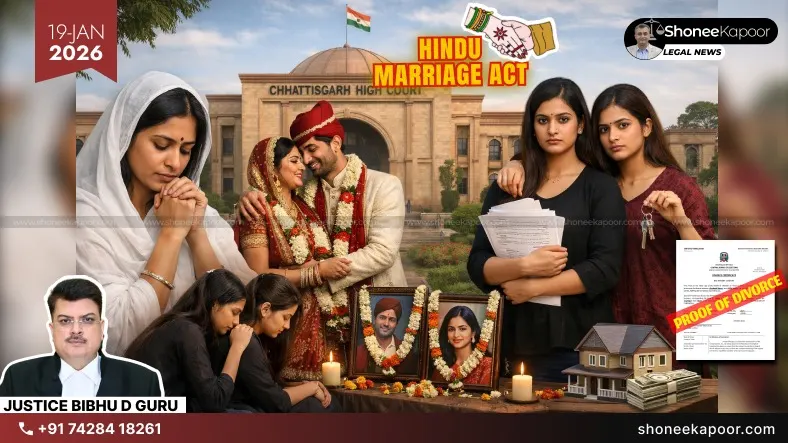
Married as “Widow” While First Husband Was Alive: Chhattisgarh HC Declares “Chudi” Marriage Void Under HMA for No Proof of Divorce, Rejects Fake Inheritance Claims

Written and analysed by Shonee Kapoor
Legal Consultant, Author & Men's Rights ActivistThe High Court exposed how a marriage was projected as valid despite the first husband being alive and with no proof of divorce, strictly applied the Hindu Marriage Act, and declared the marriage void while rejecting cohabitation stories and revenue entries as legal proof. Custom, cohabitation, and fabricated records cannot create lawful marriage or inheritance rights in a system governed by rule of law.
Married as Widow, First Husband Alive: The Chhattisgarh High Court at Bilaspur has delivered a powerful judgment reaffirming that emotional narratives, social pressure, and loosely claimed customs cannot override the mandatory provisions of the Hindu Marriage Act, 1955. This ruling sends a strong message against misuse of personal laws and fabricated marital claims to illegally grab property and harass lawful heirs.
The case arose from a property dispute where the plaintiffs claimed inheritance rights by alleging that their mother had married the land owner through a local custom known as “Chudi” marriage.
The dispute involved agricultural land measuring about 2.47 hectares situated in Village Dhameli. The original owner had a daughter from his first wife. After the first wife’s death, he allegedly brought a widow from another village and performed a so-called “Chudi” customary marriage with her. The woman already had children from her earlier life, and later two plaintiffs claimed that they were her daughters and therefore entitled to a share in the property. After the death of the landowner and the woman, the plaintiffs’ names were entered in revenue records along with the daughter from the first wife. The daughter objected and maintained that no valid marriage ever took place and that the plaintiffs were not legal heirs.
The Trial Court correctly dismissed the plaintiffs’ suit, holding that they failed to prove a valid marriage and legal succession. However, the First Appellate Court reversed this finding, relying mainly on oral statements about custom and revenue entries, and treated the woman as the legally wedded wife, thereby granting equal share to the plaintiffs.
In Second Appeal, filed under Section 100 of the Code of Civil Procedure, the High Court examined whether the finding of a valid marriage was legally sustainable and framed the substantial question of law as:
“Whether the lower Appellate Court was not justified in holding that was legally wedded wife of and the finding in this regard is perverse?”
The factual background showed that the deceased land owner had brought a widow from another village claiming to have married her under local custom. The plaintiffs asserted that she lived as his wife and therefore they were entitled to inherit the agricultural land. The defendant, who was the daughter from the first marriage, denied the validity of this alleged marriage and argued that the plaintiffs were not legal heirs.
The High Court carefully examined the evidence and found a crucial admission by the plaintiff witness that at the time of the alleged “Chudi” marriage, the woman’s first husband was still alive. There was no proof of divorce or customary dissolution of the earlier marriage. This admission destroyed the foundation of the plaintiffs’ claim and exposed how easily false inheritance narratives can be constructed when courts do not strictly enforce evidence standards.
The High Court clearly explained the law under Sections 5(i) and 11 of the Hindu Marriage Act, 1955. A valid Hindu marriage requires that neither party should have a living spouse at the time of marriage. Any marriage performed during the subsistence of an earlier valid marriage is void from the very beginning and has no legal existence. From a men’s rights standpoint, this clarity protects families from fabricated marital claims used to extract money or property.
The Court also highlighted contradictions in the plaintiffs’ evidence regarding the woman’s earlier marriage, her place of residence, and the upbringing of the plaintiffs. These inconsistencies further weakened the claim that she continuously lived as a lawful wife of the landowner.
The Court reiterated the settled legal principle that a finding of fact by the first appellate court is usually final, but interference is justified if the finding is based on misreading of evidence or wrong application of law. The judgment recorded:
“It is well settled that ordinarily, a finding of fact recorded by a First Appellate Court is considered final and binding. However, interference in a Second Appeal is permissible where the impugned finding is based on misreading of evidence, ignores material evidence, or is arrived at by applying incorrect legal principles.”
Relying on Supreme Court precedent, the High Court noted:
“The Supreme Court, in Smt. Yamunabai Anantrao Adhav v. Anantrao Shivram Adhav & Anr., (1988) 1 SCC 530, while examining the status of a Hindu woman marrying a Hindu male having a living spouse, has categorically held that for appreciating the validity of such a marriage, the provisions of the Act, 1955 must prevail.”
On the issue of burden of proof, the Court observed:
“The initial burden of proof was on the plaintiffs to substantiate their cause for actionable nuisance, which they had failed to discharge. In such a case, the weakness in the defence cannot be the basis to grant relief to the plaintiffs and to shift the burden on the defendants, as the case may be.”
The Court made it clear that mere cohabitation, revenue entries, or general statements about social practice cannot create a valid marriage or legal inheritance rights. It held that the first appellate court had committed serious legal error by ignoring the admission about subsistence of the first marriage and by treating revenue records as proof of marital validity.
The High Court concluded that the alleged “Chudi” marriage was void under law and that no succession rights could flow from such an invalid relationship. The finding of the first appellate court was declared perverse and unsustainable.
Finally, the Court allowed the Second Appeal, restored the Trial Court judgment, and denied inheritance claims based on the void marriage, holding that no costs were payable by either party. This judgment strengthens legal certainty, discourages false inheritance claims, and reinforces that statutory law must protect genuine families from misuse of customs and fabricated relationships.
Explanatory table – laws & sections involved
| Act & Section | Purpose | Application in This Case |
| CPC, 1908 – Section 100 | Allows High Court to interfere only on substantial legal error. | HC interfered as First Appellate Court ignored key evidence and misapplied law. |
| Hindu Marriage Act, 1955 – Section 5(i) | No marriage allowed if a spouse is already alive. | Woman’s first husband was alive, so second marriage was illegal. |
| Hindu Marriage Act, 1955 – Section 11 | Declares marriages void if Section 5 is violated. | Alleged “Chudi” marriage treated as void from the beginning. |
| Hindu Marriage Act, 1955 – Section 4 | Statutory law overrides custom or usage. | Customary marriage claim rejected as it conflicted with the Act. |
Case Details
- Case Title: Smt. Sooraj Bai W/o Jhagaruram vs Smt. Hiran Bai & Ors., Second Appeal No. 116 of 2005
- Court: High Court of Chhattisgarh at Bilaspur
- Bench: Hon’ble Shri Justice Bibhu Datta Guru
- Dates:
- Judgment Reserved On: 06 January 2026
- Judgment Delivered On: 13 January 2026
- Neutral Citation: 2026:CGHC:1817
Counsels
- For Appellant:
- Mr. Manoj Paranjpe, Senior Advocate
- Ms. Shivangi Agrawal, Advocate
- For Respondents:
- Mr. Virendra Soni
- Mr. Ankush Soni, Advocates
- For State: Mr. Santosh Soni, Government Advocate
Key Takeaways
- Law is above emotion and custom, if a spouse is alive, any second marriage is void, no matter what social practice claims.
- Fake or convenient “customary marriages” cannot be used to grab property or create false inheritance rights.
- Revenue entries and cohabitation are often misused in courts, but they do not create legal marriage or ownership.
- Burden of proof lies strictly on the person making the claim, weak defence of the other side cannot create rights.
- Courts must strictly enforce marriage laws to prevent manipulation of succession, false claims, and legal harassment of genuine heirs.
This Could Change Your Case-Get FREE Legal Advice-Click Here!
Disclaimer: The views and opinions expressed in this article are those of the Indian courts and do not necessarily reflect the official policy or position of “ShoneeKapoor.com” or its affiliates. This article is intended for informational and educational purposes only. The content provided is not legal advice, and viewers should not act upon this information without seeking professional counsel. Viewer discretion is advised.
Related Articles
Can Husband Stop Maintenance If Wife Is Working? Indian Law, Supreme Court Judgments & The Reality Men Must Know
Can a husband stop paying maintenance if wife is working in India? Read the latest legal position, Supreme Court judg...
Real Court Cases Where False Allegations Backfired On Wife
Real Indian court cases where false 498A, dowry, cruelty and defamatory allegations against husbands backfired, leadi...
Relevant Judgements
Can an NRI Husband Be Forced to Pay Maintenance in India? Supreme Court Rules Explained for Overseas Indian Men
Living abroad does not automatically protect an NRI husband from maintenance claims in India.But can Indian courts pa...
Share Your Thoughts
Comments are moderated before publication.