
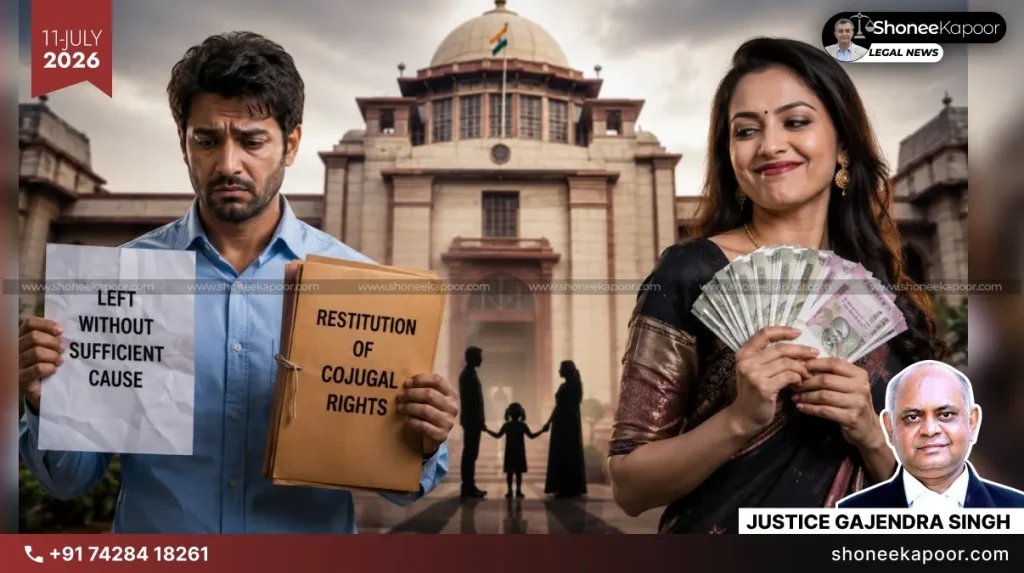
Can a husband’s restitution petition be ignored while deciding maintenance? The Madhya Pradesh High Court held that filing a restitution of conjugal rights case alone is not enough to deny maintenance.
INDORE: The Madhya Pradesh High Court, through Justice Gajendra Singh, held that a wife looking after a minor child cannot be denied maintenance merely because the husband has filed a petition for restitution of conjugal rights.
The Court set aside the Family Court’s findings and awarded ₹30,000 per month to the wife while enhancing the minor child’s maintenance from ₹20,000 to ₹30,000 per month.
The parties were married on May 6, 2013, and a son was born from the marriage in October 2015. In 2024, after matrimonial disputes arose, the wife and the minor child approached the Family Court seeking maintenance under Section 125 of the Code of Criminal Procedure. The wife alleged that she had suffered ill-treatment, economic abuse and neglect, and claimed that the husband, who was highly qualified and employed in a senior position, had sufficient income to maintain them.
The husband opposed the claim, alleging that the wife had left the matrimonial home without any valid reason and had lodged a false criminal case against him. He also argued that she was well educated and capable of earning.
The Family Court rejected the wife’s claim for maintenance after holding that she was residing separately without sufficient cause. However, it granted ₹20,000 per month only to the minor child. Challenging this decision, the wife and child approached the High Court.
After examining the record, the High Court found that the Family Court had failed to appreciate the complete circumstances of the case. It noted that the wife was taking care of the minor child and that an FIR against the husband was already on record. The Court observed:
“When revision petitioner No. 1/wife is taking care of the minor child and an FIR against the respondent… is already on record, it cannot be held that she is residing separately without sufficient cause.”
It further clarified that:
“The marital obligations of the wife are not confined only to the husband but it is also towards minor child.”
The High Court also found fault with the manner in which the Family Court assessed the husband’s financial capacity. It held that maintenance proceedings are meant to protect the welfare of dependents and cannot be treated like ordinary adversarial litigation. Therefore, the burden could not be placed entirely on the wife to prove the husband’s exact income.
Emphasising this principle, the Court observed:
“It is not an adversarial litigation; rather, it is a social welfare proceeding.”
While considering the husband’s qualifications, employment and income affidavit filed under the Supreme Court’s decision in Rajnesh v. Neha, the High Court held that after more than a decade of marriage, a wife caring for a ten-year-old child could not simply be presumed to be financially independent. The Court also stressed that a husband cannot avoid his statutory obligation by suppressing his actual earnings.
In one of the key observations of the judgment, the Court said:
“The source of income may be concealed, but the status cannot be concealed.”
It further added:
“The husband cannot escape his liability to maintain the wife and minor child in accordance with their standard of living.”
Accordingly, the High Court allowed the revision petition, granted the wife maintenance of ₹30,000 per month, enhanced the minor child’s maintenance to ₹30,000 per month, and directed that both amounts would be payable from the date of filing of the maintenance application after adjusting any amount already paid by the husband.
EXPLANATORY TABLE: LAWS AND PROVISIONS INVOLVED
| Law / Provision | Purpose | Role in This Case |
| Section 125 CrPC | Allows a wife, child or parent to claim maintenance. | The wife and child sought monthly maintenance under this section. |
| Section 498A IPC | Punishes cruelty by the husband or his relatives. | The wife’s FIR included allegations under this section. |
| Section 294 IPC | Punishes obscene words or acts in public. | This offence was mentioned in the FIR. |
| Section 323 IPC | Punishes voluntarily causing hurt. | The FIR included an allegation of physical hurt. |
| Section 506 IPC | Punishes criminal intimidation or threats. | This charge was also mentioned in the FIR. |
| Section 34 IPC | Fixes joint liability for acts done with common intention. | The husband referred to charges read with Section 34. |
| Section 3, Dowry Prohibition Act | Punishes giving or taking dowry. | The wife’s FIR included this provision. |
| Section 4, Dowry Prohibition Act | Punishes demanding dowry. | The FIR also contained a dowry-demand allegation. |
| Restitution of Conjugal Rights | A spouse asks the court to resume marital cohabitation. | The husband’s petition was not treated as enough to deny maintenance. |
| Rajnesh v. Neha | Requires full disclosure of income and assets in maintenance cases. | The High Court relied on the husband’s income affidavit. |
CASE DETAILS
- Case Title: Wife and Others v. Husband
- Case Number: Criminal Revision No. 512 of 2026
- Court: High Court of Madhya Pradesh, Indore Bench
- Bench: Hon’ble Shri Justice Gajendra Singh
- Neutral Citation: 2026:MPHC-IND:17382
- Date of Order: June 30, 2026
- Counsels:
- For Petitioners: Shri Shashank Sharma
- For Respondent: Shri Rajat Raghuwanshi
KEY TAKEAWAYS
- A restitution of conjugal rights case should not become meaningless merely because a maintenance claim is filed; both proceedings must be examined on evidence.
- A husband’s access to his minor child and his role as a father should also be considered while deciding whether separate residence is justified.
- Maintenance must be based on verified income, actual liabilities and complete financial disclosure from both spouses, not one-sided allegations.
- A wife’s qualifications, work experience and real earning capacity should be properly examined instead of automatically assuming total financial dependence.
- Maintenance should remain fair and realistic, protecting the wife and child without imposing an excessive or unsupported financial burden on the husband.
This Could Change Your Case-Get FREE Legal Advice-Click Here!
Disclaimer: The views and opinions expressed in this article are those of the Indian courts and do not necessarily reflect the official policy or position of “ShoneeKapoor.com” or its affiliates. This article is intended for informational and educational purposes only. The content provided is not legal advice, and viewers should not act upon this information without seeking professional counsel. Viewer discretion is advised.