
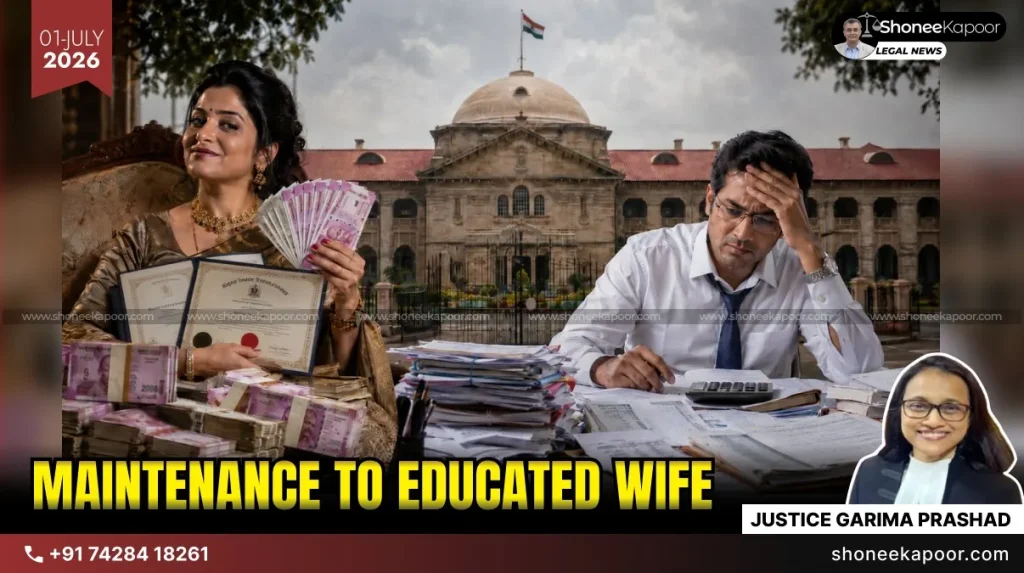
Can a husband deny maintenance because his wife is educated and capable of earning? Allahabad High Court said No. A qualified wife cannot be denied maintenance unless her sufficient independent income is proved.
PRAYAGRAJ: The Allahabad High Court, through Justice Garima Prashad, dismissed a husband’s criminal revision and upheld the Family Court order directing him to pay ₹20,000 per month as maintenance to his wife from 17 June 2017.
The husband said that the wife was educated, employable, financially independent, and allegedly earning from tuition and coaching. He also argued that he was no longer in regular employment, was working as a freelance Chartered Accountant with irregular income, and had to maintain his aged parents.
The Husband was facing a long maintenance battle while claiming job instability, reduced earnings, irregular professional work, and family responsibility. His argument was that ₹20,000 per month was excessive.
The wife opposed this and alleged cruelty, harassment, neglect, and pressure to arrange money for purchasing a flat. The Court noted that the husband had received ₹5.5 lakh from the wife’s mother during the flat transaction, though he described it as a loan.
The Court also considered medical papers relating to the wife’s injuries and noted that the husband gave different explanations about how those injuries happened. The Court further noticed that after the wife was left at her parental side, the husband filed divorce proceedings and did not make serious efforts to bring her back.
On income, the Court noted that the husband was a qualified Chartered Accountant and had worked at different places. The order records that after working with J.P. Group, Noida, he had joined another concern, namely “Intact”.
The Court also considered his lifestyle. He owned a Honda City car and had taken the wife to Goa, Delhi, and Udaipur by air travel and stayed in hotels. He had also earlier admitted earning about ₹90,000 per month, but later failed to prove any major fall in income through reliable documents.
The Court held that the husband did not produce income tax returns, complete accounts, professional receipts, bank statements, or other reliable financial documents. Since income details were within his special knowledge, the Court held that adverse inference could be drawn.
The Court made it clear that the wife cannot be denied maintenance merely because she is educated. It observed that:
“The mere fact that opposite party no.2 is educated cannot disentitle her from maintenance.”
It further said that:
“Education and earning capacity are relevant considerations, but they cannot be equated with actual and sufficient income.”
The Court also said that the wife’s mother’s pension or properties cannot be treated as the wife’s independent income. The legal obligation to maintain the wife remains on the husband.
Relying on “Rajnesh v. Neha and others; (2021) 2 SCC 324”, the Court held that maintenance must be decided by considering the status of the parties, needs of the wife, income and liabilities of the husband, and the standard of living enjoyed during marriage.
The High Court finally held that the wife had sufficient reason to live separately, the husband had neglected to maintain her, and no sufficient independent income of the wife was proved. It found ₹20,000 per month to be just and reasonable.
The revision was dismissed, and the Family Court order was affirmed. Any amount already paid as interim maintenance or under court orders will be adjusted against the arrears.
EXPLANATORY TABLE: LAWS AND PROVISIONS INVOLVED
| Law / Provision | Purpose | Use In This Case |
| Section 125 Cr.P.C. | Quick remedy for maintenance to wife, child, or parent unable to maintain themselves. | Wife sought maintenance; ₹20,000 per month was upheld. |
| Criminal Revision | High Court checks legal error, perversity, or serious irregularity in lower court order. | Husband challenged Family Court order; High Court refused interference. |
| Rajnesh v. Neha, (2021) 2 SCC 324 | Supreme Court guidelines for deciding maintenance based on income, needs, status, and lifestyle. | Court used it to assess husband’s capacity and wife’s needs. |
| Adverse Inference | Court may act against a party who hides important financial evidence. | Husband did not produce full income records, so Court drew adverse inference. |
| Educated Wife Principle | Education alone is not proof of earning or financial independence. | Wife was educated, but no sufficient income was proved. |
| Mother’s Pension / Property | Wife’s mother’s income or property is not wife’s income. | Court rejected reliance on mother’s pension and property. |
| Revisional Jurisdiction | High Court does not rehear facts like an appeal unless order is illegal or perverse. | Family Court order was found reasonable and valid. |
CASE DETAILS
- Case Title: Alok Tiwari v. State of U.P. and another
- Court: High Court of Judicature at Allahabad
- Case Number: Criminal Revision No. 5768 of 2024
- Neutral Citation: 2026:AHC:127763
- Date Of Judgment: June 17, 2026
- Bench: Hon’ble Justice Garima Prashad
- Counsels:
- For Revisionist: Aditya Yadav, Shivam Yadav
- For Opposite Parties: G.A., Indra Jit Singh
KEY TAKEAWAYS
- In maintenance cases, a husband’s financial struggle is often not accepted on words alone; he has to prove every fall in income with documents.
- Even if a husband says he has irregular work, aged parents, job loss, and reduced earnings, the Court may still look at his qualification, past income, and lifestyle.
- An educated wife may still get maintenance if the husband cannot prove that she is actually earning enough to maintain herself.
- For husbands, lifestyle can become a burden in court; car, travel, hotel stays, and past salary may be used to decide present earning capacity.
- Without income tax returns, bank statements, accounts, and financial proof, even genuine vulnerability may not be accepted.
This Could Change Your Case-Get FREE Legal Advice-Click Here!
Disclaimer: The views and opinions expressed in this article are those of the Indian courts and do not necessarily reflect the official policy or position of “ShoneeKapoor.com” or its affiliates. This article is intended for informational and educational purposes only. The content provided is not legal advice, and viewers should not act upon this information without seeking professional counsel. Viewer discretion is advised.