
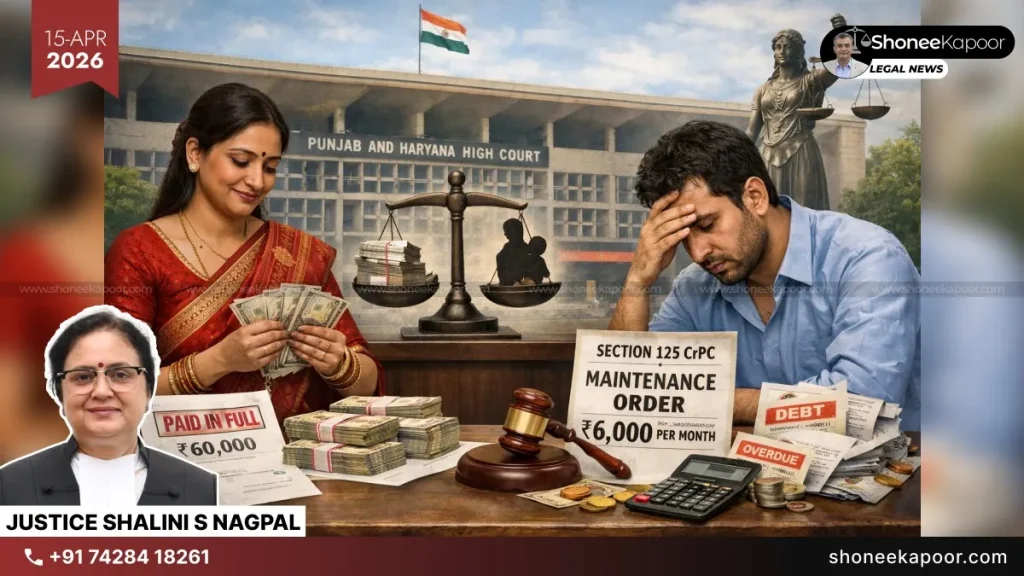
The Punjab and Haryana High Court held that the wife’s waiver of future maintenance claim is against public policy and not enforceable.
When a written settlement agreement doesn’t protect a husband, what security does a man really have?
CHANDIGARH: The Punjab and Haryana High Court, through Justice Shalini Singh Nagpal, has delivered an important ruling affecting maintenance disputes, especially in cases where husbands believe a one-time settlement ends all future liability.
In this case, the husband challenged a Family Court order from Hoshiarpur which directed him to pay ₹6,000 per month as maintenance to his wife. His main argument was that the wife had already accepted ₹60,000 as a full and final settlement covering past, present, and future maintenance. According to him, this compromise meant she had given up her right to claim anything further.
The husband also argued that the wife was capable of earning and had admitted to working as a private maid. He claimed that since she was earning, she was not entitled to maintenance. He further stated that he himself was a daily-wage worker earning around ₹10,000 per month and was not in a position to pay any additional amounts.
On the other hand, the wife admitted that she had worked as a maid, but clarified that her earnings were barely enough to meet her basic needs like food and clothing. The Court carefully examined this aspect and made a strong observation protecting such claims.
“Since the husband was not providing any maintenance to the wife, her attempt to survive by dint of her physical labour cannot debar her from claiming maintenance from the husband, nor can it be held that she is not covered within the ambit of ‘unable to maintain herself’. Till the Court compels the husband to pay maintenance allowance, the wife cannot be expected to sit and starve”.
The Court then addressed whether a wife can legally give up her right to future maintenance through a compromise. Relying on the Supreme Court judgment in Bai Tahira v. Ali Hussain Fidaalli Chothia, the Court rejected the husband’s argument.
“An agreement entered into between the wife and the husband, as a part of a compromise filed in the Court or otherwise, whereby the wife relinquishes or waives the right to claim maintenance in future from the husband against receipt of some amount is opposed to public policy and does not estop her from claiming maintenance.”
The Court clearly held that even if a wife accepts money in a settlement, it does not permanently stop her from claiming maintenance later. It also noted that ₹60,000 is insufficient to sustain a person for life, especially given rising living costs and inflation.
The husband claimed to earn only ₹10,000 per month, but the Court held that he was educated, skilled, and capable of earning more. It accepted the Family Court’s estimate of ₹20,000 per month as reasonable.
“The husband, as per his own admission is 10th+2 qualified and a diploma holder of electrical engineering. He is healthy and able-bodied. He is a skilled worker working as a mason in the village. Estimation of his income at ₹20,000/- per month cannot be said to be on the higher side, considering the minimum wages notified by the State for a skilled worker,”
Based on these findings, the High Court upheld the maintenance of ₹6,000 per month, stating that it was reasonable for basic needs such as food, clothing, shelter, and medical expenses. The husband’s revision petition was dismissed.
Explanatory Table: Laws & Provisions Involved
| Law / Provision | Purpose | How Applied in This Case |
| Section 125 Code of Criminal Procedure | Provides maintenance to wife, children, and parents if they are unable to maintain themselves | Court held it is a statutory right that cannot be waived; wife can claim maintenance despite prior settlement |
| Public Policy Principle | Prevents enforcement of agreements that are against public interest | Agreement waiving future maintenance was held void and unenforceable |
| Bai Tahira v. Ali Hussain Fidaalli Chothia | Supreme Court precedent stating maintenance rights cannot be contracted away | Relied upon to hold that waiver does not stop future maintenance claims |
| Family Courts Act 1984 | Governs jurisdiction and functioning of Family Courts | Family Court’s order granting ₹6,000 maintenance was upheld |
| Minimum Wages Act 1948 | Fixes minimum wages for workers based on skill category | Used to justify estimating husband’s income at ₹20,000/month instead of claimed ₹10,000 |
Case Details
- Case Title: Husband Vs Wife
- Court: Punjab and Haryana High Court
- Nature of Case: Criminal Revision Petition under Section 125 CrPC
- Bench: Justice Shalini Singh Nagpal
- Lower Court: Principal Judge, Family Court, Hoshiarpur
- Order Passed: ₹6,000 per month maintenance granted to wife Effective From: Date of filing of application
Key Takeaways
- One-time settlements or “full and final” compromises do not guarantee permanent protection from future maintenance claims under law.
- Waiver clauses where a wife gives up future maintenance rights are often treated as invalid and against public policy.
- Even if the wife is working in low-income jobs, courts may still consider her “unable to maintain herself” and grant maintenance.
- Courts frequently reassess the husband’s real earning capacity instead of relying on his declared income, increasing financial exposure.
- Maintenance liability under Section 125 CrPC remains a continuing obligation, creating long-term legal uncertainty for men despite prior agreements.
This Could Change Your Case-Get FREE Legal Advice-Click Here!
Disclaimer: The views and opinions expressed in this article are those of the Indian courts and do not necessarily reflect the official policy or position of “ShoneeKapoor.com” or its affiliates. This article is intended for informational and educational purposes only. The content provided is not legal advice, and viewers should not act upon this information without seeking professional counsel. Viewer discretion is advised.