
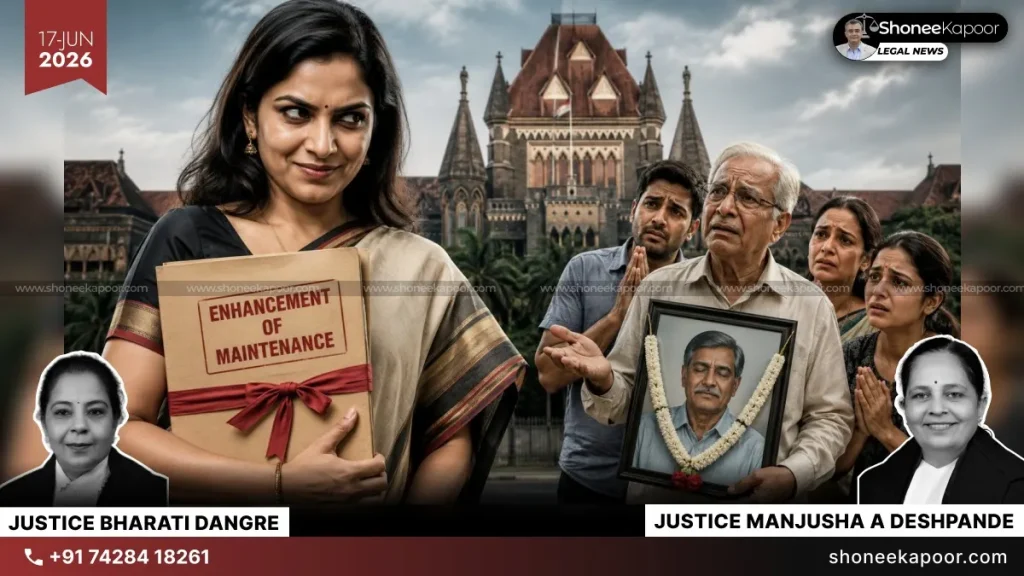
Can legal heirs be forced to pay enhanced maintenance after a husband’s death? Bombay High Court says No. Legal heirs can be made to pay existing maintenance dues and arrears, but cannot be forced to defend fresh enhancement claims after the husband’s death.
MUMBAI: The Bombay High Court, through a Division Bench of Justice Bharati Dangre and Justice Manjusha Ajay Deshpande, has clarified an important legal issue relating to maintenance rights of a divorced wife after the death of her former husband.
The Court held that while a divorced wife can continue to recover the maintenance already granted to her and any unpaid arrears from her late husband’s estate, she cannot seek enhancement of that maintenance after his death.
The case arose from an appeal filed by a woman from Malabar Hill in Mumbai. She challenged a Family Court order that had refused her request for enhancement of maintenance. Her former husband had passed away in 2012, but she sought an increase in the maintenance amount several years later.
The appeal came before the Bombay High Court, which examined whether such a claim could legally continue against the estate of a deceased husband.
While deciding the matter, Justice Bharati Dangre explained the nature of a wife’s right to maintenance. The Court observed that:
“The wife’s right to maintenance is a “a right personal to her” and cannot be alienated. Her claim of maintenance is an entitlement that holds good during her lifetime and extinguishes on her death.”
The Court further clarified that maintenance already awarded by a competent court does not disappear merely because the husband dies. Such maintenance remains recoverable from the assets and estate left behind by him. Referring to this principle, the judgment stated:
“Thus the wife can recover maintenance already directed and quantified, through the assets or estate of the dead husband.”
The High Court noted that the right to receive maintenance is personal to the wife and continues during her lifetime. It also considered the legal consequences of allowing enhancement claims against a deceased person’s estate. The judges noted that permitting enhancement proceedings after the husband’s death would create uncertainty, disturb settled succession rights, and lead to endless litigation involving legal heirs.
The appeal raised two important questions before the High Court. The first question was whether a divorced wife can enforce a decree granting monthly maintenance against the estate of her deceased husband. The Court answered this question in the affirmative and held that she can continue to recover the maintenance already awarded to her.
The second and more significant question was whether a divorced wife can seek enhancement of permanent maintenance from the estate of her deceased husband. On this issue, the Court answered in the negative and held that such a claim is not legally maintainable.
After examining the provisions of the Special Marriage Act, the High Court observed that any request for enhancement, modification, reduction, or cancellation of maintenance requires the participation of both parties. The Court explained that such proceedings involve fresh adjudication, fresh evidence, and a fresh determination of rights. Therefore, both the husband and wife must be alive for such proceedings to take place.
With these findings, the Bombay High Court dismissed the claim for enhancement while protecting the divorced wife’s right to recover the maintenance already awarded to her and any outstanding arrears from the estate of her late husband.
EXPLANATORY TABLE: LAWS AND PROVISIONS INVOLVED
| Law / Provision | Purpose | How It Applied In This Case |
| Special Marriage Act, 1954 Section 37 | Provides for permanent alimony and maintenance after divorce or judicial separation | Original maintenance rights of the divorced wife arose under this provision |
| Special Marriage Act, 1954 Section 37(2) | Allows modification, variation, cancellation, or enhancement of maintenance when circumstances change | Court held that this power can be exercised only when both spouses are alive |
| Law of Succession and Estate Liability | Legal heirs inherit property subject to lawful liabilities attached to the estate | Existing maintenance and arrears can be recovered from the deceased husband’s estate |
| Principle of Personal Rights | Certain rights are personal and non-transferable | Court held that the wife’s right to claim maintenance is personal to her and ends upon her death |
| Principle of Finality in Succession Law | Prevents endless reopening of settled inheritance matters | Court held that allowing enhancement claims after death would create uncertainty and endless litigation |
CASE DETAILS
- Case Title: Warsha @ Eleekusumchand Javeri v. Rajan Suren Goregaonkar & Ors.
- Case Number: Family Court Appeal No. 74 of 2023
- Court: Bombay High Court
- Bench: Justice Bharati Dangre | Justice Manjusha Deshpande
- Date of Judgment: 6 May 2026
- Neutral Citation: 2026:BHC-AS:24069-DB
- Counsels:
- For Appellant: Mrs. Deepa Chawan, Senior Advocate, and Mr. Ravindra R. Chile
- For Respondents: Dr. Pradip Chavan, Ms. Shweta Borhade, Pradip Chavan & Associates
KEY TAKEAWAYS
- A man’s death cannot become an opportunity to keep expanding financial claims against his estate indefinitely.
- Legal heirs should not be forced to fight fresh maintenance battles for liabilities that were never determined during the husband’s lifetime.
- Courts must distinguish between enforcing an existing order and creating new financial obligations after a person’s death.
- Succession rights of children and family members deserve protection from endless litigation and uncertainty.
- Fairness in family law requires that financial claims have clear legal limits, even in emotionally sensitive disputes.
This Could Change Your Case-Get FREE Legal Advice-Click Here!
Disclaimer: The views and opinions expressed in this article are those of the Indian courts and do not necessarily reflect the official policy or position of “ShoneeKapoor.com” or its affiliates. This article is intended for informational and educational purposes only. The content provided is not legal advice, and viewers should not act upon this information without seeking professional counsel. Viewer discretion is advised.