
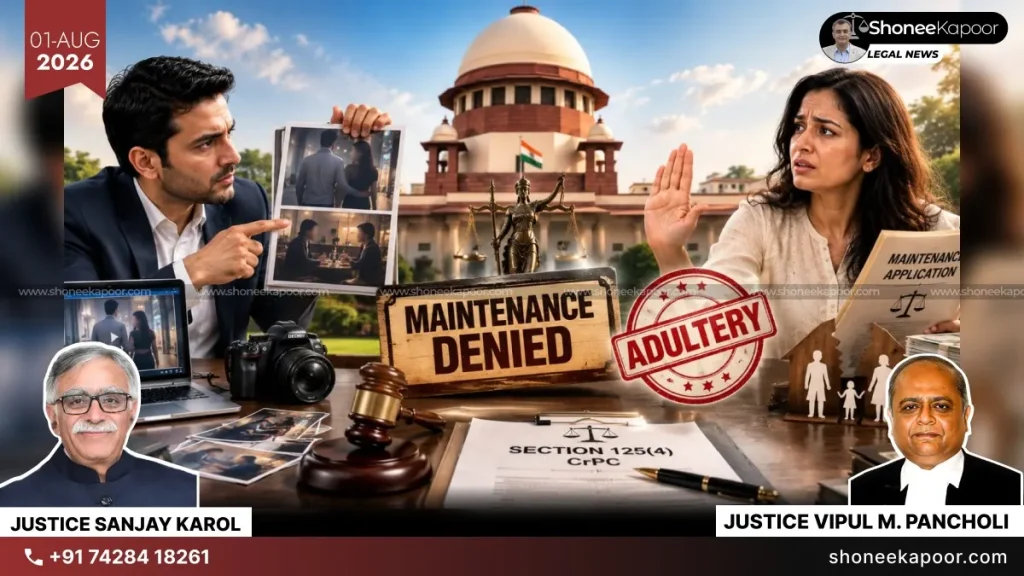
Can a husband be ordered to keep paying interim maintenance while his evidence of the wife’s alleged adultery remains undecided until the final hearing?The Supreme Court says clear evidence must be examined first, though mere allegations are not enough.
NEW DELHI: The Supreme Court has held that when a husband produces clear and cogent evidence of the wife’s alleged adultery, the court must examine his objection under Section 125(4) of the Code of Criminal Procedure before finally deciding her right to interim maintenance.
A Bench comprising Justice Sanjay Karol and Justice Vipul M. Pancholi set aside an order of the Rajasthan High Court and sent the matter back to the Trial Court for a fresh decision on the husband’s application.
The Court clarified that simply filing an adultery application will not automatically stop interim maintenance. However, if the material placed by the husband establishes adultery on the face of it, the statutory bar under Section 125(4) cannot be postponed until the end of the maintenance case.
The judgment arose from an appeal filed by Himanshu Chordia, who married Arushi Jain on July 7, 2014. Their matrimonial relationship later became strained, and the wife left the matrimonial home on May 13, 2020, along with the child and her valuables.
On November 5, 2020, she filed proceedings under Section 125 CrPC before the Special Additional Chief Judicial Magistrate, PCPNDT Cases, Udaipur. She also sought interim maintenance.
The husband filed an application under Section 125(4), claiming that the wife was allegedly involved in adulterous relationships and was therefore not entitled to maintenance. He relied upon photographs, videos and other electronic material to support his objection.
The Trial Court dismissed his application on June 27, 2024, observing that the authenticity and originality of the documents could be determined only after evidence was formally proved in the main maintenance case.
The Trial Court stated:
“During the arguments, the Ld. Counsel for the petitioner said that the petitioners was at different place on the date and time as mentioned in the petitioner’s documents. The petitioner has also presented some documents in support of her claim showing her presence at different place than the documents. The respondent’s allegations regarding the petitioner’s adultery with Deepak Mundra are mainly based on photographs and CD. However, the court cannot conclude on the authenticity and originality of these documents at this stage.”
The Trial Court held that the documents’ authenticity could be decided only after they were formally proved during the main maintenance proceedings.
On July 30, 2024, the Trial Court reportedly granted ₹25,000 per month each to the wife and the child as interim maintenance.
The husband challenged the orders before the Rajasthan High Court. The High Court dismissed his petition on February 4, 2025, holding that there was no provision requiring the adultery issue to be decided before the interim-maintenance application.
The High Court observed:
“There is no provision in the Cr.P.C. that mandates adjudication of such an issue before deciding an application for interim maintenance.”
It further held:
“As on date, it can be that the above is the disputed question of fact and for which, both the parties should be allowed to adduce evidence and the same adjudicated by the trial Court at the time of final disposal of the inquiry under Section 125 Cr.P.C.”
The husband then approached the Supreme Court, arguing that postponing his statutory objection until the final stage would defeat Section 125(4). His case was that a man should not be compelled to continue paying maintenance while potentially decisive evidence remains unexamined for years.
The Supreme Court first explained that maintenance proceedings are meant to prevent neglect and destitution. They are summary and essentially civil in nature. However, the Court also stressed that the right to maintenance is subject to the express disqualifications written into the law.
The Bench held that interim maintenance may be denied only when the husband presents clear, prima facie evidence of adultery under Section 125(4). Mere allegations are not sufficient.
The Court made it clear that mere accusations are not enough. To block maintenance at the interim stage, the husband must produce evidence that is clear, convincing and capable of establishing adultery on its face.
The judgment states:
“To reiterate, if the application for maintenance is to be denied at the interim stage itself, the party having filed the application under Section 125(4) must present clear and cogent evidence that would ex-facie establish adultery on part of the claimant for maintenance.”
The Court also explained that if the electronic material is disputed and requires detailed verification, interim maintenance may continue while the court examines its authenticity.
However, the lower courts cannot refuse to consider the husband’s application merely by saying that adultery will be examined only at the final stage.
The Bench said:
“The courts below clearly fell into error to hold that it was only at the stage of final adjudication that such a question could be decided. This view would render otiose what has been provided in the statute.”
The Court further observed that at the interim stage, the court must check whether the evidence prima facie proves adultery, while giving the wife an opportunity to challenge its legality and authenticity.
The Supreme Court further held that the Trial Court should have decided the husband’s application under Section 125(4) before finally deciding the wife’s maintenance application. The lower court was wrong in postponing the adultery-related objection until the final stage of the maintenance proceedings.
The Supreme Court therefore remanded the matter to the Trial Court to decide the husband’s application on its merits. It did not itself declare that adultery had been proved or finally reject the wife’s maintenance claim.
The Court stated:
“Consequently, the matter stands remanded to the Trial Court to make a decision on the merits since they had in this instance dismissed the application on the threshold.”
The judgment also raised concerns about the use of private investigators for collecting photographs and videos in matrimonial disputes. The record indicated that approximately 92 videos and 237 photographs had been produced before the lower court.
The Bench questioned who had taken the photographs, whether the investigator had authorisation, whether the material was genuine or technologically altered, and whether the method of collection violated privacy rights.
It observed:
“Checks and measures are perhaps required, drawn from the areas of the law, law enforcement, privacy experts, etc, that can deal with issues arising out of such endeavours, including acting as a grievance redressal forum for any individual who may be aggrieved by the actions of the private investigator having overstepped professional bounds and gone into violating the rights of the individual.”
The Court directed that a copy of the judgment be sent to the Secretary, Ministry of Law and Justice, and the Chairman of the Law Commission of India.
It ordered:
“In view of the above discussion, on the aspect of private investigation, we direct that a copy of this judgment be sent to the Secretary, Ministry of Law and Justice, Government of India, and also the Chairman, Law Commission of India, to take a view, as may be appropriate in the matter.”
Finally, the Bench held:
“The impugned judgment and order of the High Court dated 04.02.2025 is hereby set aside. The matter is remanded to the Trial Court in the above terms. Appeal is allowed. Pending application(s), if any, shall stand disposed of.”
EXPLANATORY TABLE OF LAWS AND SECTIONS
| Law and Provision | What It Means | Application in This Case |
| Section 125(1), Code of Criminal Procedure, 1973 | Allows a Magistrate to grant maintenance to a wife, child or parent who cannot maintain themselves when a person with sufficient means neglects or refuses to support them. | The wife filed an application seeking maintenance under this provision. |
| Second Proviso to Section 125(1), CrPC | Allows the court to grant interim maintenance and litigation expenses while the main maintenance proceeding remains pending. | The wife sought and received interim maintenance during the pendency of the main case. |
| Section 125(4), CrPC | Disqualifies a wife from receiving interim or final maintenance if she is living in adultery, refuses to live with her husband without sufficient reason, or the spouses live separately by mutual consent. | The husband relied on this provision and produced electronic evidence alleging adultery. |
| Section 125(5), CrPC | Requires cancellation of an existing maintenance order if the statutory disqualification under Section 125(4) is subsequently proved. | The Supreme Court referred to this provision while explaining the effect of proved adultery after an order has been passed. |
| Section 91, CrPC | Allows a court to summon documents or other material considered necessary for an inquiry, trial or proceeding. | The husband sought financial, call-detail, location and other records. His application was dismissed by the Trial Court. |
| Section 65B, Indian Evidence Act, 1872 | Prescribes conditions for the admissibility of electronic records, including the certificate required for secondary electronic evidence. | Photographs, videos and other electronic evidence relied upon by the husband must satisfy legal requirements of authenticity and admissibility. |
| Sections 65A and 65B, Indian Evidence Act, 1872 | Provide the special procedure for proving electronic records in court. | The Court discussed these provisions while addressing the verification of photographs and videos. |
| Section 7, Indian Evidence Act, 1872 | Makes facts forming the occasion, cause or effect of a relevant fact admissible. | Referred to through precedent concerning the admissibility of recorded conversations and comparable electronic evidence. |
| Section 8, Indian Evidence Act, 1872 | Makes motive, preparation and conduct relevant in legal proceedings. | Discussed through precedent dealing with relevant recorded conversations. |
| Section 354C, Indian Penal Code, 1860 | Criminalises voyeurism and protects a woman’s privacy in specified circumstances. | The Court noted the possible legal risks faced when private investigators collect photographs or videos without proper limits. |
| Bharatiya Sakshya Adhiniyam, 2023 | Replaces the Indian Evidence Act and contains corresponding rules governing electronic and digital evidence. | The Court noted that electronic evidence must also satisfy the equivalent requirements under the new evidence law. |
| Guardians and Wards Act, 1890 | Governs guardianship and custody of minors. | The husband had separately initiated proceedings under this law, though those proceedings were not directly decided in this appeal. |
CASE DETAILS
| Particular | Details |
| Case Title | Himanshu Chordia v. State of Rajasthan & Another |
| Court | Supreme Court of India |
| Jurisdiction | Criminal Appellate Jurisdiction |
| Bench | Justice Sanjay Karol and Justice Vipul M. Pancholi |
| Judgment Author | Justice Sanjay Karol |
| Neutral Citation | 2026 INSC 778 |
| Case Number | Criminal Appeal arising out of SLP (Criminal) No. 3171 of 2025 |
| Appellant | Himanshu Chordia |
| Respondents | State of Rajasthan and Arushi Jain |
| Impugned Judgment | Rajasthan High Court order dated February 4, 2025 |
| Trial Court | Special Additional Chief Judicial Magistrate, PCPNDT Cases, Udaipur |
| Main Maintenance Case | Main Case No. 570 of 2021 |
| Interim-Maintenance Application | Application No. 1328 of 2021 |
| Date of Supreme Court Judgment | July 31, 2026 |
COUNSELS APPEARED
| Party | Counsel Details |
| For the Appellant/Husband | S.S. Jauhar, Advocate-on-Record; Prabhjit Jauhar, Tulika Bhatnagar, Chahat Raghav, Shreya Narayan and Tanay Kalia, Advocates |
| For the Respondents | Shiv Mangal Sharma, Additional Advocate General; Shalini Singh, Aishwarya Jaiswal, Sunklan Porwal, Kriti Dahiya, Sakshi Trivedi and Akshay Chhabra, Advocates; Nidhi Jaswal and Preeti Singh, Advocates-on-Record |
KEY TAKEAWAYS
- A husband cannot be forced to keep paying interim maintenance while his adultery evidence is ignored until the final hearing.
- The court must examine whether his evidence prima facie proves adultery before continuing the maintenance burden.
- Mere allegations are not enough, but clear and cogent material produced by the husband must be considered promptly.
- The wife may challenge the evidence, but that cannot become a reason to postpone the husband’s statutory objection indefinitely.
- The Supreme Court protected the husband’s right to a fair decision by directing the Trial Court to properly examine his application under Section 125(4).
This Could Change Your Case-Get FREE Legal Advice-Click Here!
Disclaimer: The views and opinions expressed in this article are those of the Indian courts and do not necessarily reflect the official policy or position of “ShoneeKapoor.com” or its affiliates. This article is intended for informational and educational purposes only. The content provided is not legal advice, and viewers should not act upon this information without seeking professional counsel. Viewer discretion is advised.