
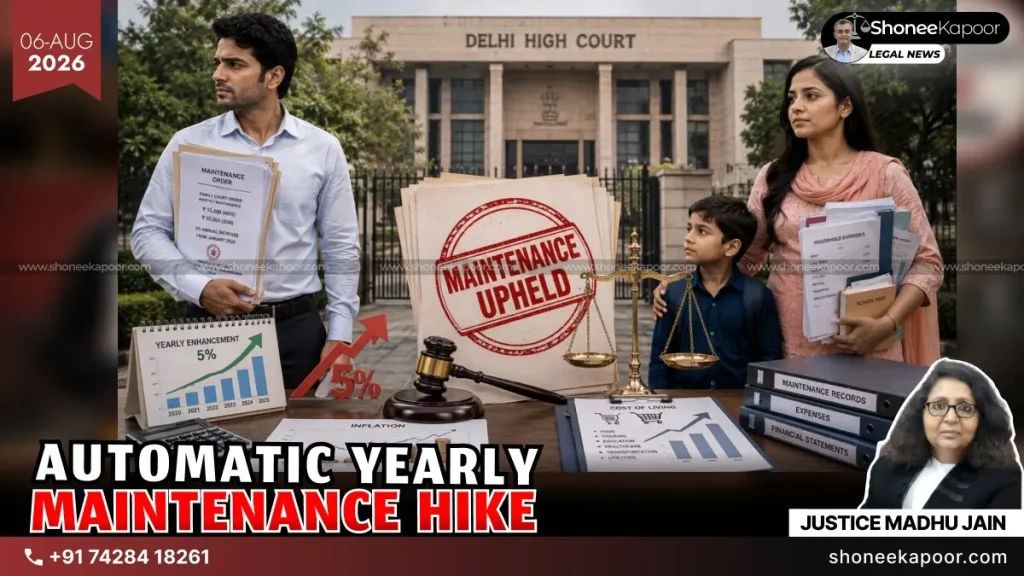
Can a husband earning ₹11,000 per month be ordered to pay ₹25,000 maintenance with an automatic increase every year? The Delhi High Court examined his qualifications, earning capacity and unrebutted evidence before upholding the Family Court’s order.
NEW DELHI: The Delhi High Court has upheld an order directing a husband to pay monthly maintenance of ₹15,000 to his wife and ₹10,000 to his minor son, along with an automatic annual increase of 5%.
Justice Madhu Jain dismissed the husband’s criminal revision petition and held that a reasonable yearly increase in maintenance may be granted to address inflation and the rising cost of living.
The case arose from a judgment passed by the Principal Judge (East), Family Courts, Karkardooma Courts, Delhi. The Family Court had directed the husband to pay a total of ₹25,000 per month from January 2020, with a 5% annual enhancement.
The parties were married on December 5, 2012, and a son was born from the marriage in September 2013. Matrimonial disputes later arose between them.
The wife alleged that she was subjected to cruelty and dowry demands and was forced to leave the matrimonial home. She filed a complaint before the Crime Against Women Cell on November 17, 2014, and started residing with her parents.
The husband denied these allegations. He claimed that the parties had been living separately since November 2013 and alleged that the wife had concealed her independent income and earlier maintenance.
The matter was also referred to mediation in August 2025, but no settlement could be reached.
While deciding maintenance, the Family Court relied on the Supreme Court ruling in Jasbir Kaur Sehgal v. District Judge, Dehradun. It explained that courts must consider the status and needs of both parties, the husband’s actual capacity to pay, his own reasonable expenses, legal responsibilities and compulsory deductions. The amount awarded should allow the wife to live with reasonable comfort according to the standard of living enjoyed during the marriage and should also enable her to pursue the case properly. At the same time, the maintenance amount must remain fair and should not become excessive or extortionate.
The Family Court examined the husband’s educational and financial background. He had completed a course in Hospitality Management from Edinburgh, Scotland, but claimed that he was earning only ₹11,000 per month.
He argued that the properties referred to by the wife belonged to his father and that he did not own any immovable property. He also stated that he was living in rented accommodation and that the minor child had obtained school admission under the Economically Weaker Section category.
The husband challenged the Family Court’s order under Sections 397 and 401 CrPC. He argued that the Court had wrongly assessed his income and had awarded maintenance beyond his actual financial capacity.
He further argued that an automatic future increase could not be granted under Section 125 CrPC. According to him, any increase in maintenance required a separate application under Section 127 CrPC based on changed circumstances.
The respondents opposed the petition and submitted that the husband’s income claim was not believable considering his foreign education and professional qualifications.
They also informed the Court that proceedings for recovering approximately ₹7 lakh in maintenance arrears for 2023–24 and 2024–25 were pending before the Trial Court.
The High Court noted that the wife’s evidence regarding her financial dependence, the child’s educational expenses and the husband’s financial position had remained substantially unrebutted. Despite repeated opportunities, the husband had failed to cross-examine her.
The Court found that the Family Court was therefore justified in drawing appropriate conclusions from the evidence available on record.
The High Court also rejected the husband’s claim that his earning capacity was limited to ₹11,000 per month. It noted that he possessed a degree in Hospitality Management from Edinburgh Napier University and had failed to place convincing material showing that he was capable of earning only the amount claimed by him.
On the issue of the automatic 5% annual maintenance hike, the High Court explained that maintenance under Section 125 CrPC is meant to help the wife and minor child live with dignity and broadly maintain the standard of living they had during the marriage. Since inflation and living costs rise over time, the real value of a fixed maintenance amount gradually falls. The Court therefore held that a reasonable yearly increase only protects the effectiveness of the maintenance order and cannot automatically be treated as arbitrary or illegal.
The Court held that the 5% annual increase did not suffer from any patent illegality requiring interference in revision.
It also clarified that the High Court’s power in a criminal revision is limited. A revisional court does not ordinarily reassess the entire evidence like an appellate court. Interference is justified only where the challenged order contains patent illegality, perversity, jurisdictional error or material irregularity causing a miscarriage of justice.
Finding no such defect, the Delhi High Court upheld the Family Court judgment and dismissed the husband’s revision petition.
EXPLANATORY TABLE OF LAWS AND SECTIONS
| Law / Section | What It Means | How It Applied in This Case |
| Section 125 CrPC | Provides a summary remedy for maintenance to a wife, child or parent who is unable to maintain themselves. | The Family Court awarded ₹15,000 per month to the wife and ₹10,000 per month to the minor child, with a 5% annual increase. |
| Section 127 CrPC | Allows alteration of an existing maintenance order when there is a material change in circumstances. | The husband argued that any future increase should only be granted through proceedings under this section. The High Court did not accept that objection to the existing 5% annual escalation. |
| Section 397 CrPC | Gives the High Court and Sessions Court revisional power to examine the legality and correctness of certain lower-court orders. | The husband invoked this provision to challenge the Family Court’s maintenance judgment. |
| Section 401 CrPC | Defines the High Court’s powers while exercising criminal revisional jurisdiction. | The High Court held that revisional interference was unavailable without patent illegality, perversity or material irregularity. |
| Criminal Revision | A limited supervisory remedy used to correct serious legal, jurisdictional or procedural errors. | The Court refused to reassess the evidence merely because the husband disputed the Family Court’s conclusions. |
| Annual Enhancement of Maintenance | A periodic increase intended to prevent inflation from reducing the real value of maintenance. | The Court upheld the automatic 5% yearly increase as a reasonable protection against rising living costs. |
| Unrebutted Evidence | Evidence that remains substantially unanswered because the opposing party fails to challenge it through cross-examination or contrary proof. | The wife’s evidence concerning financial dependence, child-related expenses and the husband’s financial position remained substantially unchallenged. |
CASE DETAILS
| Case Particular | Details |
| Case Title | Rahul Gaurav Nagar v. Neeta @ Savita & Anr. |
| Neutral Citation | 2026:DHC:5965 |
| Court | High Court of Delhi at New Delhi |
| Case Number | CRL.REV.P. 16/2021 |
| Impugned Proceeding | MT No. 158/18 (2015) |
| Bench | Justice Madhu Jain |
| Reserved On | July 17, 2026 |
| Pronounced On | July 27, 2026 |
| Counsel for Petitioner | Mr. K.P. Mavi, Advocate, with Ms. Kavita Kumari, Advocate |
| Counsel for Respondents | Mr. Arjun Singh Bhati, Advocate |
KEY TAKEAWAYS
- A husband’s education or qualifications should not automatically be treated as proof of a high income.
- Automatic yearly hikes can create a growing financial burden unless the husband’s actual capacity is properly examined.
- Men must file complete income, expense and liability records instead of relying on verbal claims.
- Failure to cross-examine the wife or challenge her financial evidence can permanently weaken the husband’s defence.
- Maintenance is for dignity, not financial destruction. It must remain fair and never become excessive or extortionate.
This Could Change Your Case-Get FREE Legal Advice-Click Here!
Disclaimer: The views and opinions expressed in this article are those of the Indian courts and do not necessarily reflect the official policy or position of “ShoneeKapoor.com” or its affiliates. This article is intended for informational and educational purposes only. The content provided is not legal advice, and viewers should not act upon this information without seeking professional counsel. Viewer discretion is advised.