
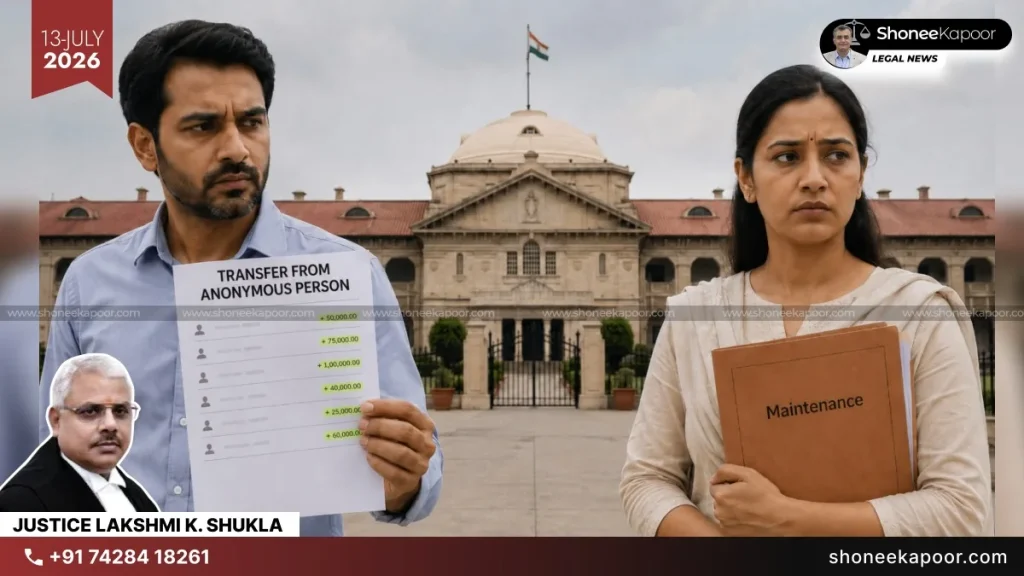
Can a wife receive maintenance while regularly accepting money from a man she claims not to know? The Allahabad High Court held that such unexplained transactions were a relevant circumstance under Section 125(4) CrPC and cancelled the maintenance awarded to the wife.
PRAYAGRAJ: The Allahabad High Court has cancelled the monthly maintenance awarded to a wife after finding that she repeatedly received money from an unrelated man but failed to satisfactorily explain the transactions. Justice Lakshmi Kant Shukla, however, continued the maintenance granted to the couple’s son.
The husband had challenged an order of the Family Court, Agra, directing him to pay ₹15,000 per month to his wife and ₹10,000 per month to their son under Section 125 CrPC.
He argued that the Family Court had failed to properly examine his objection under Section 125(4) CrPC. According to him, his wife was regularly receiving money from a man named Lalit Mohan Pandey, who was neither her relative nor someone she claimed to know personally.
During her statement, the wife admitted that money had been transferred several times from the man’s bank account to her account. She also admitted that the transfers continued even after she had separated from her husband.
At the same time, she stated that she had never met the man, did not know where he lived and had no illicit relationship with him.
The husband argued that the wife had failed to explain why an unrelated man was regularly sending money to her. He also submitted that these payments should have been considered while deciding whether she was capable of maintaining herself.
The State opposed the revision and argued that the money had been received by the wife for medical treatment. It submitted that merely receiving financial help from another person could not automatically prove an illicit relationship.
The husband had also relied upon certain photographs. However, the High Court refused to consider them because they had not been legally proved according to the rules of evidence.
The Court nevertheless found that the regular money transfers were an important circumstance which the Family Court had failed to properly examine.
The High Court observed:
“However, the unexplained and regular receipt of money by O.P. No. 2 from a third person was a relevant circumstance which required due consideration by the trial court while examining the plea of the revisionist under Section 125(4) Cr.P.C.”
The Court held that the circumstances surrounding the repeated transfers had not been satisfactorily explained. It therefore set aside the direction requiring the husband to pay ₹15,000 per month to the wife.
However, the Court upheld the ₹10,000 monthly maintenance awarded to the son. It noted that the child’s right to maintenance from his father was separate and undisputed.
Accordingly, the husband’s criminal revision was partly allowed. The wife’s maintenance was cancelled, while the son’s maintenance remained unchanged.
EXPLANATORY TABLE: LAWS AND PROVISIONS INVOLVED
| Law / Provision | Purpose | How It Applied In This Caes |
| Section 125 CrPC | Allows a wife, child or parent to claim maintenance. | Used to grant maintenance to the wife and son. |
| Section 125(4) CrPC | A wife may be denied maintenance in specified situations, including living in adultery. | Husband relied on it to challenge the wife’s claim. |
| Criminal Revisional Jurisdiction | Higher court checks serious legal errors in a lower court order. | High Court reviewed and partly changed the Family Court order. |
| Rules of Evidence for Photographs | Photographs must be properly proved before being relied upon. | The Court rejected the photographs as unproved. |
| Child’s Right to Maintenance | A child has an independent right to financial support. | Son’s ₹10,000 monthly maintenance was upheld. |
CASE DETAILS
- Case Title: Devendra Saraswat v. State of U.P. and 2 Others
- Case Number: Criminal Revision No. 408 of 2025
- Court: High Court of Judicature at Allahabad
- Date of Decision: July 6, 2026
- Neutral Citations: 2026:AHC:134499
- Bench: Hon’ble Justice Lakshmi Kant Shukla
- Counsels:
- For Revisionist: Mr. Gaurav Srivastava, assisted by Mr. Mukesh Rai
- For State: Learned Additional Government Advocate
KEY TAKEAWAYS
- Maintenance should not be granted mechanically when important financial transactions remain unexplained. Courts must examine the full evidence before directing a husband to pay.
- A husband’s objection under Section 125(4) CrPC deserves proper judicial consideration. It cannot be ignored merely because the allegation is disputed.
- Unproved photographs may be rejected, but admitted bank transfers can still become strong and relevant evidence in a maintenance case.
- A wife’s maintenance claim is legally separate from a child’s right. Even when the wife’s maintenance is cancelled, the father’s duty towards the child continues.
- Men contesting excessive or unfair maintenance must present bank records, income documents and legally admissible evidence. Proper documentation can significantly affect the final outcome.
This Could Change Your Case-Get FREE Legal Advice-Click Here!
Disclaimer: The views and opinions expressed in this article are those of the Indian courts and do not necessarily reflect the official policy or position of “ShoneeKapoor.com” or its affiliates. This article is intended for informational and educational purposes only. The content provided is not legal advice, and viewers should not act upon this information without seeking professional counsel. Viewer discretion is advised.