
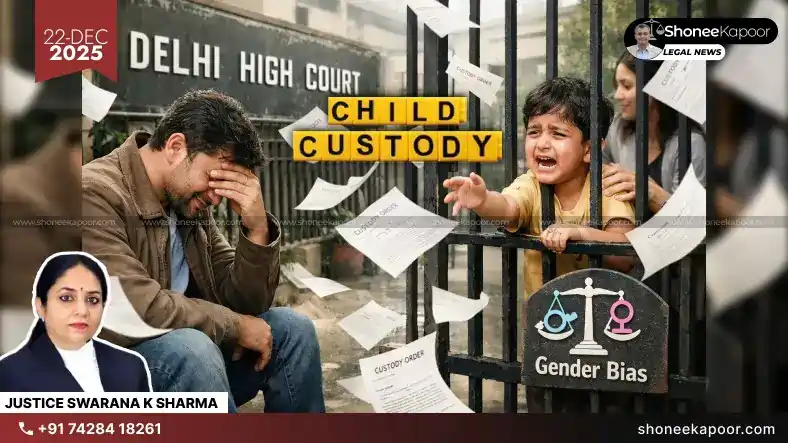
Delhi High Court Says Single Fathers Cannot Be Judged With Gender Bias in Child Care and Maintenance Cases: “They Face Equal Burden as Mothers”

Written and analysed by Vaibhav Ojha
Head Of Legal CommunicationsThe Delhi High Court has ruled that caregiving by a single parent cannot be judged through a gendered lens. The Court also set aside a family court order on maintenance for ignoring financial deductions borne by a single father.
Single Fathers Can’t Judged with Gender Bias in Child Care: The Delhi High Court has delivered an important ruling clarifying how Family Courts must approach caregiving and maintenance disputes involving single parents. The Court held that it is neither appropriate nor legally permissible to assess the caregiving capacity or hardships of a single parent based on gender.
The judgment strongly recognises that fathers who raise children alone face emotional, psychological, social, and financial burdens equal to those faced by single mothers.
The ruling was delivered by Justice Swarana Kanta Sharma while deciding a criminal revision petition filed by a husband challenging a Family Court order directing him to pay ad-interim maintenance of ₹12,000 per month to his wife, despite substantial salary deductions being made towards government accommodation occupied by the wife.
The case arose from matrimonial discord between the parties, who have two minor children. After separation, the wife continued to stay in a government accommodation allotted to the husband, who is serving as a Head Constable in Delhi Police. The husband alleged that he was compelled to vacate the accommodation along with the children and shift to his parental home, while deductions towards House Rent Allowance and water charges continued from his salary even though he was not residing there.
The wife had filed proceedings under Section 125 of the Code of Criminal Procedure seeking maintenance. The Family Court initially directed payment of ₹12,000 per month as ad-interim maintenance. When the husband contended that a large part of this amount was already being indirectly paid through HRA and water charge deductions, the Family Court rejected the argument and reiterated the maintenance direction.
While examining the dispute, the High Court observed that caregiving roles cannot be evaluated through stereotypes. The Court made it clear that caregiving responsibilities are the same irrespective of whether the parent is a mother or a father.
The Court observed:
“That said, this Court is also conscious that the social realities faced by a single mother and a single father are not identical. In many cases, especially in Indian society, a single mother may find it difficult to return to or be comfortably accommodated in her parental home, whereas a father, continuing in his parental household, may face relatively fewer societal barriers. However, such distinctions do not permit a mechanical comparison or an assumption of lesser hardship on the part of such a single father,”
The Court further emphasised that every case before a Family Court is fact-specific and must be decided on its own merits without undermining the efforts of either parent who single-handedly raises children.
It clearly stated:
“It added that each case must be evaluated on its own facts, without undermining the genuine efforts of either parent who assumes the responsibility of single-handedly caring for minor children.”
The judgment also highlighted a significant policy gap affecting single fathers in India. Unlike mothers, single fathers are not entitled to child care leave. The Court noted the serious impact this has on working fathers who must balance employment with the emotional and psychological needs of minor children.
The Court observed:
“It is also to be noted that in India, a single father is not entitled to child care leave. A mother is entitled to child care leave whether single or not. This may pose significant challenges for a single working father who has to care for the psychological and emotional needs of the minor children in his custody and also ensure running of a household with minor children while ensuring that his career possibilities and progress does not suffer as in the case of a single mother,”
On the financial aspect, the High Court found that the Family Court had failed to consider undisputed deductions from the husband’s salary. The record showed that nearly ₹9,828 per month towards HRA was not being paid to the husband and ₹719 per month was being deducted towards water charges for the government accommodation occupied by the wife. In effect, the husband was bearing an additional burden of around ₹10,500 per month apart from the ordered maintenance.
The High Court held that such deductions must be taken into account while determining maintenance, especially when the wife continues to occupy official accommodation allotted to the husband. The Court concluded that ignoring these deductions resulted in an unfair financial burden on the husband.
After analysing the facts and law, the Court set aside the impugned Family Court order and remanded the matter for fresh consideration. The Court directed that both parties be allowed to file updated income affidavits and supporting documents before the Family Court.
The Court stated:
“Accordingly, the impugned order is set aside and the matter is remanded to the learned Family Court for fresh consideration, after affording both parties an opportunity to place updated income affidavits and supporting material on record,”
The High Court also clarified that nothing stated in the judgment should be treated as a final determination on the merits of the matrimonial dispute itself.
This judgment is significant because it reinforces the principle of gender neutrality in family law adjudication. It sends a clear message that courts must move away from assumptions that caregiving hardship automatically falls heavier on women and must recognise the realities faced by single fathers raising children under difficult circumstances.
Explanatory Table: Laws & Sections Involved in the Case
| Law / Statute | Section | Simple Explanation (Indian English) | How It Applied in This Case |
| Code of Criminal Procedure, 1973 | Section 125 | Provides monthly maintenance to a wife, children, or parents who cannot maintain themselves | The wife filed a maintenance case under this section seeking financial support from the husband |
| Family Courts Act, 1984 | Section 7(2) | Gives Family Courts power to decide certain matrimonial and family disputes | The Family Court passed the impugned order while exercising this power |
| Family Courts Act, 1984 | Section 19(4) | Allows a criminal revision against certain Family Court orders | The Delhi High Court held that the husband’s criminal revision was maintainable under this provision |
| Code of Criminal Procedure, 1973 | Sections 125–128 | Entire scheme governing grant, enforcement, and alteration of maintenance | The High Court clarified that revision lies for interim and final maintenance orders under these sections |
| Hindu Marriage Act, 1955 | Sections 24–27 | Deal with interim maintenance, permanent alimony, and property | Referred in precedent to distinguish appeal and revision remedies |
| Case Law | Manish Aggarwal v. Seema Aggarwal (2012) | Clarifies when appeal or revision is maintainable against Family Court orders | Relied upon to reject the objection that the revision was not maintainable |
| Case Law | Annurita Vohra v. Sandeep Vohra (2004) | Lays down principle of equitable distribution of family income | Used to assess whether the effective financial burden on the husband was excessive |
Case Summary
- Case Title: ABC vs XYZ
- Court: Delhi High Court
- Bench: Justice Swarana Kanta Sharma
- Case Number: CRL.REV.P. 617/2024
- Dates
- Judgment Reserved On: 10.12.2025
- Judgment Pronounced On: 15.12.2025
- Judgment Uploaded On: 19.12.2025
- Counsel for Petitioner (Husband): Mr. Vaibhav Shukla, Advocate
- Counsel for Respondent (Wife): Mr. Jairaj Singh, Advocate and Mr. Deepankar, Advocate
Key Takeaways
- The Delhi High Court has clearly said that a single father’s caregiving role cannot be treated as inferior or lighter just because he is a man.
- Family Courts cannot use gender bias or stereotypes while judging who is the real caregiver of children. Facts matter, not gender.
- The Court recognised that single fathers face serious emotional, psychological, and career challenges, especially since Indian law does not grant them child care leave.
- Maintenance cannot be fixed blindly. Salary deductions like HRA and water charges paid by a husband must be counted to avoid financial injustice.
- This judgment strengthens the demand for gender-neutral family laws and fair treatment of fathers who are raising children alone.
This Could Change Your Case-Get FREE Legal Advice-Click Here!
Disclaimer: The views and opinions expressed in this article are those of the Indian courts and do not necessarily reflect the official policy or position of “ShoneeKapoor.com” or its affiliates. This article is intended for informational and educational purposes only. The content provided is not legal advice, and viewers should not act upon this information without seeking professional counsel. Viewer discretion is advised.
Related Articles
Family Courts Refuse My RTI To Reveal Divorce Data: Is Transparency Selective When It Comes to Men?
Family Courts have refused to provide year-wise divorce and alimony statistics under the RTI Act, citing technical gr...
Can an Educated Wife Claim Maintenance from Her Husband? The Legal Reality No One Explains
Indian courts recognise education and earning capacity, yet husbands are still routinely ordered to pay maintenance.I...
Alimony vs Maintenance in India: The Real Legal Difference Every Man Must Know Before Divorce
Alimony and maintenance are not the same, but Indian courts often blur the line, creating lifelong financial pressure...
Relevant Judgements
Can an NRI Husband Be Forced to Pay Maintenance in India? Supreme Court Rules Explained for Overseas Indian Men
Living abroad does not automatically protect an NRI husband from maintenance claims in India.But can Indian courts pa...
Share Your Thoughts
Comments are moderated before publication.