
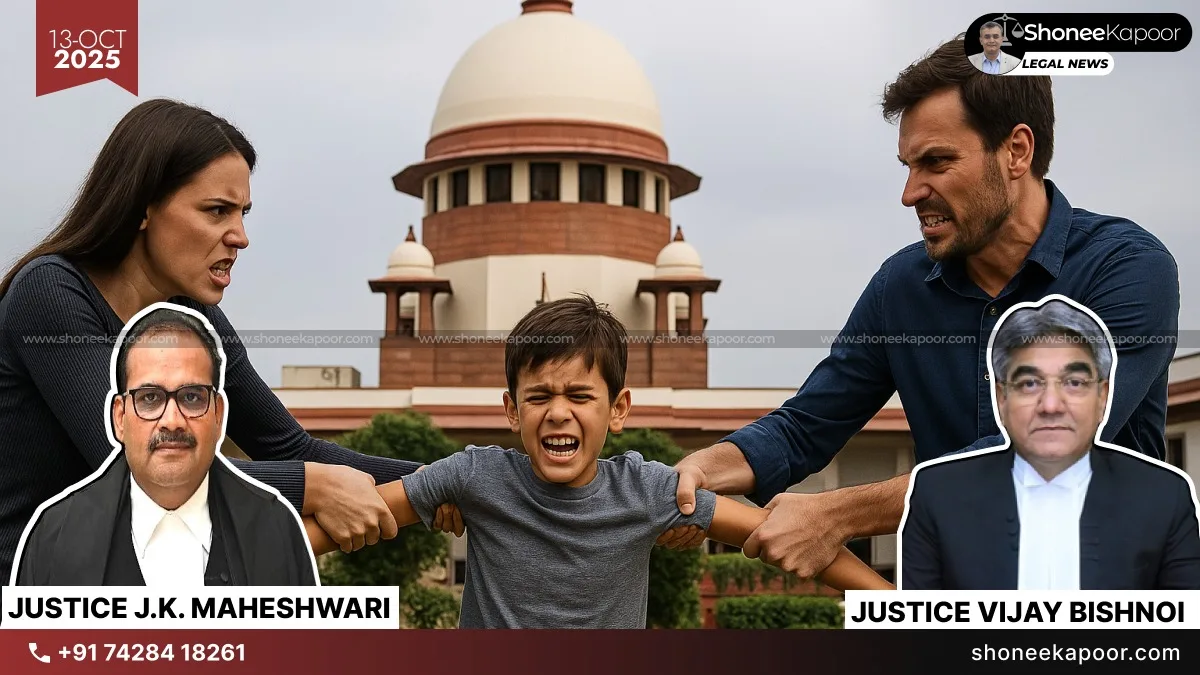
Supreme Court Slams Mother for Misleading Indian & UK Courts, Grants Interim Custody of Son to Father from Noida

Written and analysed by Shonee Kapoor
Legal Consultant, Author & Men's Rights ActivistThe Supreme Court strongly criticised a mother for deceiving both Indian and UK courts, granting temporary custody of her 6-year-old son to his father. The Court said the mother’s actions went against the child’s welfare and “took both judicial systems for a ride.”
NEW DELHI: In a major child custody ruling, the Supreme Court of India on September 16, 2025, handed interim custody of a six-year-old boy to his father, a Noida resident, after observing that the mother had left for the United Kingdom in 2021 without informing her husband and had left the child with her parents in Sonipat.
A bench of Justices J.K. Maheshwari and Vijay Bishnoi expressed strong displeasure at the mother’s conduct, observing that she had no intention to let the child meet his father or obey court orders.
“The judicial system in India as well as the UK had been taken for a ride by the mother for the reasons known best to her. Be that as it may, the entire whirlpool of litigation has been set into motion by the parents, wherein the children are being pulled in and at this stage, we are concerned with the welfare of the child and certainly, in our view, such conduct is clearly not in favour of the welfare,’’ the bench said.
The Court ordered that custody of the child be handed to the father within 15 days from the wife’s parents in Sonipat. The mother, currently in the UK, was permitted video call interaction with her son, and the maternal grandparents were granted visitation rights.
Having reviewed the facts, the Court said:
“We are constrained to observe that the present case reflects a deep-rooted conflict between the mother and father, arising from their divergent intentions regarding staying together and raising their children in India. This discord has not only strained their marital relationship but has also adversely impacted their children.”
The bench further noted that the mother’s act of leaving the child with her parents came to light only after the father filed a habeas corpus petition, which led to interim custody being given to him.
The judges stated that since the mother is living in London with the daughter while the son is with the grandparents, despite the father being financially stable and available, the child’s welfare would be best served by staying with his father.
The Court also highlighted the father’s qualifications and stable background. He holds a Master’s degree in Computer Science and a post-graduate diploma in Business Administration, having worked in Singapore, the UK, and the US.
“Similarly, looking to other factors, his earning is sufficient, and he is owner of residential flat in Sector-70, Noida and currently residing there with his mother and younger sister. In our considered opinion, Noida is more suitably located than Sonipat, having better educational institutes, therefore, in our view, welfare of the child would be served if the interim custody of the child is given to the father who is also the natural guardian,” the bench said.
The bench directed that either parent must file appropriate proceedings under the Guardians and Wards Act, 1890 within one month before the competent court. Since the child was born in the UK, the issue of citizenship would depend on the outcome of those proceedings.
The couple had married on November 29, 2010, and have two children—a daughter and a son. The father alleged that his wife left India on May 8, 2021, with both children and did not return. On June 3, 2021, he filed a police complaint.
He then approached the UK High Court and filed a divorce petition in Noida. The UK court had earlier directed the mother to allow video calls between the father and children, but the mother failed to comply.
Suspecting that the son was not in the UK, the father filed a habeas corpus petition in India in 2021. On visiting the maternal grandparents’ house in Sonipat, he discovered his son there. However, he was attacked and injured during the visit. Following this, the Punjab and Haryana High Court ordered custody of the child to the father.
Meanwhile, the UK Family Court granted a divorce decree to the mother on December 21, 2021, which the father has challenged in appeal. Conversely, the Family Court at Jind, Haryana, on September 20, 2022, granted an ex parte divorce decree to the father, which the mother has challenged.
The UK High Court also recorded that the mother played a “crude subterfuge” by not revealing that the son was actually in India.
Later, on May 8, 2024, the Supreme Court interacted with the child in chambers.
“Upon interaction and looking to his age, which was approximately 5 years, we found that Master K was not in a position to substantially express anything for anyone,” the bench observed.
The apex court also remarked that both parents are pursuing divorces in different countries while refusing to recognise decrees passed outside their preferred jurisdiction.
“It appears that both parties wish to obtain divorce only from the court of the jurisdiction in which they currently reside. This is not merely a clash of egos, but prima-facie, reflects a concerning mindset that may ultimately come at the cost of the welfare of the minor children,” the bench said.
Finally, the Court emphasised that it was the mother’s duty to inform the father about the child’s location and to disclose the child’s whereabouts to the UK High Court, but she failed to do so.
Her disclosure came only after the father had filed applications before both the UK High Court and the Punjab and Haryana High Court seeking the return of his children.
Explanatory Table of Laws & Legal Sections Referred
| Law / Section | Provision Summary | Context in This Case |
|---|---|---|
| Habeas Corpus (Article 32 / 226 of Constitution) | Remedy to produce a person held unlawfully in custody. | Father filed habeas corpus in Punjab & Haryana High Court seeking production of minor son, alleging illegal custody by maternal grandparents. |
| Section 9, Hindu Marriage Act, 1955 | Restitution of conjugal rights – a spouse can seek order to live together again. | Father had filed a petition under this section before the Family Court, Jind. |
| Guardians and Wards Act, 1890 | Governs appointment and rights of guardians for minors. | SC directed both parents to file proceedings under this Act for permanent custody and guardianship of the minor. |
| Parens Patriae Principle | The State (and Courts) act as guardian for those unable to protect themselves. | Cited by Supreme Court to emphasize welfare of child as paramount consideration. |
| Doctrine of Comity of Courts | Respect for jurisdiction and judgments of foreign courts. | Discussed due to conflicting Indian and UK custody/divorce orders. |
| Article 21 of the Constitution (Implicit) | Protection of life and personal liberty. | Implied in the child’s right to live with safety, security, and dignity. |
| Precedents Cited | ||
| Nithya Anand Raghavan v. State (NCT of Delhi) (2017) 8 SCC 454 | Child welfare overrides foreign court orders. | Used to justify prioritizing child’s welfare over UK orders. |
| Lahari Sakhamuri v. Sobhan Kodali (2019) 7 SCC 311 | Best interest of child is paramount in cross-border custody cases. | Relied on by SC to assess welfare of minor. |
| Rajeswari Chandrasekar Ganesh v. State of Tamil Nadu (2023) 12 SCC 472 | Welfare of child supersedes parental legal rights. | Cited to emphasize child-centric approach. |
| Neethu B. v. Rajesh Kumar (2025 SCC OnLine SC 1435)* | Courts may alter custody to serve welfare and mental health of the child. | Quoted by SC to reaffirm evolving child-welfare standards. |
Case Summary
- Case Title: Komal Krishan Arora & Ors. vs. Sandeep Kumar & Ors.
- Citation: 2025 INSC 1123
- Court: Supreme Court of India
- Jurisdiction: Criminal Appellate / Inherent Jurisdiction
- Case Type: Criminal Appeal (Arising out of SLP (Crl.) No. 9497 of 2021) with connected contempt petitions and SLP (Crl.) No. 17530 of 2024
- Bench: Hon’ble Justice J.K. Maheshwari and Hon’ble Justice Vijay Bishnoi
- Date of Judgment: 16 September 2025
- Appellants: Komal Krishan Arora & Others (Maternal family of the child)
- Respondents: Sandeep Kumar @ Sandeep Chugh & Others (Father of minor child)
- Counsel for Petitioner (Father): Sh. Anil Malhotra, Advocate
- Counsel for Respondents (Mother’s Side): Mr. Sandhu, Advocate
- Judgment Authored by: Justice J.K. Maheshwari
- Connected Courts Involved: Punjab & Haryana High Court, UK High Court (Family Division), Family Court at Jind, Haryana; Family Court, London (UK)
Final Directions
- Custody of minor Master K to be handed to father within 15 days (by 30 Sept 2025).
- Both parents to file guardianship case under the Guardians and Wards Act, 1890 within one month.
- Mother allowed video call every Saturday (5–7 PM IST) and visitation during India visits.
- Maternal grandparents allowed visits every Sunday (1–5 PM).
- Father cannot take the child abroad without High Court’s permission.
- Child Welfare Committee / Juvenile Justice Magistrate to monitor minor’s wellbeing and report to Supreme Court if any adverse findings arise.
- All connected SLPs and contempt petitions disposed of.
Disclaimer: The views and opinions expressed in this article are those of the Indian courts and do not necessarily reflect the official policy or position of “ShoneeKapoor.com” or its affiliates. This article is intended for informational and educational purposes only. The content provided is not legal advice, and viewers should not act upon this information without seeking professional counsel. Viewer discretion is advised
Related Articles
Child Custody Legal Guide: Can School Remove Father’s Name From Records?
Can a school remove a biological father’s name from child records after divorce or custody dispute? Read Indian law, ...
Child Custody Guide: At What Age Can a Child Choose Between Mother and Father in India?
Can a child decide whether to live with mother or father in India? Know the real law, child preference age, custody c...

8 Court Judgments Every Man Should Know in India Before 498A, Maintenance, Custody or Divorce Hits
From arrest protection in 498A (85 BNS) cases to maintenance disclosure, child visitation, DV residence rights and fo...
Share Your Thoughts
Comments are moderated before publication.