
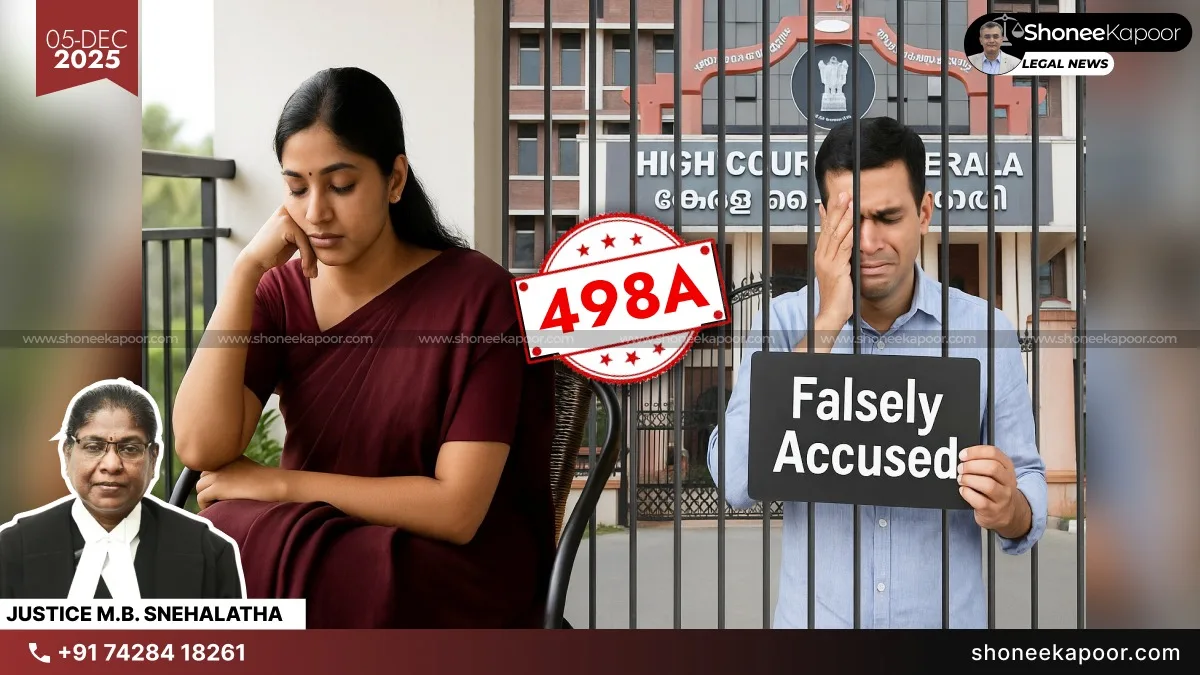
Kerala High Court Says Independent Witnesses Not Needed in 498A Cases, Raising Fresh Concerns for Men Facing Unverified Allegations

Curated by NEWS DESK
Editorial DeskKerala High Court ruled that 498A cruelty cases do not become weak even if there are no independent witnesses. The Court said family members’ testimony can be enough, raising major concerns for fairness in matrimonial cases.
KOCHI: The Kerala High Court has ruled that the absence of independent witnesses in a Section 498A IPC case does not weaken the prosecution story. The Court relied heavily on the idea that cruelty inside a marriage usually happens privately and cannot always have outside witnesses.
This judgment, delivered by Justice M.B. Snehalatha, came in a criminal revision petition filed by the husband who challenged his conviction for cruelty towards his wife.
The husband was earlier sentenced to one year of simple imprisonment and a fine, which was later reduced on appeal to six months. He approached the High Court arguing that the prosecution failed to prove the ingredients of 498A IPC. He also pointed out that although the wife claimed cruelty since 2003, she filed no complaint until 2009, which, according to him, raised serious doubt about the genuineness of allegations.
The Court, however, accepted the prosecution’s position that the wife and her relatives gave consistent statements about continuous dowry harassment. The Court rejected the argument that lack of independent witnesses should weaken the case.
It stated:
“The acts of cruelty which attract the offence under Section 498A IPC are offences committed within the privacy of matrimonial home. By its very nature, the offence is one that occurs behind closed doors away from public view and ordinarily without the presence of independent witnesses”.
The Court further explained that demanding independent evidence in such cases does not match the ground realities of domestic violence.
It added:
“The testimony of a married woman regarding the physical assault she was subjected to on account of dowry demand carries significant evidentiary value if her version is found to be cogent, credible and trustworthy.”
The husband also argued that the wife never went to the police for years and that delay should show the allegations were false. The Court disagreed completely, saying that a woman may not immediately go to the police due to family responsibilities and hope that things may improve.
The Court said:
“One cannot adopt a stand that whenever there is an act of cruelty by the husband, the victim wife should rush to the police station or any other authorities to lay a compliant. The victim wife may wait with a hope that things may change, especially to safeguard her children born in the said wedlock.
So the contention put forward by the accused that in spite of the cruelty allegedly suffered by her from 2003 onwards she laid complaint only in the year 2009 and the delay in lodging complaint shows the falsity of her case, is unsustainable.”
The judgment then discussed the wider problem of dowry and violence within marriage, calling dowry a social evil.
The Court stated:
“Assaulting the wife in connection with dowry demands is not a mere domestic dispute but a serious offence rooted in greed, coercion and gender based violence. When a woman is physically harmed because she or her family cannot meet the unlawful dowry demands, it reflects the deliberate and oppressive misuse of power within the matrimonial home.”
Finally, the High Court refused to interfere in the conviction and upheld the modified sentence given by the appellate court. It found no legal error in the lower courts’ findings and dismissed the revision petition, confirming the six-month imprisonment and fine.

Explanatory Table Of All Laws & Sections Mentioned
| Law / Section | What It Means (Simple Indian English) | Why Mentioned in This Case |
| Section 498A IPC | Punishes cruelty by husband or his relatives — cruelty includes physical/mental harm or dowry-related harassment. | Accused husband was convicted under this section for alleged cruelty and dowry harassment. |
| Section 397 CrPC | Gives High Court power to check the correctness of trial court orders in revision. | Husband filed a revision petition under this section. |
| Section 401 CrPC | Gives High Court power to revise, modify, or reverse lower court decisions. | High Court examined whether conviction needed interference. |
| Section 156(3) CrPC | Magistrate can direct police to register FIR and investigate. | Wife’s complaint (Ext. P1) was forwarded under this section to police. |
| Section 313(1)(b) CrPC | Accused is questioned about the evidence against him. | Accused denied allegations during this stage. |
| Section 357(1)(b) CrPC | Court can give the fine amount as compensation to the victim. | HC directed the fine of ₹10,000 to be paid to PW1. |
| Dowry Prohibition Act, 1961 | Law that criminalises giving and taking dowry. | Court discussed dowry as a social evil while justifying punishment. |
| Sections 85 & 80 of Bharatiya Nyaya Sanhita, 2023 | New criminal law replacing IPC provisions for cruelty & dowry death. | Court noted these while discussing the future legal framework. |
| Section 304B IPC (Dowry Death) | Punishes dowry death when a woman dies unnaturally within 7 years of marriage. | Mentioned to discuss how dowry-related laws operate together. |
| Medical Evidence (Wound Certificate Ext.P4) | Physical injury proof. | Supported wife’s allegation of assault in 2009 incident. |
Case Summary
| Field | Details |
| Case Title | TOMON vs State of Kerala |
| Case Number | Crl.R.P. No. 890 of 2018 |
| Court | High Court of Kerala at Ernakulam |
| Bench / Judge | Hon’ble Mrs. Justice M.B. Snehalatha |
| Date of Judgment | 27 November 2025 |
| Originating Case Numbers | Crl.A No. 217 of 2016 (Sessions Court, Manjeri) arising out of CC No. 1 of 2010 (Judicial Magistrate First Class–I, Manjeri) |
| Revision Petitioner / Accused | Tomon, 49 years, S/o Thomas, Vallikunnan House, Kalkundu Cheri, Karuvarakundu, Malappuram District |
| Advocate for Petitioner | Advocate Anu Krishna T.U (appointed as amicus curiae) |
| Respondent | State of Kerala |
| Counsel for State | Smt. Maya M.N., Public Prosecutor |
| Offence Alleged | Section 498A IPC |
| Initial Sentence (Trial Court) | 1 year Simple Imprisonment + ₹10,000 fine |
| Modified Sentence (Appellate Court) | 6 months Simple Imprisonment + ₹10,000 fine |
| Final Outcome (High Court) | Revision dismissed; conviction & sentence upheld |
| Compensation Direction | Fine to be paid to PW1 under Section 357(1)(b) CrPC |
| Police Station | Karuvarakundu Police Station |
| Crime Number | Crime No. 104/2009 |
Key Takeaways
- Kerala High Court held that 498A cases do not need independent witnesses, making husbands vulnerable to unverified, closed-door allegations.
- Testimony of wife and her relatives alone can sustain conviction if found “credible,” reducing evidentiary safeguards for innocent men.
- Delay of six years in filing the complaint was dismissed as normal, weakening the defence of delayed reporting in matrimonial disputes.
- Court reaffirmed that cruelty inside a home cannot be expected to have neutral witnesses, a stance that often leaves men without a fair chance to prove innocence.
- Despite inconsistencies claimed by the husband, the conviction and sentence were upheld, highlighting the urgent need for balanced, gender-neutral scrutiny in 498A cases.
This Could Change Your Case-Get FREE Legal Advice-Click Here!
Disclaimer: The views and opinions expressed in this article are those of the Indian courts and do not necessarily reflect the official policy or position of “ShoneeKapoor.com” or its affiliates. This article is intended for informational and educational purposes only. The content provided is not legal advice, and viewers should not act upon this information without seeking professional counsel. Viewer discretion is advised.
Related Articles
Karisma Kapoor – Sunjay Kapur Case Explained: Marriage, Divorce, 498A, Death & the Delhi High Court Property War
From a celebrity wedding to IPC 498A allegations, a Supreme Court-linked divorce settlement, and now a Delhi High Cou...
The Law That Forgot Its Sons: How India’s Gender Laws Turn Protection into Persecution
India’s gender laws were designed to protect women — but today, countless innocent men are being destroyed by false c...
False 498A – 85 BNS Fear And Need Legal Help? The Law Changed, The Risk Remains, The Defence Must Change Too
If arrest is “not automatic” now, why are families still rushing for bail and protection? Is Section 85 BNS just a ne...
Share Your Thoughts
Comments are moderated before publication.