
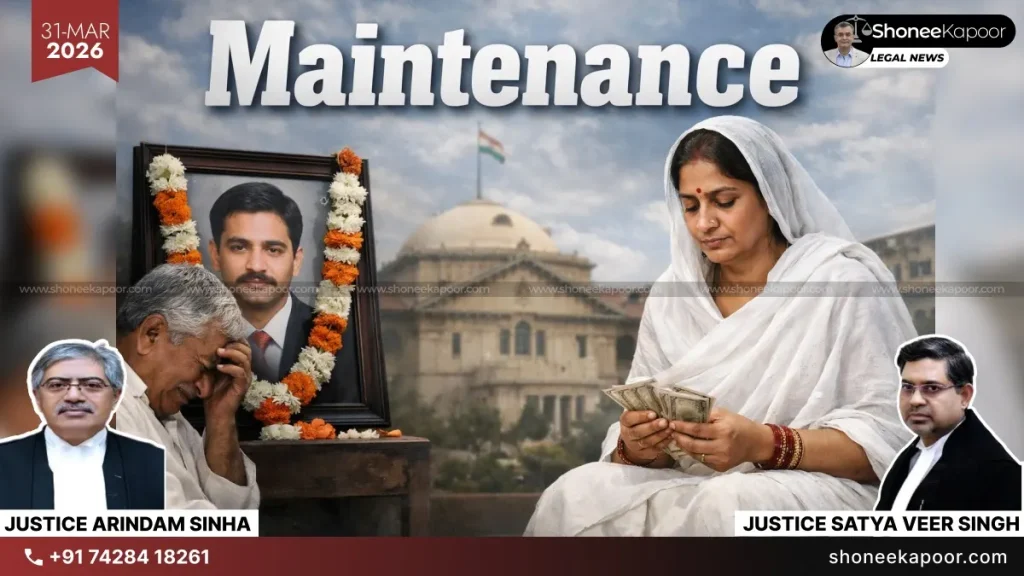
Does a husband’s responsibility ever truly end—even after death? This ruling quietly shifts the maintenance burden beyond the husband, raising deeper questions many are ignoring.
PRAYAGRAJ: The Allahabad High Court said that under Hindu law, a husband’s responsibility to maintain his wife does not end with his death, and in such situations, the widow can claim maintenance from her father-in-law if conditions are met.
“It is well settled that a husband is obliged to maintain his wife. This position has emanated from situations, where the spouses have separated and the wife has sought for maintenance, either on the criminal side or under maintenance provisions in Hindu law. So much so, this obligation of the husband to maintain the wife attaches even after death of the husband in the law allowing the widow to claim maintenance from her father-in-law”
The Court was hearing a case where a husband challenged a Family Court order. He wanted permission to prosecute his wife for perjury, claiming she gave false information to get maintenance. According to him, she wrongly showed herself as a housewife even though she was working.
He also claimed that she had Fixed Deposit Receipts worth more than Rs 20 lakh in a bank but hid this fact in her affidavit. Later, it was revealed that around Rs 4 lakh remained, while the rest had already been withdrawn.
The High Court noted that the husband failed to provide any proof that the wife was actually employed. It clearly stated that the burden of proof was on the husband, and a person cannot be forced to prove something negative, like not being employed.
On the issue of money, the Court observed that the deposits were given by her father. It also pointed out that after marriage, a father generally has no obligation to maintain his daughter unless she becomes a widow.
The Court further noted that since most of the FDR amount had already been used, it indicated that the wife needed financial support, especially when no maintenance was being provided by the husband.
The husband also argued that since the wife did not disclose all financial details in her affidavit filed under the Supreme Court guidelines in Rajnesh vs Neha, he should be allowed to prosecute her. However, the Court rejected this argument.
The Court made it clear that not mentioning certain details does not automatically amount to giving a false statement.
“The suppression is not, or cannot be, a false statement.”
Since there was no strong evidence to prove that the wife made any false claim, the High Court dismissed the husband’s appeal at the initial stage itself.
Under Section 19 of the Hindu Adoptions and Maintenance Act, 1956, a widowed daughter-in-law can claim maintenance from her father-in-law if she cannot maintain herself from her own income, property, or from her husband’s estate, parents, or children. However, this obligation applies only if the father-in-law has sufficient means, especially from ancestral or coparcenary property.
This right is not unlimited. It ends if the widow remarries, and it also cannot be enforced if the father-in-law does not have the financial capacity.
Section 21 of the same Act also supports the right of a widowed daughter-in-law to seek maintenance from the father-in-law’s estate, provided she has not remarried.
This ruling again reflects how financial responsibility in marriage can legally continue for a man and even extend to his family, while the evaluation of the wife’s financial position remains strictly dependent on proof placed before the court.
Explanatory Table Of Laws & Sections
| Law / Provision | Purpose | How Applied In This Case |
| Section 19, Hindu Adoptions and Maintenance Act, 1956 | Gives right to widowed daughter-in-law to claim maintenance from father-in-law if she cannot maintain herself | Basis of legal principle that widow can claim maintenance after husband’s death |
| Section 21(viii), Hindu Adoptions and Maintenance Act, 1956 | Defines dependents including widowed daughter-in-law for maintenance claims | Supports continuation of maintenance rights against father-in-law’s estate |
| Order 41 Rule 11, Code of Civil Procedure | Allows appellate court to dismiss appeal at admission stage without notice | Court used this to dismiss husband’s appeal at initial stage |
| Rajnesh vs Neha (2021) 2 SCC 324 | Mandates financial disclosure affidavits in maintenance cases | Husband relied on wife’s affidavit to allege suppression of facts |
| Law of Evidence (General Principle) | Entire document must be read, selective reliance not allowed | Court rejected husband’s attempt to rely on selective parts of documents |
Case Details
- Case Title: Akul Rastogi vs Shubhangi Rastogi
- Case Number: First Appeal Defective No. 212 of 2026
- Court: High Court of Judicature at Allahabad
- Bench: Hon’ble Justice Arindam Sinha & Hon’ble Justice Satya Veer Singh
- Date of Judgment: March 17, 2026
Counsels
- For Appellant (Husband): Pragya Pandey
- For Respondent (Wife): Not mentioned in order
Key Takeaways
- A man’s financial obligation doesn’t end even after death — liability can shift to his family.
- Burden of proof is heavily on the husband, even when alleging financial concealment by the wife.
- Wife’s financial assets were acknowledged, yet still treated as insufficient for self-maintenance.
- Suppression of financial details was not treated as a false statement, weakening accountability.
- Legal framework continues to prioritize maintenance rights without equally strict scrutiny of claims.
This Could Change Your Case-Get FREE Legal Advice-Click Here!
Disclaimer: The views and opinions expressed in this article are those of the Indian courts and do not necessarily reflect the official policy or position of “ShoneeKapoor.com” or its affiliates. This article is intended for informational and educational purposes only. The content provided is not legal advice, and viewers should not act upon this information without seeking professional counsel. Viewer discretion is advised.