
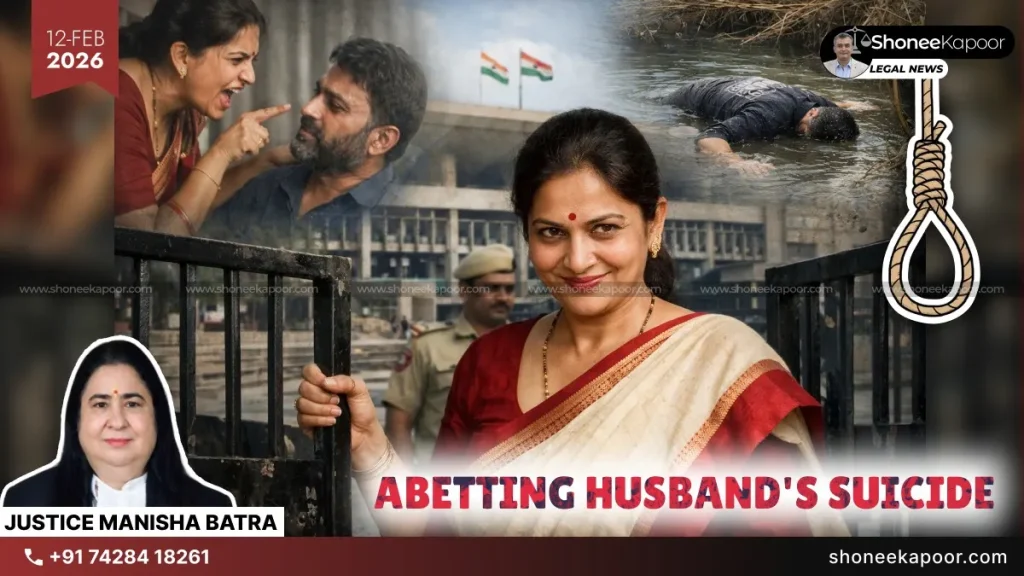
Punjab and Haryana High Court granted bail to a wife accused of abetment to suicide after her husband was found dead in a canal following a marital dispute. The Court held that abetment to suicide cannot be presumed from mere harassment allegations and requires clear evidence of intent and mens rea.
CHANDIGARH: In a case that has raised serious questions around matrimonial disputes and criminal prosecution, the Punjab & Haryana High Court at Chandigarh granted regular bail to Satnam Kaur in an alleged abetment of suicide matter.
The order was passed by Hon’ble Mrs. Justice Manisha Batra on 10 February 2026. The case concerns the death of a husband, Kartar Singh, whose body was recovered from a canal after he allegedly left home following a domestic dispute.
The matter relates to an FIR registered at Police Station Division ‘B’, Amritsar, under Section 108 of the Bharatiya Nyaya Sanhita (BNS), which deals with abetment of suicide. It was claimed that on 21 June 2025, the wife and her sister abused and assaulted Kartar Singh. After this incident, he left the house and did not return. A few days later, his body was found in a canal near village Dhund.
Following the registration of the FIR, the petitioner and her son were arrested. She remained in custody for about seven months. The prosecution alleged that harassment and assault by the wife forced the husband to take the extreme step of ending his life. The State also opposed bail on the ground that the allegations were serious and that the accused could influence witnesses if released.
The defence argued that the woman had been falsely implicated, that the co-accused persons had already received anticipatory bail, and that there was no material to show instigation or intentional abetment. It was also submitted that the trial would take considerable time to conclude.
While examining the case, Justice Manisha Batra clearly explained the legal position regarding abetment of suicide. The Court stated that:
“In order to bring a case within the provisions of Section 108 of BNS, undoubtedly, there must be a case of suicide and in the commission of the said offence, the person who is said to have abetted the commission of suicide must have played an active role by act of instigation and doing certain acts to facilitate the commission of suicide.”
Justice Batra also underlined the importance of intention and guilty mind. The order records that:
“It must be the state of mind of the accused to commit a particular crime that must also be visible so as to determine the culpability of his action.”
The Court clarified that:
“There must be some mens rea and some material on record to establish that he or she had a guilty mind and in furtherance of that state of mind, the suicide by the victim was abetted.”
While acknowledging the seriousness of a husband losing his life, the Court emphasised that pre-trial detention cannot be used as punishment. Reiterating a fundamental principle of criminal law, the judge stated that:
“Bail is the rule and jail is an exception and pre-trial incarceration of the petitioner should not be a replica of post conviction sentencing.”
Taking into account the period of custody, the likely delay in trial, and the absence of prima facie evidence showing direct instigation, the High Court granted regular bail to the petitioner, subject to furnishing bonds. The Court also made it clear that the prosecution is free to seek cancellation of bail if the accused is found involved in any subsequent case or misuses the liberty.
The case leaves behind difficult questions. A husband has lost his life following a matrimonial conflict, yet the Court found that the strict legal requirements for abetment were not met at this stage. The order highlights that in criminal law, emotional gravity alone cannot replace proof of intention, instigation, and direct involvement.
Explanatory Table: Laws And Sections Involved
| Law and Section | Purpose | How Applied in This Case |
| Section 108, Bharatiya Nyaya Sanhita (BNS) | Punishes abetment of suicide. | Alleged against wife; Court found no prima facie instigation. |
| Section 3(5), BNS | Fixes joint liability in group offences. | Added due to multiple accused persons. |
| Section 45, BNS | Defines abetment under new law. | Court examined whether its ingredients were met. |
| Section 306, IPC | Old provision for abetment of suicide. | Referred for legal interpretation. |
| Section 107, IPC | Defines abetment: instigation or aid. | Used to explain need for mens rea and instigation. |
| Section 483, BNSS | High Court power to grant bail. | Bail petition filed under this section. |
Case Details
- Case Title: Satnam Kaur vs State of Punjab
- Case Number: CRM-M-65803-2025 (O&M)
- Court: High Court of Punjab & Haryana at Chandigarh
- Date of Decision: 10.02.2026
- Bench: Hon’ble Mrs. Justice Manisha Batra
- Neutral Citation: 2026:PHHC:020236
- FIR Details: FIR No. 0126 dated 25.06.2025, Police Station Division ‘B’, Amritsar
- Counsels:
- For Petitioner: Mr. Gurmohan Preet Singh, Advocate
- For State: Mr. Roshandeep Singh, AAG, Punjab
- For Complainant: Mr. Shivam Joshi, Advocate
Key Takeaways
- A man lost his life after marital conflict, but his death alone was not treated as proof that he was driven to suicide by his wife under criminal law.
- Allegations of harassment or routine marital quarrels were held insufficient unless there is clear evidence showing the husband was intentionally pushed towards suicide.
- The law requires proof of mens rea and direct instigation, meaning a husband’s emotional suffering must still be legally linked to deliberate acts, not assumptions.
- Despite the husband being found dead in a canal, the burden remained on the prosecution to show a clear and proximate cause between the wife’s conduct and his death.
- Men’s deaths in matrimonial disputes often face a high legal threshold for accountability, raising concerns about justice for deceased husbands and their families.
This Could Change Your Case-Get FREE Legal Advice-Click Here!
Disclaimer: The views and opinions expressed in this article are those of the Indian courts and do not necessarily reflect the official policy or position of “ShoneeKapoor.com” or its affiliates. This article is intended for informational and educational purposes only. The content provided is not legal advice, and viewers should not act upon this information without seeking professional counsel. Viewer discretion is advised.