
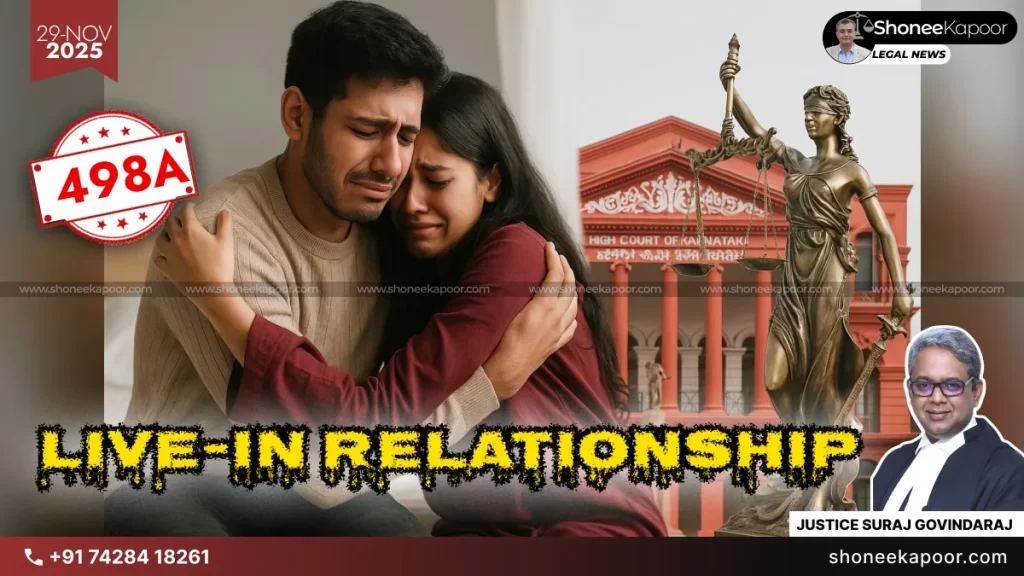
The Karnataka High Court has ruled that Section 498A IPC (cruelty) can apply even when the marriage is void, voidable, or when the couple is in a live-in relationship, as long as the woman was made to believe she was a wife. The Court rejected the accused man’s claim that cruelty cannot apply because the relationship was not a legally valid marriage.
BENGALURU: The Karnataka High Court has given a major ruling that will impact many relationship-cruelty cases across India. The Court has held that Section 498A of the IPC, which deals with cruelty by husband or relatives, can apply even when the marriage is not legally valid, or when the couple was simply living together like husband and wife.
Justice Suraj Govindaraj made this important ruling while hearing two connected criminal petitions where the man argued that the complainant woman was never his legally wedded wife. He said that since he was already married earlier, there could be no second valid marriage, and at most, his relationship with the complainant was a “live-in relationship,” where according to him, Section 498A could not apply.
But the High Court rejected this argument very strongly after examining the facts and the purpose of Section 498A.
What the Court Observed
The Court noted that the man had lived with the woman for years, represented her as his wife, and they lived together performing all duties expected in a normal marriage. The woman believed she was legally married.
Quoting the judge, the Court said:
“When a man induces a woman to believe that she is lawfully married to him and thereafter subjects her to cruelty, such a man cannot be permitted to evade criminal responsibility on the plea that no valid marriage existed in law”.
The Court further explained that the couple’s relationship clearly showed all characteristics of a marriage-like arrangement. Therefore, even if the marriage is void or illegal, Section 498A can still apply if cruelty is proved.
“The relationship thus falls squarely within what has been recognised in recent times as a relationship in the nature of marriage, or colloquially known as a Live-In relationship, attracting the protective umbrella of Section 498A, provided the factual allegations satisfy the elements of cruelty as defined in the explanation to the section. The argument that the relationship was merely a live-in arrangement is equally untenable in the present factual matrix. Even assuming that the relationship is not legally valid, the nature and substance of the relationship, rather than its formal legality, is determinative for the purpose of invoking Section 498A”
The Court made it clear that the woman cannot be left without legal protection simply because the man had hidden his earlier marriage.
“Where parties live together as husband and wife, and the woman is subjected to cruelty or harassment in that relationship, she cannot be left remediless merely because the man had concealed a subsisting marriage. The legislative intent behind Section 498A, being to suppress a social mischief, requires a liberal and purposive construction, more so when the man has married the woman, the woman is under the belief that she is legally married to the man, it was only the man who was aware that the marriage was void, which he seeks to take advantage of when prosecuted for a crime relating or in connection thereto”
Background Of The Case
According to the complainant, she married the petitioner on 17 October 2010 as per Hindu customs. They lived together in Bengaluru and later moved to Shivamogga for his job at Nanjappa Life Care Hospital.
When she returned from her parents’ home in August 2016 after treatment, she found the house empty. The petitioner and his family had removed all belongings. She filed a complaint for theft and cruelty.
Later, in another complaint, she alleged that on 5 September 2016, the petitioner poured kerosene on her and tried to set her on fire, causing burn injuries. Police added charges under Sections 498A, 307, and provisions of the Dowry Prohibition Act.
The man approached the High Court arguing that:
- He was already married to another woman.
- So the complainant is not his legally wedded wife.
- Therefore Section 498A cannot apply.
But the Court said the law cannot allow a man to escape criminal liability just because he deceived the woman.
“The Court cannot permit the accused to take advantage of his own wrong, particularly where he himself has acted in deceit and bad faith to induce Respondent No.2 into a relationship clothed with the appearance of marriage”
The Court added that accepting the man’s argument would create injustice because men who deceive women would be able to commit cruelty without facing Section 498A.
“If the Petitioner’s submission were to be accepted, it would produce a manifestly unjust and anomalous result – namely, that a man who deceives a woman into a void marriage by concealing his earlier marriage could then escape criminal liability under Section 498A merely because the relationship lacks legal validity. Such a position would not only defeat the purpose of the enactment but also encourage fraud and exploitation of women under the guise of invalid marital relationships. The courts cannot countenance such a perverse consequence”
The Court concluded that Section 498A must be understood broadly and purposively.
The term “husband” in Section 498A must be given a purposive and expansive construction, and the protection afforded by the provision cannot be denied merely on the technical ground of a void marriage.
Other Observations
The Court also clarified procedural issues:
- If the complainant is alive, her hospital statement does not need to meet dying declaration standards.
- Two criminal cases under Section 498A in different courts cannot run separately.
- Therefore, one case was transferred so both can be tried together.
Finally, the High Court dismissed the man’s petitions and allowed the trial to continue.
Final Decision
The Court held that Section 498A applies even to void marriages, bigamous marriages, and live-in relationships, as long as cruelty is established.
It dismissed the petitions and ordered both cases to be tried together.

Explanatory Table Of All Sections / Laws Mentioned
| Law / Section | Meaning in Simple English | Why It Was Used in This Case |
| Section 498A IPC | Cruelty by husband or his relatives—mental or physical abuse, dowry harassment | Main allegation: woman claimed mental & physical cruelty, dowry demands, and attempt to burn her. HC said 498A applies even to void marriages & live-in relationships. |
| Section 504 IPC | Intentional insult to provoke breach of peace | Added after further statements alleging verbal abuse. |
| Section 506 IPC | Criminal intimidation | Woman alleged threats to life by petitioner & family. |
| Section 307 IPC | Attempt to murder | Allegation that petitioner poured kerosene and set her on fire. |
| Section 494 IPC | Bigamy—marrying again while first marriage still valid | Petitioner allegedly concealed earlier marriage; woman believed she was legally married. |
| Section 149 IPC | Unlawful assembly—common intention of group | Police added this while charging other accused family members. |
| Section 380 IPC | Theft in dwelling house | Complaint that petitioner vacated house & took all belongings. |
| Section 143 IPC | Unlawful assembly | Added during theft complaint expansion. |
| Section 114 IPC | Abettor present during offence | Added when alleging family members supported the acts. |
| Section 3 & 4 Dowry Prohibition Act | Demanding dowry (Sec 3) & harassment for dowry (Sec 4) | Woman said petitioner demanded gold, cash, silver and more dowry. |
| Section 482 CrPC | Inherent powers of High Court to quash criminal cases | Petitioner used this to try quashing both FIRs. |
| Section 528 BNSS | Transfer of criminal cases under new criminal procedure law | Connected to procedural prayer in petitions. |
| Section 32(1) Evidence Act / Section 26 BSA | Provision about dying declarations | Petitioner argued hospital statement invalid; HC said dying declaration rules do not apply because complainant is alive. |
Case Summary
- Case Title
- XYZ vs State of Karnataka & ANR
- IN THE HIGH COURT OF KARNATAKA AT BENGALURU
- CRL.P No. 8134 of 2024 C/W CRL.P No. 9412 of 2021
- Bench: HON’BLE MR. JUSTICE SURAJ GOVINDARAJ (Order dated 18th November 2025)
Counsels
- For Petitioner(s):
- Sri. Harsha Kumar Gowda H.R., Advocate (in Crl.P 8134/2024)
- Advocate for petitioner in Crl.P 9412/2021 (name not fully visible in extract, but arguments by: Sri. A.N. Radhakrishna)
- For Respondent No.1 (State):
- Sri. M.R. Patil, High Court Government Pleader
- For Respondent No.2 (Complainant):
- Sri. Santhosh Kumar M.B., Advocate (in Crl.P 8134/2024)
- Sri. Udaya Prakash Muliya, Advocate (in Crl.P 9412/2021)
Parties
Petitioners: Accused persons (names masked as per document snippet) Represented through respective advocates.
Respondents:
- State of Karnataka, Vijayanagar Police Station, Bengaluru
- De facto complainant (woman alleging cruelty & attempt to murder)
Case Details
| Detail | Information |
| Case Numbers | CRL.P No. 8134/2024 & CRL.P 9412/2021 |
| Court | High Court of Karnataka at Bengaluru |
| Judge | Justice Suraj Govindaraj |
| Order Reserved On | 27.10.2025 |
| Order Pronounced On | 18.11.2025 |
| Relief Sought | Quashing of criminal proceedings under Sections 498A, 307, 494, 504, 506 IPC + DP Act charges + Theft + Unlawful Assembly etc. |
| Outcome | Petitions dismissed; both 498A cases transferred to one court for joint trial. |
Key Takeaways
- Karnataka High Court has stretched Section 498A so wide that even a live-in or a void, illegal marriage can now trigger cruelty charges against a man.
- A man’s claim that the woman was not his legally wedded wife is no longer a defence; the court says “appearance of marriage” is enough.
- This judgment effectively blurs the line between a wife and a live-in partner, exposing men to criminal liability without any legal marital status.
- Even if the relationship is void because the man was already married, he can still face 498A—opening the door to misuse in informal relationships.
- With two parallel criminal cases allowed to continue jointly, the man now fights multiple proceedings based largely on allegations, not proven facts.
This Could Change Your Case-Get FREE Legal Advice-Click Here!

Disclaimer: The views and opinions expressed in this article are those of the Indian courts and do not necessarily reflect the official policy or position of “ShoneeKapoor.com” or its affiliates. This article is intended for informational and educational purposes only. The content provided is not legal advice, and viewers should not act upon this information without seeking professional counsel. Viewer discretion is advised.