
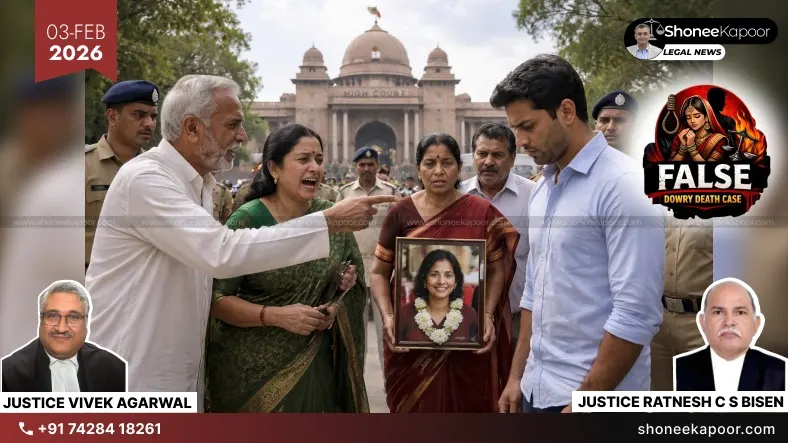
The Madhya Pradesh High Court ruled that a husband and his family cannot be presumed guilty under dowry death laws without clear proof of dowry-linked cruelty. Criminal law cannot operate on timelines alone—evidence remains the foundation.
Wife Death 7 Yrs Marriage Not Dowry Death: The Madhya Pradesh High Court at Jabalpur, in a judgment delivered by Justice Vivek Agarwal and Justice Ratnesh Chandra Singh Bisen, dismissed an appeal filed by the father of the deceased woman and upheld the acquittal of the husband and his family members in a case under Sections 498A and 304B of the IPC.
The Court made it clear that sympathy and suspicion cannot replace legal proof in serious criminal cases.
The case related to the death of a young woman who suffered severe burn injuries within seven years of her marriage. The prosecution claimed that she was harassed for dowry and that this harassment forced her to take the extreme step.
Based on this allegation, the husband and his relatives were charged with dowry cruelty and dowry death.
While examining the record, the High Court noticed that the FIR was lodged more than one month after the incident. This unexplained delay raised serious doubts about the truthfulness of the allegations that surfaced later.
The Court also noted that the marriage was solemnised in a community gathering and that no dowry or gifts were exchanged at the time of marriage. This fact was admitted by several prosecution witnesses, including close family members of the deceased.
Importantly, none of the witnesses could clearly explain what dowry was demanded, when it was demanded, or which accused made such a demand. During cross-examination, most witnesses admitted that they never personally heard any demand for dowry from the accused persons and were only repeating what the deceased had allegedly told them.
The Court found that there were no prior complaints to the police, no written records of any village panchayat, and no independent witnesses from the neighbourhood supporting the claim of dowry harassment. Even the investigating officer admitted that no neutral villagers were examined on the issue of dowry demand.
Medical evidence showed that the woman died due to extensive burn injuries. However, there were no other injury marks on her body suggesting physical assault. The prosecution also failed to clearly establish whether the death was homicidal, accidental, or suicidal.
The High Court accepted the evidence showing that the deceased wanted to live separately from her in-laws, while the husband was unwilling to leave his aged parents. The Court observed that disagreement over living arrangements, by itself, cannot be treated as proof of dowry cruelty or dowry death.
The judges clearly held that unless the strict conditions of Section 113B of the Evidence Act are satisfied, courts cannot presume a dowry death. In this case, the prosecution failed to prove dowry demand or cruelty “soon before death,” which is mandatory under law.
While refusing to interfere with the acquittal, the Court relied on settled Supreme Court law and quoted as follows:
The Court in Ganesha v. Sharanappa & Anr. reported in (2014) 1 SCC 87, in para 11, clarified that :-
“The Interference with the order of acquittal is called for only in exceptional cases – where there is manifest error of law of procedure resulting into miscarriage of justice, and, where the acquittal has been caused by shutting out evidence which otherwise ought to have been considered or where material evidence which clinches the issue has been overlooked. In such exceptional cases, the High Court can set aside an order of acquittal, but it cannot covert it into one of conviction. The only course left to the High Court in such exception cases, is to order retrial.”
Applying this principle, the Madhya Pradesh High Court held that the trial court had properly appreciated the evidence and that the acquittal suffered from no legal error.
The appeal was therefore dismissed, reaffirming that dowry laws cannot be used to convict husbands and families unless the prosecution proves its case with clear, reliable, and legally admissible evidence.
Explanatory Table: Laws & Sections Involved
| Law / Section | Purpose | How Applied in This Case |
| Section 498A IPC | Punishes cruelty by husband or his relatives | Court held cruelty was not proved as allegations were vague, hearsay, and unsupported by evidence |
| Section 304B IPC (Dowry Death) | Applies when a woman dies unnaturally within 7 years of marriage due to dowry cruelty | Court ruled mandatory ingredients were missing; dowry demand and cruelty were not proved |
| Section 34 IPC | Fixes joint liability when act is done with common intention | Not applicable as no offence itself was proved |
| Section 372 CrPC | Gives victim/complainant right to appeal against acquittal | Appeal was examined but dismissed |
| Section 113B Evidence Act | Presumption of dowry death if cruelty for dowry is proved “soon before death” | Court held presumption cannot arise as foundational facts were not established |
Case Details
- Case Title: Mansoor Khan vs State of Madhya Pradesh & Others
- Court: High Court of Madhya Pradesh, Jabalpur
- Case Number: Criminal Appeal No. 3221 of 2023
- Bench: Justice Vivek Agarwal & Justice Ratnesh Chandra Singh Bisen
- Date of Judgment: 29 January 2026
- Neutral Citation: 2026:MPHC-JBP:8178
- Counsels:
- For Appellant (Complainant): None appeared
- Amicus Curiae: Shri Dharmendra Kaurav, Advocate
- For State: Shri Manas Mani Verma, Government Advocate
Key Takeaways
- False allegations alone are not enough to jail a man; courts require clear, direct, and legally admissible proof of dowry demand and cruelty.
- Delayed FIRs, hearsay statements, and family narratives without independent evidence weaken cases and expose misuse of criminal law against husbands and their families.
- Living separately from parents is a marital issue, not dowry cruelty, and cannot be criminalised to trigger serious offences like dowry death.
- The presumption of dowry death under Section 113B is not automatic and applies only when cruelty for dowry is proved “soon before death.”
- Acquittals cannot be reversed just to satisfy emotions; criminal law exists to punish the guilty, not to become a weapon against men and elderly relatives.
This Could Change Your Case-Get FREE Legal Advice-Click Here!
Disclaimer: The views and opinions expressed in this article are those of the Indian courts and do not necessarily reflect the official policy or position of “ShoneeKapoor.com” or its affiliates. This article is intended for informational and educational purposes only. The content provided is not legal advice, and viewers should not act upon this information without seeking professional counsel. Viewer discretion is advised.