
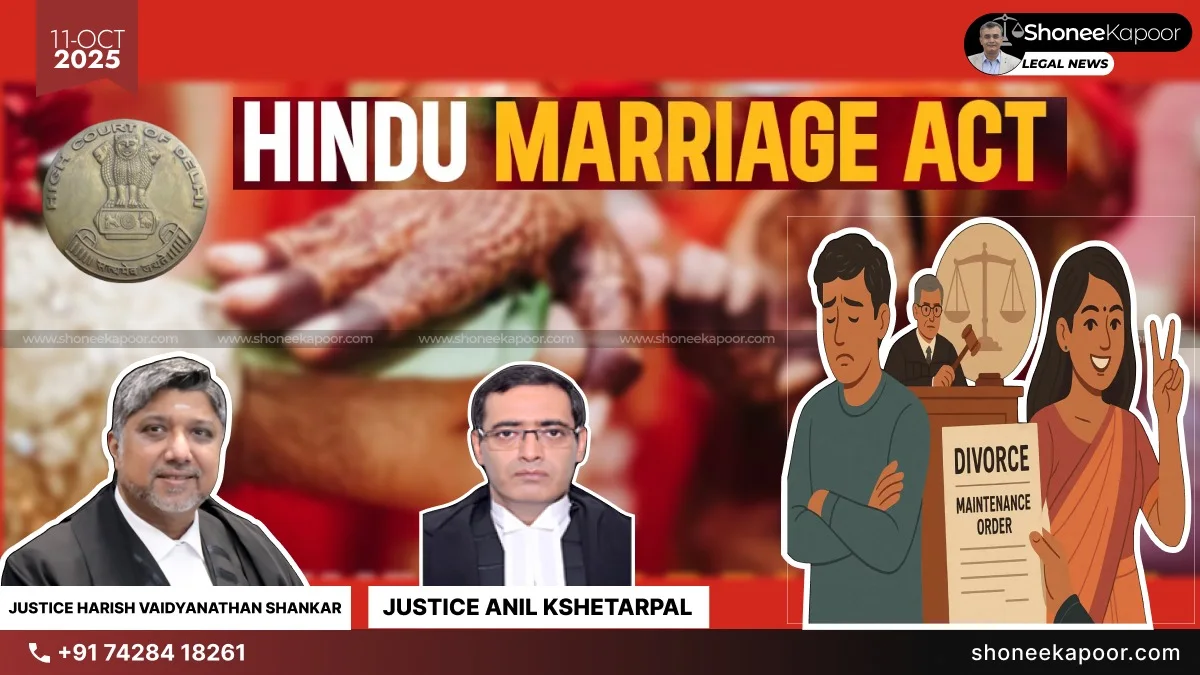
The Delhi High Court has ruled that the Hindu Marriage Act must be interpreted strictly to preserve the dignity and permanence of marriage. It rejected a couple’s plea to declare their Arya Samaj wedding “null and void” for skipping rituals like Saptapadi.
NEW DELHI: The Delhi High Court, through a Division Bench of Justice Anil Kshetarpal and Justice Harish Vaidyanathan Shankar, delivered a strong reminder that the Hindu Marriage Act, 1955 (HMA) must be read and applied strictly.
The Court said that liberal or creative interpretations of the Act’s divorce and annulment provisions could “trivialise the sanctity of marriage” and erode the intent of the law, which seeks to protect the stability, dignity, and permanence of the marital institution
The Bench observed —
“We are firmly of the view that the provisions of the HMA, particularly those concerning declarations of nullity, voidable marriages, divorce, and judicial separation, must be strictly construed and applied.”
The Case: Visa Marriage Turned Legal Battle
The case arose from an appeal filed jointly by a man and a woman who had married in an Arya Samaj temple in Delhi on 30 January 2024 and later registered the marriage on 2 February 2024.
They admitted that the marriage was performed hurriedly to help the wife obtain a UK visa and that no Saptapadi or other essential Hindu rituals were performed. Later, when disputes arose, they approached the Family Court seeking a declaration that their marriage was “null and void ab initio.”
However, the Family Court dismissed their plea, calling it an attempt to bypass settled law, and the couple appealed to the High Court.
The High Court found the appeal “a product of sheer ingenuity and a misguided attempt to turn settled law on its head.” It said that allowing such pleas would encourage misuse and even harm India’s credibility in international marriage registration systems.
The judges cautioned:
“Not only would, in our opinion, permitting the present appeal or upholding even the maintainability of the underlying petition be an affront to our statutory scheme, but it could well become the chosen route of such of the ingenious, who seek documentation in support of their nefarious intent, and thereafter, the interference of the Judicial system to validate this malafide.”
Marriage Under HMA Must Be “Solemnised”
The Court stressed that under the Hindu Marriage Act, the concept of marriage is not merely a civil contract but a sacred sacrament that binds not just two individuals but their families and communities. Therefore, all reliefs under the Act—such as nullity, voidability, divorce, and judicial separation—apply only when a validly solemnised marriage exists.
The Bench categorically noted:
“All provisions in the HMA that deal with declarations, whether relating to a marriage being void, voidable, or grounds for divorce, are applicable only to those marriages that have been solemnised.”
It clarified that Section 11 of the HMA applies only when a marriage is duly solemnised but violates specific prohibitions under Section 5, such as bigamy, prohibited relationship, or sapinda relationship.
“A conjoint reading of Sections 5 and 11 of the HMA makes it abundantly clear that the remedy of nullity under Section 11 is strictly confined to situations where a marriage, though duly solemnised in accordance with law, contravenes the specific prohibitions contained in the above clauses of Section 5. Section 11 thus presupposes a solemnised marriage.”
Hence, a claim that no valid marriage took place due to missing rituals like Saptapadi cannot be entertained under the Act.
Doctrine of Estoppel: You Can’t Deny What You Declared
The Court also upheld the Family Court’s finding that the couple’s plea was barred by the principle of estoppel. Both parties had earlier submitted sworn affidavits affirming that they had married “according to Hindu rites and ceremonies,” and had obtained their marriage certificate based on that declaration.
“Consequently, any prayer now seeking a declaration that such a marriage, as well as the marriage certificates obtained on the basis of the documents voluntarily executed, is squarely barred by the doctrine of estoppel.”
Misuse of Supreme Court’s Dolly Rani Judgment
The couple had relied on the Supreme Court’s decision in Dolly Rani vs. Manish Kumar Chanchal (2025), where the marriage was declared invalid under Article 142 of the Constitution. But the Delhi High Court clarified that the Supreme Court’s extraordinary powers under Article 142 cannot be cited as a general precedent for similar reliefs.
“The Judgment in Dolly Rani (supra) is being sought to be misused and converted into a regular means of separation of parties by bypassing the statutory mandate, and it is the bounden duty of Courts to disabuse such notions.”
It explained that the Supreme Court’s powers under Article 142 are meant only to do complete justice in unique situations, not to create new remedies for lower courts.
Presumption of Valid Marriage
The High Court observed that a validly issued marriage certificate by a recognised authority like Arya Samaj or a District Magistrate carries a presumption of validity, and anyone disputing it must bring strong proof. The couple had not produced any credible evidence—such as witnesses or the officiating priest—to prove that rituals were skipped.
“Mere assertions by the parties are insufficient in matters of this nature. A Hindu marriage is considered a sacrament and not merely an informal understanding between two individuals.”
Final Verdict
In conclusion, the Delhi High Court held that:
“Provisions of the HMA… must be strictly construed and applied. The petition and now appeal before us, which seeks to carve out a remedy wholly outside the statutory framework, though ingenious, is not only legally untenable but also depreciable.”
“Courts cannot lend approval to such devices that undermine the sanctity of the statutory scheme and established judicial principles.”
Accordingly, the appeal was dismissed in entirety, with the Court noting that it found no error in the Family Court’s decision and that no costs were awarded
Explanatory Legal Table
| Law / Act | Section | Subject / Provision | Court’s Interpretation / Key Finding |
|---|---|---|---|
| Hindu Marriage Act, 1955 (HMA) | Section 5 | Conditions for a valid Hindu marriage | Marriage can only be between two Hindus if the essential conditions (no existing spouse, not within prohibited relationship, not sapindas) are met. These are preconditions to a lawful marriage. |
| Hindu Marriage Act, 1955 (HMA) | Section 7 | Ceremonies for a Hindu marriage (including Saptapadi) | Marriage must be solemnised with customary rites and ceremonies. Saptapadi (7 steps before sacred fire) completes the marriage if it’s part of custom. Lack of rituals doesn’t automatically invalidate marriage unless properly challenged. |
| Hindu Marriage Act, 1955 (HMA) | Section 8 | Registration of marriages | Registration is only proof of an already solemnised valid marriage; it cannot make an invalid ceremony valid. |
| Hindu Marriage Act, 1955 (HMA) | Section 11 | Void marriages (Nullity) | Section 11 applies only to marriages that are solemnised but violate Section 5 conditions (bigamy, prohibited degrees, sapinda). The Court said it cannot be used if the marriage itself was never solemnised. |
| Hindu Marriage Act, 1955 (HMA) | Section 12 | Voidable marriages | Relief only for existing marriages that are solemnised but voidable for specific reasons (fraud, impotence, etc.). Not applicable when parties claim no valid marriage occurred. |
| Hindu Marriage Act, 1955 (HMA) | Section 13 & 13A | Divorce and Judicial Separation | These apply only to solemnised marriages. Liberal interpretation of these provisions would “trivialise the sanctity of marriage.” |
| Hindu Marriage Act, 1955 (HMA) | Section 13B | Divorce by mutual consent | Also applies only to solemnised marriages; cannot be used to annul a “sham” marriage entered merely for convenience. |
| Hindu Marriage Act, 1955 (HMA) | Section 23(1)(c) | Bars relief to parties taking advantage of their own wrong | Mentioned by Amicus Curiae; joint petitions must satisfy this clause. However, Court held no petition maintainable if the marriage wasn’t solemnised. |
| Bharatiya Sakshya Adhiniyam, 2023 (BSA) | Section 121 (Earlier Section 115 of Indian Evidence Act, 1872) | Doctrine of Estoppel | Once parties declare and act as if married, they cannot later deny it. The couple’s affidavits and registration created a presumption of valid marriage; estoppel prevented them from reversing their claim. |
| Constitution of India | Article 142 | Supreme Court’s extraordinary powers | Used in Dolly Rani v. Manish Kumar Chanchal (2025); Supreme Court can declare marriages void to do “complete justice.” However, High Courts and Family Courts cannot exercise this power. |
| Constitution of India | Article 141 | Binding nature of Supreme Court’s law | The Court clarified that Article 142 orders (like in Dolly Rani) do not form binding precedent under Article 141. |
| Family Courts Act, 1984 | Section 19 | Appeal to High Court | The present appeal was filed under this provision, challenging the Family Court’s judgment. |
| Indian Evidence Act (Old Law) | Section 115 | Estoppel (now replaced by BSA Section 121) | Parties cannot deny what they have earlier represented and relied upon to obtain legal benefit (like marriage registration). |
Case Summary
- Case Title: VN vs DG
- Case Number: MAT.APP.(F.C.) 222/2025
- Court: High Court of Delhi at New Delhi
- Bench: Hon’ble Mr. Justice Anil Kshetarpal and Hon’ble Mr. Justice Harish Vaidyanathan Shankar
- Date of Judgment Reserved: 15 September 2025
- Date of Judgment Pronounced: 9 October 2025
- Type of Case: Matrimonial Appeal under Section 19 of Family Courts Act read with Section 28 of HMA
- Appellant (Husband): VN
- Respondent (Wife): DG
- Appellant’s Counsel: Mr. Peeyoosh Kalra, Advocate & Mr. Ashok Kumar Nagrath, Advocate
- Respondent’s Counsel: Ms. Meghna Nair, Advocate & Mr. Yashwant Singh Baghel, Advocate
- Amicus Curiae: Mr. Prosenjeet Banerjee, Advocate assisted by Ms. Anshika Sharma, Advocate
- Lower Court: Family Court, Saket, District-South, New Delhi
- Impugned Order Date: 04 October 2024
- Relief Sought: Declaration that marriage dated 30.01.2024 was “null and void” since Saptapadi and other Hindu rites were not performed
- Grounds of Appeal: Marriage was performed hurriedly for visa purposes, without essential rituals; parties never cohabited; want to declare marriage void ab initio
- Court’s Finding: Petition not maintainable; marriage deemed validly registered; parties estopped from denying solemnisation; liberal interpretation would harm sanctity of marriage
- Final Order: Appeal dismissed in entirety; no costs imposed
- Judgment Style: Detailed and cautionary—reaffirms sanctity and stability of Hindu marriage and warns against misuse of annulment provisions.
Disclaimer: The views and opinions expressed in this article are those of the Indian courts and do not necessarily reflect the official policy or position of “ShoneeKapoor.com” or its affiliates. This article is intended for informational and educational purposes only. The content provided is not legal advice, and viewers should not act upon this information without seeking professional counsel. Viewer discretion is advised
