
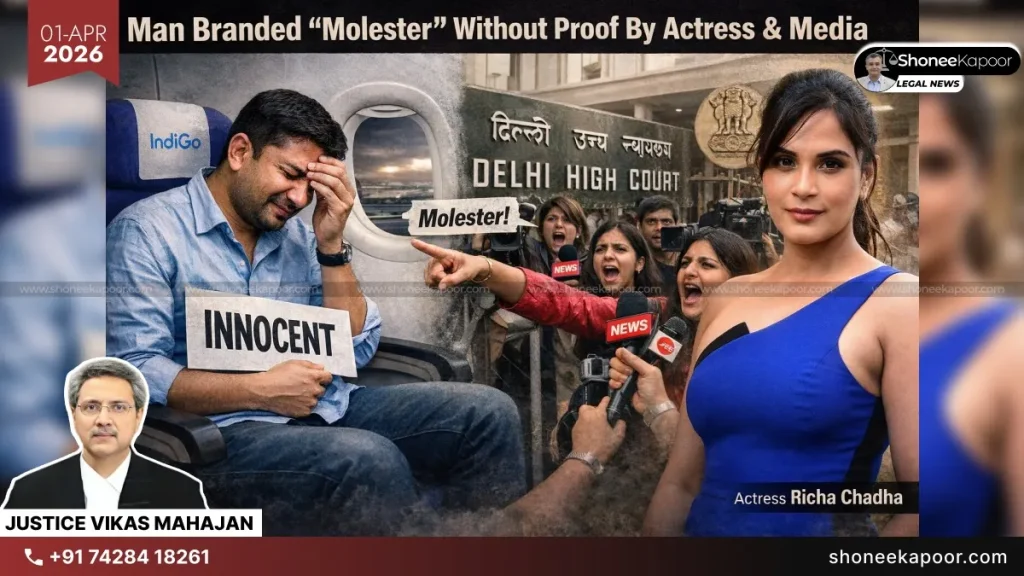
Can someone be declared guilty just through tweets and media posts before investigation? Delhi High Court raises serious concerns after a man was publicly labelled without trial.
NEW DELHI: The Delhi High Court has strongly criticised media platforms, a journalist, and actress Richa Chadha for social media posts that labelled a man as a “molester” in connection with an Indigo flight incident.
Justice Vikas Mahajan observed that several media reports and online posts went beyond the actual FIR and created a narrative that effectively judged the man before any proper investigation or trial. The Court noted that instead of reporting facts, these platforms crossed the line and acted as if guilt had already been decided.
The Court specifically criticised a post by “Pardafaash Media”, calling it the “most outrageous and unwarranted usage of social media” for sensationalising the matter without verifying facts.
“The post in question labels the plaintiff as a ‘molester’ prominently using that expression right above his photograph which also includes his and his employer’s name, prima facie, constituting online defamation that could cause public ridicule and loss of reputation to the plaintiff,” the Court said.
The matter arose from a defamation suit filed by the man against multiple parties including a journalist, X Corp, OBNews, Google LLC, Meta Platforms, NDTV Hindi, ABP Live, Richa Chadha and Indigo Airlines.
The issue started from an incident on March 11 during a Delhi–Mumbai Indigo flight, where a female journalist accused the man of inappropriate behaviour during the journey. However, as per the man’s claim, he denied all allegations and stated that he was seated and asleep before landing.
The situation escalated when the journalist posted the allegations on social media, revealing the man’s identity, photograph, and professional details even before any FIR was registered. This post was then widely shared and amplified by media houses and public figures.
Actor Richa Chadha also reposted the content with the remark “Make him famous,” which further increased the spread and impact of the allegations.
The High Court, while granting interim relief to the man, clearly stated that such posts had “prematurely labelled” him guilty and violated his right to reputation and fair trial.
“In the context of the present case, when the FIR already stands registered against the plaintiff and the investigation is underway, the defendants may be within their right to share or disseminate the contents of FIR or material which is informative but in public interest,
but at the same time the defendants have to exercise restraint and refrain from publishing and circulating any material referring to the character of the plaintiff which creates an atmosphere of prejudice for him or mar his reputation and thereby causes prejudice to an ongoing investigation,” the Court said.
The Court also highlighted the timing of events, noting that the allegations were posted online even before legal action formally began.
“The overhasty public disclosure, prima facie, suggests an attempt to sensationalize the issue and subject the plaintiff to a trial by public opinion, rather than a bona fide pursuit of legal redress.
While defendant no. 1 has an unhindered right to report a grievance, but using social media to circulate allegations of inappropriate touching and revealing the identity of the plaintiff along with his photograph before a formal investigation even commences, in a prima facie view of this Court, is a severe transgression of the plaintiff’s fundamental right to live with dignity and have fair trial,” the Court said.
Regarding Richa Chadha, the Court pointed out that public figures have greater responsibility due to their wide influence and reach.
“The endorsement and amplification of an unverified allegation, accompanied by the instigatory text „Make him famous‟, transcends mere free expression and acts as a catalyst for public shaming and digital vigilantism. A public figure, such as defendant no. 7, bears a legal and moral responsibility to verify the veracity of facts before leveraging her platform to amplify grave accusations.
The Court is prima facie of the view that endorsement of unverified allegations has inflicted immediate, exponential, and incalculable harm on the plaintiff’s reputation. However, this Court is cognizant of the submission made by Mr. Khuranna with regard to the taking down of the tweet posted by defendant no. 7 and expects defendant no. 7 not to precipitate the issue in future,” the Court said.
The Court finally directed the journalist, OBNews, and Pardafaash Media not to publish any similar defamatory content against the man until the next hearing. It also ordered social media platforms to remove such posts, including Chadha’s repost if it was still available.
This case once again highlights how quickly allegations can turn into public judgment in the digital space, often before facts are verified or tested in court, raising serious concerns about fairness, due process, and reputational damage.
Legal Provisions & Principles Involved (Explanatory Table)
| Law / Principle | Explanation | Relevance in Case |
| Defamation (Civil Law) | Protection against false statements harming reputation | Plaintiff alleged reputational damage due to being labelled “molester” publicly |
| Right to Reputation (Article 21 – Constitution of India) | Reputation is part of right to life and dignity | Court held that premature labelling violated dignity and reputation |
| Right to Fair Trial | Ensures no prejudice before judicial determination | Social media posts created bias before investigation |
| Freedom of Speech (Article 19(1)(a)) | Right to express opinions | Court clarified this right is not absolute and must be exercised responsibly |
| Reasonable Restrictions (Article 19(2)) | Limits on free speech including defamation | Media and individuals cannot publish unverified allegations causing harm |
| Law of FIR (CrPC) | FIR is the starting point of criminal investigation | Court noted posts were made even before FIR registration |
| Media Ethics & Responsible Reporting | Duty to verify facts before publishing | Court criticised sensationalism and lack of verification |
| Digital Vigilantism (Judicial Observation) | Public shaming through social media without due process | Court strongly condemned this trend |
Case Details
| Particular | Details |
| Case Title | MR. NIDISH GOPALKRISHNAN NAIR v. X & ORS |
| Court | Delhi High Court |
| Bench | Justice Vikas Mahajan |
| Case Type | Civil Suit (Defamation) |
| Nature of Order | Interim Order |
| Date of Incident | 11 March (Indigo Flight Incident) |
| FIR Timing | Registered at 12:27 PM |
| Social Media Post Timing | Around 09:39 AM (Before FIR) |
| Parties Involved | Plaintiff vs Journalist, X Corp, OBNews, Google LLC, Meta Platforms, NDTV Hindi, ABP Live, Richa Chadha, Indigo Airlines |
Key Takeaways
- A man was publicly branded a “molester” before any investigation — pure violation of due process.
- Social media and media houses acted as judge, jury, and executioner without verifying facts.
- Identity disclosure before FIR shows how easily a man’s reputation can be destroyed overnight.
- Courts clearly held that free speech does not include the right to defame or run media trials.
- Once reputation is damaged, no court order can fully restore what was lost — this is the real injustice men face.
This Could Change Your Case-Get FREE Legal Advice-Click Here!
Disclaimer: The views and opinions expressed in this article are those of the Indian courts and do not necessarily reflect the official policy or position of “ShoneeKapoor.com” or its affiliates. This article is intended for informational and educational purposes only. The content provided is not legal advice, and viewers should not act upon this information without seeking professional counsel. Viewer discretion is advised.