
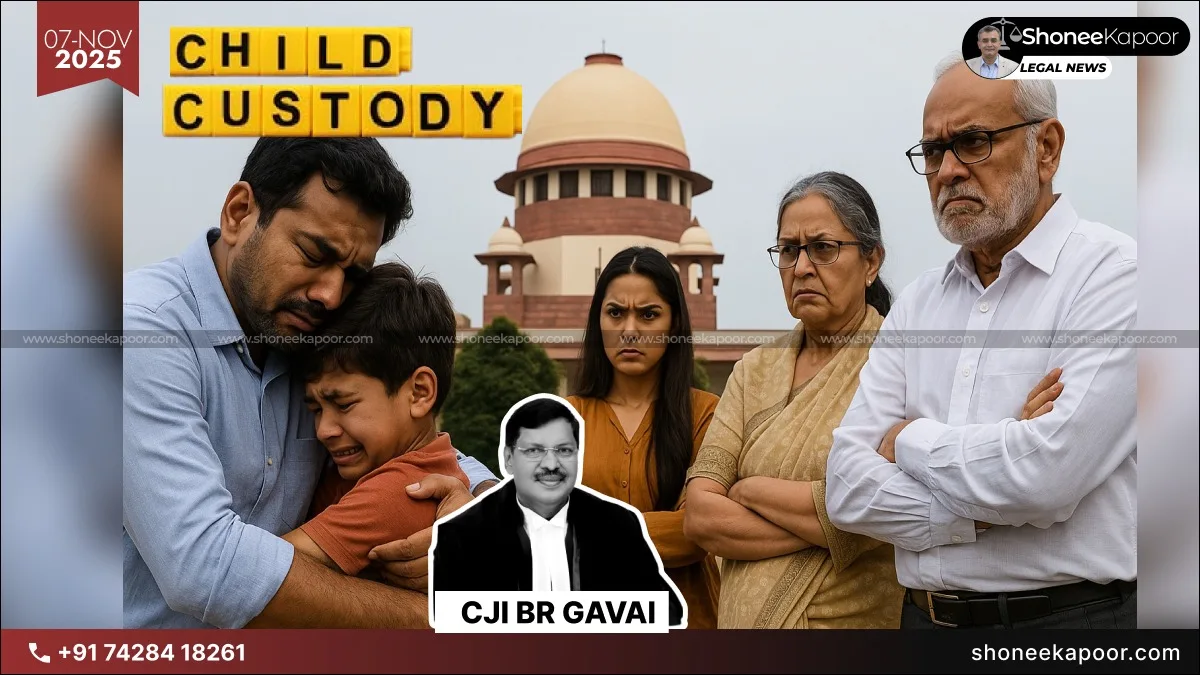
Supreme Court held that when the mother is no more, the father — being the natural guardian — has a stronger legal right over custody than grandparents. The Court ordered custody to the father while allowing visitation rights to the maternal grandparents.
NEW DELHI: The Supreme Court of India made it clear that when a child’s mother has passed away, the father — who is the natural guardian under law — has a stronger claim for the custody of the child than the maternal grandparents.
The judgment came in the case of a father who had moved a Habeas Corpus petition seeking custody of his minor son, who was living with the child’s maternal grandparents after the death of the mother.
A bench of CJI BR Gavai and Justice K Vinod Chandran heard a father’s appeal against the High Court’s rejection of his habeas corpus petition.
Initially, the High Court had refused to grant custody to the father. The High Court had interacted with the child and noted that the child seemed “comfortable” living with his maternal grandparents and was also continuing his schooling there.
The High Court had also mentioned the fact that the father had remarried, and therefore decided that the child should continue living with the maternal grandparents, while the father could only meet the child once a month.
The father then filed an appeal before the Supreme Court.
The Supreme Court, while examining the matter, observed that the High Court did not adequately understand or consider the emotional bond between the child and the father, especially since the child had lived with both parents for nearly ten years before the mother passed away.
The Court made an important legal observation and stated:
“We cannot but observe that the learned Single Judge has not endeavored to elicit the child’s attitude towards his father. Admittedly, the child, after his birth, was with his parents for about 10 years till the death of his mother. He was separated from the father in 2021 and has been living with his grandparents, who cannot have a better claim than the father, who is the natural guardian.
Read Also: How False Rape Cases Are Destroying Young Men’s Lives: The Hidden Crisis Nobody Talks AboutThere is no allegation of any matrimonial dispute when the mother of the child was alive nor a complaint of abuse perpetrated against the wife or son. The father, the natural guardian, we reiterate, is well employed and educated and there is nothing standing against his legal rights; as a natural guardian, and legitimate desire to have the custody of his child.
We are of the opinion that the welfare of the child, in the facts and circumstances of this case, would be best served if custody is given to the father.”
The Supreme Court highlighted that the father had a stable job, was well-educated, and there were no allegations of cruelty, violence, or neglect against him. Moreover, the child’s paternal grandfather had secured the child’s future by transferring property in the child’s name and also depositing money for the child’s welfare.
The Court emphasized that while the grandparents may be caring, emotionally attached, and well-intentioned, the law clearly recognizes the father as the natural guardian unless there is strong evidence showing that the father is unfit, irresponsible, or harmful to the child’s well-being — none of which existed in this case.

However, the Court also recognized that the child had been living with the maternal grandparents for more than three years and was currently in the middle of an academic year. Therefore, the Court decided on a transition arrangement to avoid emotional shock or disruption to the child’s education.
The Supreme Court directed that:
- The child will continue staying with the maternal grandparents until 30 April 2025 to complete the current school year.
- During this period, the father is allowed to take the child to his home on alternate weekends (from Friday evening/Saturday morning to Sunday evening).
- From 1 May 2025, the custody of the child shall be formally handed over to the father.
- After custody shifts, the maternal grandparents will have visitation rights, and the child may visit them on weekends with a second Saturday, for one year, after which the child’s preference will be considered.
The Supreme Court also ordered that the pending Guardianship case in the Family Court will be closed, as custody has now been settled through this decision.
With this decision, the Supreme Court reaffirmed an important legal principle — emotional comfort alone is not enough to override the legal right of the natural guardian when he is capable, responsible, and willing to care for the child.
Explanatory Table of Laws, Principles & Precedents Referred
| Law / Case / Principle | Explanation (Simple English) | Relevance in This Case |
| Natural Guardian Principle (Hindu Minority & Guardianship Law) | Under Indian law, the father is the primary natural guardian of a minor child (when the mother is not alive). | Supreme Court reaffirmed that grandparents cannot override the father’s legal status unless he is unfit. |
| Article 226 – Habeas Corpus (Constitution) | Allows a person to seek court intervention when someone is illegally detained or held. | Father used Habeas Corpus to seek custody claiming child was illegally withheld by grandparents. |
| Guardians and Wards Act, 1890 | Governs custody rights, guardianship & child welfare decisions. | Grandparents argued the father should seek custody only under this Act; Court said Habeas Corpus is still valid depending on facts. |
| Tejaswini Gaud v. Shekhar Tewari (2019) 7 SCC 42 | Held that Habeas Corpus is maintainable in child custody cases when custody is claimed against a person with no legal rights. | SC relied on this to permit father’s custody claim under Article 226. |
| Gautam Kumar Das vs. NCT of Delhi (2024) 10 SCC 588 | SC held that a father cannot be denied his child’s custody after mother’s death. | Used as precedent to support father’s right in this case. |
| Nirmala vs. Kulwant Singh (2024 INSC 370) | Emphasized need for detailed enquiry under Guardians & Wards Act in some cases. | Respondents cited this — but SC said facts are different here, so custody still goes to father. |
Case Summary
| Detail | Information |
| Case Title | Vivek Kumar Chaturvedi & Anr. Vs. State of Uttar Pradesh & Ors. |
| Court | Supreme Court of India |
| Case Type | Criminal Appeal (arising out of SLP (Crl.) No.14809/2024) |
| Judgment Date | 7 February 2025 |
| Bench | Justice B.R. Gavai and Justice K. Vinod Chandran |
| Judgment Authored By | Justice K. Vinod Chandran |
| Appellant | Father of minor child – Vivek Kumar Chaturvedi |
| Respondents | State of U.P. & Maternal Grandparents |
| Counsel for Appellant | Mr. Gopal Jha, Advocate |
| Counsel for Respondents | Mr. Rajeev Kumar Dubey, Advocate |
| Originating Court Order Challenged | High Court order refusing custody in a Habeas Corpus petition |
| Final Result | Custody given to Father (after academic year ends); Visitation rights granted to maternal grandparents |
Why the Supreme Court Ruled for the Father
- The child lived with both parents for 10 years before mother passed away.
- There was no allegation of abuse, cruelty or danger from the father.
- The father has stable employment and family support.
- Grandparents themselves sought maintenance, meaning they were not financially capable of raising the child long-term.
- Emotional comfort cannot override legal guardianship, unless strong negative evidence exists against the father.
Disclaimer: The views and opinions expressed in this article are those of the Indian courts and do not necessarily reflect the official policy or position of “ShoneeKapoor.com” or its affiliates. This article is intended for informational and educational purposes only. The content provided is not legal advice, and viewers should not act upon this information without seeking professional counsel. Viewer discretion is advised.
