
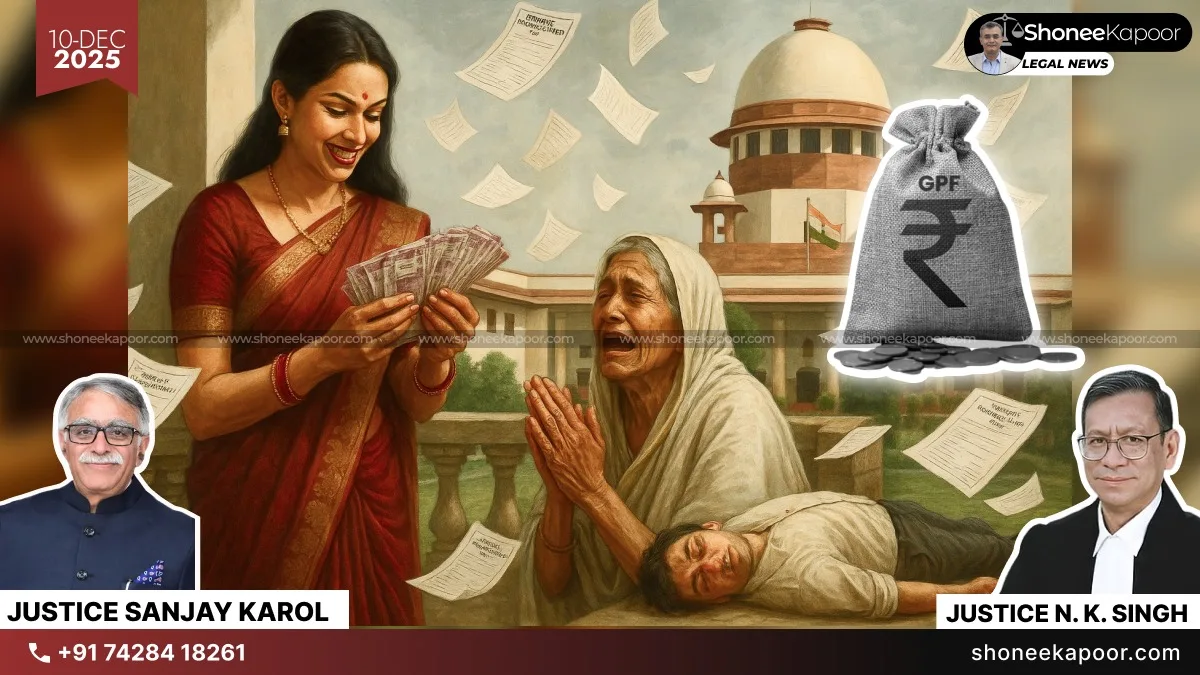
GPF Nomination for Mother Becomes Invalid After Marriage: Supreme Court Rules Wife – A Govt Servant’s Widow, Has Stronger Claim

Written and analysed by Vaibhav Ojha
Head Of Legal CommunicationsThe Supreme Court ruled that a mother’s nomination for GPF becomes invalid once the employee gets married. The wife and the mother must share the GPF equally, as nomination alone does not give a higher legal right.
NEW DELHI: The Supreme Court has clearly said that a mother’s nomination for the General Provident Fund (GPF) does not give her a better right than the wife after the employee gets married. The Court allowed the appeal of the deceased employee’s wife and ordered that the GPF amount must be shared equally between the wife and the mother.
This case came to the Supreme Court after the wife and mother of a govt servant, working in the Defence Accounts Department, disagreed over who should receive the GPF amount after his death.
When the employee joined service in 2000, he nominated his mother for GPF, insurance, and gratuity. But when he married in 2003, he changed the nomination for insurance and gratuity in favour of his wife—but he did not update the GPF nomination.
After he died in 2021, his widow wife received all other benefits worth ₹60 lakhs, but the authorities refused to give her the GPF because the old nomination still showed the mother.
The Central Administrative Tribunal (CAT) said that as soon as the employee got married, the old nomination automatically became invalid because the rules say so. Since there was no valid nomination at the time of death, the GPF must be divided equally between all family members. The Tribunal ordered a 50-50 share between the wife and the mother.
But the High Court later reversed this and held that the nomination does not cancel automatically unless the employee formally changes it. According to the High Court, the mother was still the “valid sole nominee”.
The matter then reached the Supreme Court, where the Bench of Justice Sanjay Karol and Justice Nongmeikapam Kotiswar Singh examined the rules in detail. The Court made it absolutely clear that the nomination form itself said that the nomination becomes invalid “on acquiring family”—meaning after marriage. Therefore, the nomination in favour of the mother automatically became void in 2003.
The Court said:
“The position stated by us above is no longer under any manner of doubt. Granted that the nomination was in favour of respondent no.1, however, the condition stipulated in the nomination form rendered such nomination, at the time of death, void. In other words, the nomination itself would not give respondent no.1 a better claim over the total GPF amount than the appellant.”
The Supreme Court also relied on the famous judgment Sarbati Devi v. Usha Devi, where it was held that a nominee is simply the person who receives the money first, but it does not mean the nominee becomes the owner of the money.
The Court repeated this important quote:
“The nomination only indicates the hand which is authorised to receive the amount, on the payment of which the insurer gets a valid discharge… The amount, however, can be claimed by the heirs… in accordance with the law of succession.”
The Court also cited its judgment in Shakti Yezdani v. Jayanand Salgaonkar, stating:
“It is clear… that the nomination so made would not lead to the nominee attaining absolute title… The legal heirs therefore have not been excluded by virtue of nomination.”
Looking at all these legal principles, the Supreme Court held that the nomination in favour of the mother had become invalid upon the employee’s marriage. The rules, including Rule 33 and Note 2 of Rule 476, require that when a nomination becomes invalid, the GPF must be given in equal shares to all eligible family members.
The Court therefore restored the CAT’s order and ruled that:
“The GPF of the deceased shall be distributed between the appellant and respondent no.1.”
Since the widow wife had already received her half of the GPF as directed by CAT, the Supreme Court ordered that the remaining half—which is lying with the High Court Registrar—should now be released to the mother.
With this, the Supreme Court allowed the appeal and settled the dispute by ensuring equal distribution of GPF between the widow wife and the mother.
Explanatory Table Of All Laws, Rules & Precedents Mentioned
| Law / Rule / Case | What It Says (Simple Explanation) | How It Applied in This Case |
| GPF (Central Services) Rules, 1960 – Rule 5(5) | Nomination becomes invalid when a “contingency” occurs — like acquiring a family (marriage). | Employee married in 2003 → nomination in favour of mother automatically became invalid. |
| Rule 5(6) | When nomination becomes invalid, employee must file fresh nomination. | Employee failed to file a fresh GPF nomination → So Rule 33 applies. |
| Rule 33 – Procedure on Death of a Subscriber | If no valid nomination exists, the GPF amount must be paid equally to all family members. | Since mother’s nomination invalid, GPF must be split 50–50 between wife & mother. |
| Official Manual (Part V) – Rule 476 Note 2 | If nomination becomes invalid, GPF should be paid equally to all eligible family members. | Reinforced that equal distribution is mandatory once old nomination becomes invalid. |
| Central Government Employees Group Insurance Scheme (CGEGIS) | Employee updated nomination for this scheme in favour of wife after marriage. | Used to show intention to favour wife, but not the key deciding factor. |
| DCRG (Death-cum-Retirement Gratuity) | Another benefit where the employee updated nomination to wife. | Authorities used this to show other benefits already paid to wife. |
| Sarbati Devi v. Usha Devi (1984) 1 SCC 424 | Landmark ruling: Nominee is NOT heir; nominee only receives the amount, ownership decided by succession law. | SC used this to say: Nomination ≠ Ownership. Mother cannot claim full GPF. |
| Shipra Sengupta v. Mridul Sengupta (2009) 10 SCC 680 | Nomination does not override inheritance rights. | High Court used this case wrongly; Supreme Court corrected interpretation. |
| Shakti Yezdani v. Jayanand Salgaonkar (2024) 4 SCC 642 | Nominee never gets absolute title; legal heirs not excluded. | Used by SC to reiterate: wife remains legal heir; mother’s nomination irrelevant after marriage. |
- Case Title: Smt. Bolla Malathi Vs B. Suguna & Ors. Ci, (Arising out of SLP (Civil) No. 8303 of 2025) Supreme Court of India
- Decision Date: 05 December 2025
Bench
- Hon’ble Mr. Justice Sanjay Karol
- Hon’ble Mr. Justice Nongmeikapam Kotiswar Singh
Important Facts Of The Case
- Deceased employee: Bolla Mohan, Defence Accounts Department
- Joined service: 29 February 2000
- Initial nomination (2000): Mother (Respondent No.1) for GPF, CGEGIS, DCRG
- Marriage: 20 June 2003
- After marriage: He updated CGEGIS and DCRG nomination in favour of wife, but did NOT update GPF
- Death: 04 July 2021
- Wife received: approx ₹60 lakh in other service benefits
- Dispute: GPF payable to wife or mother?
Court History
CAT (Central Administrative Tribunal) — Mumbai Bench
- Held:
- GPF nomination in favour of mother became invalid after marriage
- GPF must be distributed equally under Rule 33
- Wife and mother get 50% each
Bombay High Court
- Reversed CAT:
- No auto-cancellation of nomination
- Old nomination remains valid unless employee files written cancellation
- Mother is “valid sole nominee” for GPF
Supreme Court (Final Ruling)
Allowed wife’s appeal.
- Held:
- Nomination became invalid automatically upon marriage
- Mother cannot claim superior right over wife
- GPF must be shared 50–50
Key Takeaways
- Supreme Court reaffirmed that a mother’s old nomination cannot override a wife’s legal right once the man acquires a family; marriage cancels previous nominations.
- Nominee is only the person to receive the money first, not the legal owner; actual rights flow through succession, not paperwork.
- The system again shows how careless interpretation of rules by authorities and lower courts forces families into unnecessary litigation.
- Had the wife not fought all the way to the Supreme Court, the man’s lifetime savings would have been handed over entirely to a nominee instead of being shared fairly.
- This judgment is a reminder that men’s earnings must be protected by clear, family-centric rules, not outdated nominations that create conflict after their death.
This Could Change Your Case-Get FREE Legal Advice-Click Here!
Disclaimer: The views and opinions expressed in this article are those of the Indian courts and do not necessarily reflect the official policy or position of “ShoneeKapoor.com” or its affiliates. This article is intended for informational and educational purposes only. The content provided is not legal advice, and viewers should not act upon this information without seeking professional counsel. Viewer discretion is advised.
Related Articles

Supreme Court Backs Romeo–Juliet Clause in POCSO, But How Many Young Men Were Destroyed Before This Wake-Up Call?
The Supreme Court of India has openly acknowledged rampant misuse of the POCSO Act against consensual adolescent rela...
Share Your Thoughts
Comments are moderated before publication.