
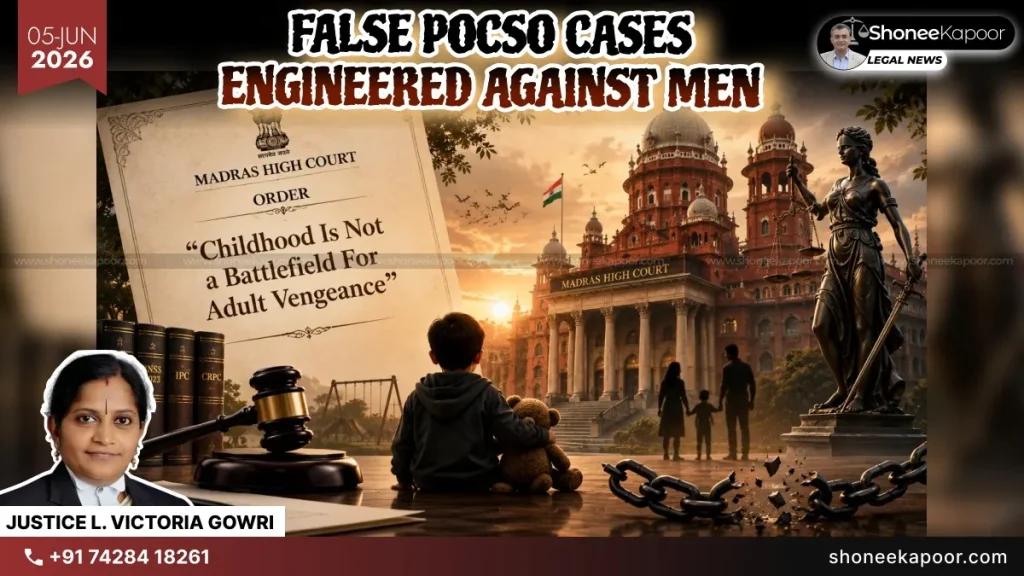
Why do innocent men pay the price when POCSO cases become tools in adult conflicts? The Madras High Court warned against mechanical POCSO investigations and called for fair, child-sensitive inquiries.
In a judgment delivered on June 1, 2026, Justice L. Victoria Gowri of the Madurai Bench of the Madras High Court examined four separate cases under the Protection of Children from Sexual Offences (POCSO) Act and used the occasion to highlight larger concerns about how children are treated within the criminal justice system.
The Court clarified that its purpose was not to weaken the POCSO Act or reduce the seriousness of child sexual abuse allegations. Instead, the judgment focused on improving the way child-protection laws are implemented and ensuring that children remain at the centre of the justice process.
While the four matters arose from different facts and districts, the Court found a common concern. Children who entered the criminal justice system often faced emotional stress, repeated questioning, family disputes, social stigma, and lengthy legal proceedings. The Court observed that these experiences can leave a lasting impact on a child’s mental and emotional well-being.
Justice Victoria Gowri noted that the POCSO Act is one of India’s most important child-protection laws and represents a constitutional commitment to safeguard children from abuse, exploitation, intimidation, and neglect. However, the Court observed that strong legislation alone cannot achieve its objectives unless it is supported by sensitive and effective implementation.
Highlighting the purpose of the legislation, the Court observed:
“The true object of the POCSO Act is not confined merely to registration of FIRs, filing of charge sheets, or securing convictions.”
The Court further stated:
“The soul of child protection jurisprudence lies in preserving childhood dignity, emotional safety, educational continuity, psychological healing, social reintegration, and constitutional compassion.”
According to the Court, a child who enters the justice system should emerge feeling protected, reassured, and supported rather than carrying additional trauma caused by insensitive institutional processes.
Justice Victoria Gowri emphasised that constitutional courts have a broader responsibility beyond deciding individual disputes. Courts must also identify systemic shortcomings and encourage improvements in the justice delivery system. The Court therefore treated the four cases as an opportunity to initiate a larger discussion about child welfare, institutional accountability, and policy reform.
At the same time, the Court made it clear that genuine allegations of child sexual abuse must continue to be handled with the utmost seriousness. The Court observed:
“These orders should never be interpreted as diluting the seriousness of genuine child sexual abuse prosecutions.”
The Court further stressed:
“Every allegation involving a child must be handled with the highest degree of caution, care, expertise, sensitivity, responsibility, and institutional sincerity.”
Calling for a more humane approach, the Court urged police authorities, welfare departments, counsellors, psychologists, prosecutors, educators, policymakers, and the judiciary to work together to create a truly child-centric system.
The Court ultimately emphasised that child protection requires more than legal enforcement. It requires empathy, rehabilitation, emotional support, and a sustained commitment to safeguarding the dignity and well-being of every child who comes into contact with the justice system.
EXPLANATORY TABLE: LAWS AND SECTIONS INVOLVED
| Law / Section | Purpose | How It Appears In This Judgment |
| Section 528 BNSS, 2023 | Inherent powers of High Court | Used for seeking quashing of criminal proceedings |
| Section 482 CrPC | Inherent powers of High Court (old provision) | Court notes Section 528 BNSS corresponds to Section 482 CrPC |
| POCSO Act, 2012 | Protection of children from sexual offences | Central legislation discussed throughout the judgment |
| Section 7 POCSO | Defines sexual assault | Invoked in multiple prosecutions |
| Section 8 POCSO | Punishment for sexual assault | Invoked along with Section 7 |
| Section 3(a) POCSO | Penetrative sexual assault | Applied in one prosecution |
| Section 4 POCSO | Punishment for penetrative sexual assault | Applied in one prosecution |
| Section 5(n) POCSO | Aggravated penetrative sexual assault by relative/trusted person | Alleged in serious child abuse cases |
| Section 5(l) POCSO | Aggravated penetrative sexual assault in specified circumstances | Invoked in prosecution |
| Section 6 POCSO | Punishment for aggravated penetrative sexual assault | Applied in serious allegations |
| Section 16 POCSO | Abetment of offence | Included in charge sheet |
| Section 17 POCSO | Punishment for abetment | Included in charge sheet |
| Section 22 POCSO | False complaint and false information | Court directed enquiry into possible applicability in certain cases |
| Section 39 POCSO | Child assistance and support guidelines | Court discussed rehabilitation and support obligations |
| Section 43(a) & (b) POCSO | Awareness and training obligations | Court highlighted need for public awareness and stakeholder training |
| Rule 9 POCSO Rules, 2020 | Victim compensation | Court observed gaps in rehabilitation despite compensation framework |
| Section 366 IPC | Kidnapping/abduction to compel marriage etc. | Original offence in one case |
| Section 87 BNS | Corresponding provision replacing Section 366 IPC | Invoked in prosecution |
| Section 351(3) BNS | Criminal intimidation related provision | Included in one prosecution |
| Section 351(2) BNS | Criminal intimidation provision | Included in one prosecution |
| Section 296(b) BNS | Obscene acts/words related provision | Included in one prosecution |
| Tamil Nadu Prohibition of Harassment of Women Act, Section 4 | Punishment for harassment of women | Invoked in one prosecution |
| Section 183(6)(a) BNSS | Recording statement before Magistrate | Victim statements recorded under this provision |
| Section 200 CrPC | Private complaint before Magistrate | Mentioned in village rivalry case |
CASE DETAILS
- Case Titles:
- Mikavel v. State of Tamil Nadu & Others
Crl.O.P.(MD) No.3924 of 2026 - Narendra Prasath v. State of Tamil Nadu & Others
Crl.O.P.(MD) No.3628 of 2026 - Ibrahim v. State of Tamil Nadu & Others
Crl.O.P.(MD) No.3769 of 2026 - S. Muniyandi & Another v. State of Tamil Nadu & Others
Crl.O.P.(MD) No.21788 of 2025
- Mikavel v. State of Tamil Nadu & Others
- Court: Madurai Bench of Madras High Court
- Bench: Justice L. Victoria Gowri
- Date of Judgment: 01.06.2026
KEY TAKEAWAYS
- A strong law protects society, but a fair investigation protects justice.
- When adults fight their battles through allegations, children often become the biggest victims.
- Every accusation deserves attention, but every accused deserves a fair and impartial investigation.
- Justice is not measured by the number of cases filed, but by the ability to separate truth from falsehood.
- A legal system earns public trust when it protects genuine victims while safeguarding innocent people from wrongful prosecution.
This Could Change Your Case-Get FREE Legal Advice-Click Here!
Disclaimer: The views and opinions expressed in this article are those of the Indian courts and do not necessarily reflect the official policy or position of “ShoneeKapoor.com” or its affiliates. This article is intended for informational and educational purposes only. The content provided is not legal advice, and viewers should not act upon this information without seeking professional counsel. Viewer discretion is advised.