
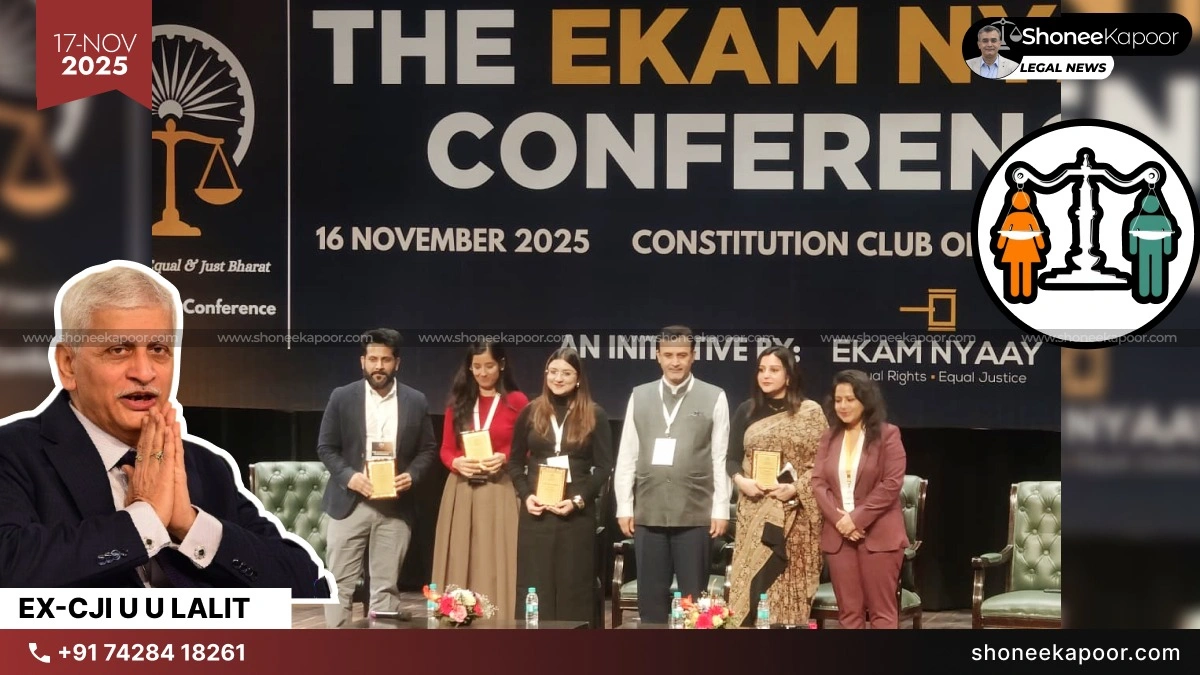
I Won’t Want My Daughters in a System Where Laws Are Misused: Ex CJI U U Lalit Over Broken Justice System & False Cases Against Men

Written and analysed by Vaibhav Ojha
Head Of Legal CommunicationsFormer Chief Justice of India U U Lalit has raised strong concerns about how India’s criminal justice system works, highlighting misuse of laws and extremely low conviction rates. He urged reforms, including separating police investigation from law-and-order duties to protect innocent people, especially men, from false cases.
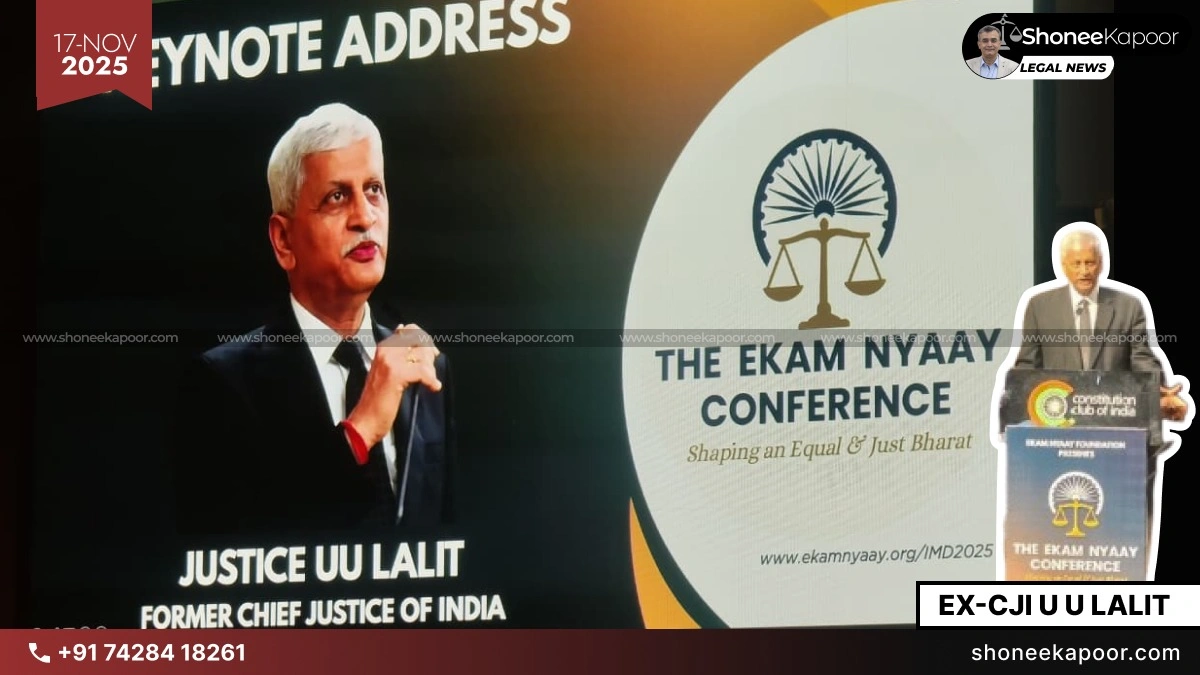
NEW DELHI: Former Chief Justice of India U U Lalit has once again brought national attention to the serious problems inside India’s criminal justice system. Speaking at a conference organised by the Ekam Nyaay Foundation, he explained how weak investigations, misuse of laws, and very low conviction rates are creating a major crisis for ordinary citizens.
He said the system urgently needs changes so that innocent people are not trapped in long legal battles or wrongly arrested.
Former CJI clearly stated that in his 42 years as a lawyer, judge, and professor, he has seen how criminal cases in India often move forward without proper evidence, proper investigation, or correct procedure.
According to him:
“The administration of criminal justice is perhaps the most neglected sphere in the apparatus of government.”
He pointed out that many police officers who handle investigations do not get the proper training, resources or professional support they need. Because of this, investigations are sometimes incomplete or poorly conducted.
He reminded the audience about the Supreme Court’s famous Prakash Singh judgment where the court had already recommended separating the investigative function of police from routine law-and-order work.
As he explained:
“And that perhaps was the lament which was expressed by the Supreme Court in that famous Prakash Singh case , that we must separate or segregate the investigative wing from the normal law and order issues, so that the very same police officer does not double up as the person in charge of law and order and the one taking up the mantle as an investigator”
Former CJI also explained how in 1973, when the Code of Criminal Procedure was amended, the old system where a magistrate recorded witness statements was removed. Now, police record statements under Section 161 CrPC or its new equivalents under the Bharatiya Nagarik Suraksha Sanhita.
But he said these statements are often not reliable and not signed. He noted that many witnesses change their statements during trial.
He said:
“We now rest content with what is called the statements recorded by the police under Section 161 or whatever is the equivalent under Bharatiya Nagarik Suraksha Sanhita , but these statements are never signed, and many of the statements are resiled from when the matter reaches trial”
Because of these weaknesses in the system, conviction rates across India remain shockingly low — about 20% overall. In specific categories, especially false matrimonial cases, the conviction rate is even worse. Former CJI pointed out:
“Now, leave aside this 498 A , issues, or the allied matters, the rate of conviction is less than 5 per cent. Now that tells you the story”
He shared a worrying fact: Four out of every five undertrials sitting in jail today will eventually be acquitted. That means the system is arresting and locking up people who later turn out to be innocent.
He said:
“So, therefore, what does that mean? Are we not taking somebody in custody who ultimately is going to be completely discharged and found to be innocent, or at least it is said that the crime has not been proved against him?”
Former CJInarrated an example he once heard from a lawyer, who compared the justice system to cats chasing what they think are mice, only to find out later that they were actually chasing rabbits.
U U Lalit quoted him:
“10 years of running after that so-called mice, and finally, it turns out that it was not a mouse, but it was a rabbit. Now, where does society stand? So, therefore, do we not, or should we not, insulate our system in such a way that perhaps innocent rabbits are not run after and given a chase for life, and at the end of that chase, they are left a sort of huffing and panting”
He then asked an important moral question:
“So therefore, does not society owe it to such persons what is legally and morally due to them?”
Lalit said the system must be improved so that innocent people are not pushed into courts, not prosecuted without reason, and not forced to suffer unnecessary arrests. He added that he does not want his own family to face such dangers.
He said:
“I won’t like my daughters to live in that environment where, perhaps, there is the slightest chance that the laws can be misused”
Talking about the misuse of rape laws, ex-CJI suggested that magistrates should record the survivor’s statement at the earliest opportunity so the statement becomes an official deposition under oath, not just a police note.
He said:
“Maybe our system must be such that if there is a false accusation, then the charge of false or malicious prosecution should not be left for a second kind of trial to be undertaken after the conclusion of the first one, but a finding could be recorded by the presiding officer of the court that this is a false accusation”
He also added:
“Now the accuser must be sort of punished, so therefore we must have these kinds of safety valves at every juncture, at the stage of investigation, at the stage of conduct of trial, at the stage of inquiry by the magistrates”
Ex-CJI described how many modern criminal cases start from relationships between young men and women, where both enter the relationship willingly. But years later, after a conflict, claims arise that the woman was misled or exploited.
He explained:
“And in a court of law, the capsule is given a sugar-coated kind thing; that on the pretext or promise to marry, I was taken advantage of, and so therefore it becomes a charge under 376 420 , so on and so forth”
While he acknowledged that some cases may be genuine, he warned that many fall under grey areas where the system must ensure that innocent people are not prosecuted wrongly.
He said:
“And it is those shades of grey that we, as a system, must ensure that an innocent is not being prosecuted. Not being prosecuted or subjected to unnecessary restraint or arrest”
He further questioned the purpose of arresting people in delayed or doubtful matters, especially when the incident happened years ago.
Ex-CJI asked:
“Something may have happened two years back, or some such thing. Yet, day in and day out, we find that the investigators put the liberty of that person at their end, and these are some of the issues that need a deeper kind of understanding”
He stressed the need for deeper discussion and more expert attention, saying that conferences like these can help bring new ideas.
As he concluded:
“And that is what this conference seeks to achieve. The idea that: let there be churning of ideas.”
Finally, he added:
“It is through this ‘amrit manthan’ that perhaps, I think something may emerge out of that, and what may emerge may perhaps be for the good of the society, for the betterment of the surroundings, and for the real cause of justice”
Explanatory Table Of All Laws & Sections Mentioned
| Law / Section | Full Name / Law | Meaning in Simple Terms | Why Ex-CJI Mentioned It |
| Section 161 CrPC | Code of Criminal Procedure, 1973 | Police record witness statements during investigation. These statements are unsigned and not under oath. | Lalit said these statements are unreliable and often changed during trial, affecting justice. |
| Bharatiya Nagarik Suraksha Sanhita (BNSS) | New criminal procedure law replacing CrPC | Modern version of CrPC with updated procedures. Section equivalent to 161 exists. | He highlighted that even in the new BNSS, statements still remain unsigned, causing the same problem. |
| Section 498A IPC | Cruelty by husband or relatives of husband | Used in dowry harassment and domestic cruelty complaints. | Lalit pointed out conviction rate is less than 5%, showing heavy misuse against men. |
| Section 376 IPC | Rape | Covers sexual assault offences. | He mentioned its misuse in relationship cases where accusations come years later. |
| Section 420 IPC | Cheating & dishonestly inducing delivery of property | Cheating, fraud, promise-to-marry cases. | He cited how false “promise to marry” cases turn into 376 + 420 charges. |
| Prakash Singh Case (2006) | Supreme Court judgment on police reforms | Ordered separation of police investigation wing from law & order wing. | Lalit said this reform is still not implemented, causing poor investigations. |
| CrPC Amendment 1973 | Revision of criminal procedure | Removed magistrate-led witness recording and shifted it entirely to police. | Lalit said this change weakened the reliability of evidence. |
| “False or malicious prosecution” provisions | Legal principle (no specific section cited) | Someone who files a false case can be punished. | He demanded that false accusers be punished within the same case, not in a separate trial. |
Event Details
- Speaker: Former Chief Justice of India Uday Umesh Lalit
- Event: Conference organised by Ekam Nyaay Foundation
- Topic: Failures and required reforms in India’s criminal justice system
- Key Focus Areas:
- Low conviction rate (20% overall; <5% in 498A & related offences)
- Poor police investigation standards
- Misuse of criminal laws, especially against men
- Need to separate police investigation wing from law & order wing
- Need to protect innocents from wrongful arrest & prosecution
- Need to punish false accusers
- Misuse of rape laws & promise-to-marry allegations
- Importance of magistrates recording statements directly
- Long trials destroying lives
- Need for “safety valves” at every stage of investigation and trial
Disclaimer: The views and opinions expressed in this article are those of the Indian courts and do not necessarily reflect the official policy or position of “ShoneeKapoor.com” or its affiliates. This article is intended for informational and educational purposes only. The content provided is not legal advice, and viewers should not act upon this information without seeking professional counsel. Viewer discretion is advised.
Related Articles
Real Court Cases Where False Allegations Backfired On Wife
Real Indian court cases where false 498A, dowry, cruelty and defamatory allegations against husbands backfired, leadi...
Can a ‘girlfriend’ of the husband be implicated under Section 498A?
From landmark Supreme Court rulings to ground-level misuse, this article unpacks how Section 498A defines ‘husband’ a...
5 Rights Every Husband Should Know In India: Most Ignored Legal Protections
Every Indian husband must know these 5 ignored legal rights in 498A, maintenance, arrest, custody and false matrimoni...
Share Your Thoughts
Comments are moderated before publication.