
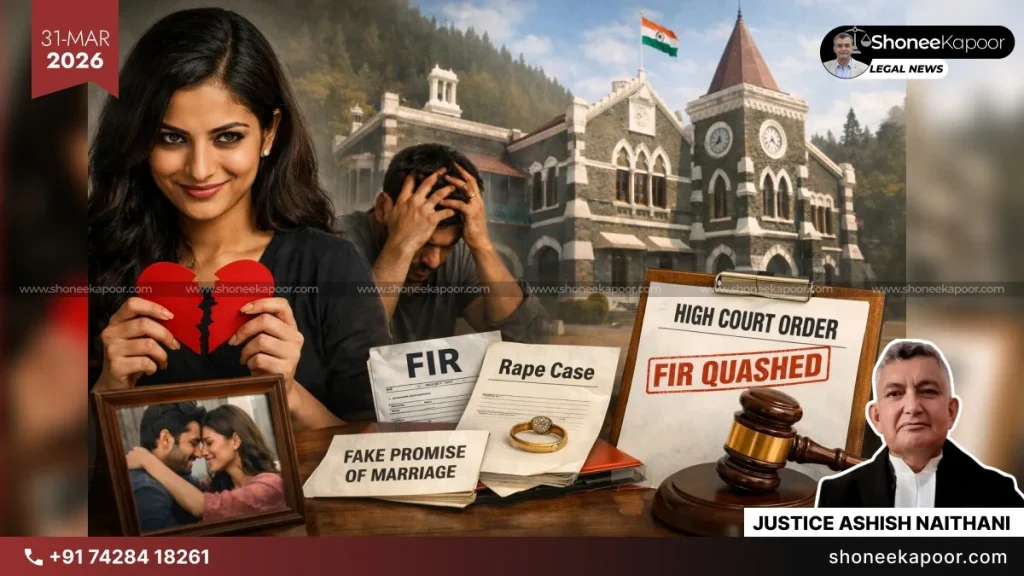
Are rape laws becoming a tool of harassment after relationships fall apart?
Uttarakhand High Court exposes how serious provisions are being misused as pressure tactics in personal disputes.
Failed Relationship Not Rape: In a recent judgment, Justice Ashish Naithani of the Uttarakhand High Court addressed how criminal law is being stretched in relationship disputes. The case involved a man accused of rape on the claim that he had physical relations on the promise of marriage but later refused.
The facts clearly showed both were adults in a long-term relationship, with continuous interaction and consensual physical relations. The allegation was based only on the promise of marriage not being fulfilled.
The Court examined whether this could amount to rape and clarified an important legal principle.
It observed:
“Consent for sexual relations, when given by an adult woman, does not become vitiated merely because a relationship ultimately culminates in refusal to marry.”
It further explained that for such cases to become rape, there must be clear proof of deception from the beginning.
The Court stated:
“To attract the offence under Section 376 IPC on the ground of promise of marriage, it must be prima facie shown that the promise was false from the very inception and was made solely as a device to obtain consent.”
The Court also made it clear that a failed relationship or broken promise cannot be criminalised.
It said:
“A mere breach of promise, howsoever reprehensible morally, does not ipso facto constitute rape in the absence of material indicating initial deception.”
On examining the case, the Court found no evidence of dishonest intention from the start, and held that this was, at best, a failed consensual relationship.
It strongly noted that continuing such proceedings would misuse the legal process, observing:
“Continuation of criminal proceedings would amount to abuse of the process of law and would subject the Applicant to unnecessary harassment.”
The Court further warned that such cases can become pressure tactics, stating they would-
“Operate as a tool of harassment, which the inherent jurisdiction of this Court is duty bound to prevent.”
Accordingly, the High Court quashed the FIR, charge sheet, and entire proceedings.
This judgment highlights a serious issue—relationship failures are increasingly being turned into criminal cases without proof of initial fraud. Where consent exists between adults, criminal law cannot be used as a weapon after things fall apart.
Explanatory Table: Laws & Sections Involved
| Section / Law | Purpose | Laws And Sections Involved | |
| Section 376 IPC | Punishment for rape | Alleged against the accused based on promise of marriage | |
| Section 323 IPC | Punishment for voluntarily causing hurt | Included in FIR as an additional allegation | |
| Section 504 IPC | Intentional insult to provoke breach of peace | Added as a supporting charge | |
| Section 506 IPC | Criminal intimidation | Alleged threats by the accused | |
| Section 482 Cr.P.C. | Inherent powers of High Court to prevent misuse of law | Used by the accused to seek quashing of proceedings | |
| Section 161 Cr.P.C. | Statement recorded by police during investigation | Basis of prosecution’s version | |
| Section 164 Cr.P.C. | Statement before Magistrate | Used to support complainant’s allegations | |
Case Details
- Case Title: Suraj Bora vs State of Uttarakhand and Another
- Court: High Court of Uttarakhand at Nainital
- Case Number: Criminal Miscellaneous Application No. 2082 of 2023
- Bench: Hon’ble Justice Ashish Naithani
- Neutral Citation:2026:UHC:800
- Date Of Judgment: 11.02.2026
- Counsels:
- For Applicant: Mr. Pawan Mishra
- For State: Mr. Vijay Khanduri (Brief Holder)
- For Respondent No.2: Mr. Shubhang Dobhal along with Mr. Bhupendra Singh Bora
Key Takeaways
- A consensual relationship between adults cannot be turned into a rape case just because marriage did not happen later.
- False promise of marriage becomes rape only if there is clear proof that the man never intended to marry from the beginning.
- Law cannot criminalise failed relationships or emotional disputes after consent was given.
- Misuse of serious criminal provisions like Section 376 IPC in relationship matters leads to harassment of men.
- Courts are now recognizing and stopping such misuse by quashing cases that lack real evidence of deception.
This Could Change Your Case-Get FREE Legal Advice-Click Here!
Disclaimer: The views and opinions expressed in this article are those of the Indian courts and do not necessarily reflect the official policy or position of “ShoneeKapoor.com” or its affiliates. This article is intended for informational and educational purposes only. The content provided is not legal advice, and viewers should not act upon this information without seeking professional counsel. Viewer discretion is advised.