
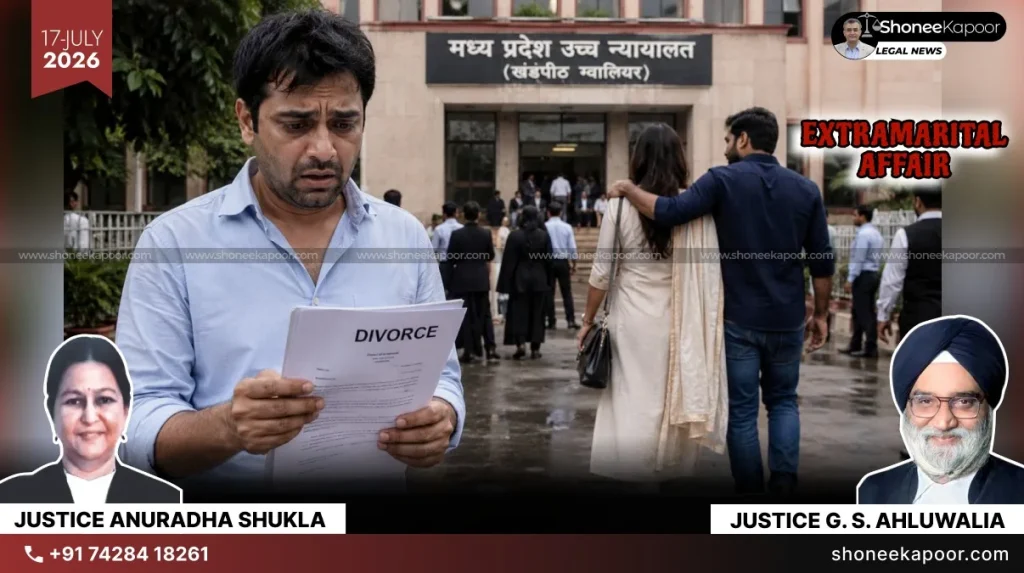
Can a wife walk out of the marriage, engage in an extramarital affair, and then seek a divorce by blaming the husband? The Madhya Pradesh High Court says no, holding that the wife cannot take advantage of their own misconduct to secure a decree of divorce U/S 13 of the Hindu Marriage Act,1955.
NEW DELHI: The Madhya Pradesh High Court has refused to grant divorce to a wife after finding that she had voluntarily left her matrimonial home and had engaged in an extramarital affair. The Court held that a person cannot seek relief by taking advantage of his or her own wrong.
The wife had approached the Family Court seeking a decree of divorce under Section 13 of the Hindu Marriage Act, 1955, alleging that she had been subjected to cruelty and dowry-related harassment by her husband and his family.
However, during the trial, the allegations failed to stand on firm footing. The courts found that the accusations of cruelty and dowry demand were vague, general and unsupported by evidence. Instead, the evidence suggested that the wife had left the matrimonial home of her own choice and was involved in an extramarital relationship.
The Family Court dismissed her divorce petition, and the wife challenged the decision before the Madhya Pradesh High Court.
A Division Bench of Justice G.S. Ahluwalia and Justice Anuradha Shukla upheld the Family Court’s decision and refused to interfere with the findings.
The High Court observed that none of the grounds pleaded by the wife for seeking divorce had been proved. The Court reiterated an important legal principle: a litigant cannot take advantage of his or her own wrong.
The decision acknowledges that husbands, too, can face unfounded allegations and that matrimonial courts must carefully examine the conduct of both spouses before granting relief and serves as a reminder that divorce is not a reward for abandoning the marriage and then shifting the blame to the other spouse. Courts still require evidence, and mere allegations cannot become a shortcut to obtaining matrimonial relief.
EXPLANATORY TABLE OF LAWS AND SECTIONS
| LAW/SECTION | LEGAL MEANING | APPLICATION IN THIS CASE | FINAL FINDING |
| Section 13, Hindu Marriage Act, 1955 | Provides the grounds on which a spouse may seek divorce | The wife sought divorce alleging cruelty and harassment. | The allegations were not proved and the divorce petition was dismissed. |
| Section 23(1)(a), Hindu Marriage Act, 1955 | A court shall not grant relief if the petitioner is taking advantage of his or her own wrong. | Evidence suggested that the wife had voluntarily left the matrimonial home and was involved in an extramarital affair. | The Court held that she could not seek divorce by relying on circumstances created by her own conduct. |
| Principle of Burden of Proof | The person making allegations must prove them with evidence. | The wife alleged cruelty and dowry harassment. | The allegations were found to be vague and unsupported by evidence. |
| Principle Against Taking Advantage of One’s Own Wrong | A litigant cannot benefit from his or her own misconduct. | The wife attempted to seek divorce despite evidence against her own conduct. | Relief was denied. |
CASE DETAILS
| PARTICULAR | DETAILS |
| Case | Smt. L. Y. vs R. Y. |
| Court | Madhya Pradesh High Court |
| Neutral Citation | 2026: MPHC-GWL:19983 |
| Bench | Justice G.S. Ahluwalia and Justice Anuradha Shukla |
| Law Involved | Sections 13 and 23 of the Hindu Marriage Act, 1955 |
| Main Issue | Whether a wife who voluntarily left the matrimonial home and engaged in an extramarital relationship could seek divorce by blaming the husband |
| Decision | Appeal dismissed; divorce denied |
| Decision Date | 8 July 2026 |
KEY TAKEAWAYS
- False or unsupported allegations of cruelty cannot automatically entitle a wife to a decree of divorce.
- A wife who voluntarily leaves the matrimonial home and engages in an extramarital relationship cannot later seek to benefit from her own conduct.
- The judgment is a reminder that courts still require evidence and cannot grant matrimonial relief merely on allegations.
- The ruling acknowledges that husbands can also face unsubstantiated accusations in matrimonial disputes and that courts must examine the conduct of both parties before granting relief.
- The decision reiterates an important principle of family law: a wife cannot secure legal relief by taking advantage of her own wrong.
This Could Change Your Case-Get FREE Legal Advice-Click Here!
Disclaimer: The views and opinions expressed in this article are those of the Indian courts and do not necessarily reflect the official policy or position of “ShoneeKapoor.com” or its affiliates. This article is intended for informational and educational purposes only. The content provided is not legal advice, and viewers should not act upon this information without seeking professional counsel. Viewer discretion is advised.