
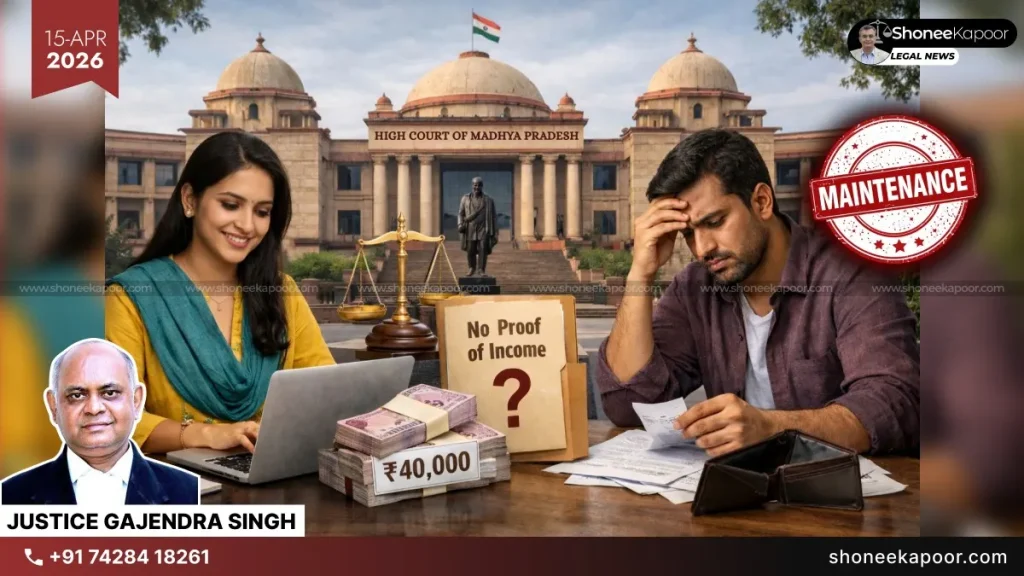
The Madhya Pradesh High Court says a wife cannot be denied maintenance after leaving work due to marital obligations.
When “marital obligations” justify a wife not working, why does the same standard not protect a husband facing financial hardship?
JABALPUR: In a judgment dated 23.03.2026, the Madhya Pradesh High Court, presided over by Justice Gajendra Singh, rejected a husband’s revision petition challenging the maintenance order directing him to pay ₹40,000 per month to his wife under Section 125 CrPC.
The case arose after the Family Court awarded maintenance to the wife from the date of application, despite the husband arguing that she was highly educated and capable of earning. He claimed that she was a qualified engineer and working through freelancing, and therefore should not be dependent on him financially.
The wife, on the other hand, stated that she had no stable source of income and had left her job due to marital responsibilities and circumstances. She also alleged cruelty and financial demands during the marriage. The husband denied all allegations and attempted to show that she had sufficient financial resources and qualifications to support herself.
While examining the case, the Madhya Pradesh High Court noted clear gaps in the husband’s defence. Although he claimed that the wife was earning, he failed to provide any concrete proof of her actual income. At the same time, the Court also observed that the husband himself did not place proper documentary evidence regarding his own earnings.
The Court stated that:
“There is difference between ‘may earn’ and ‘is earning’”
This observation became the central reasoning of the judgment. The Court clarified that simply having qualifications or the ability to earn does not mean that a person is actually earning at present.
The Court further held:
“There is no evidence that the wife is earning. The awarded amount is proportionate to the standard as the husband who previously worked in United Kingdom and now working as Assistant Manager in Genpact Pvt. Ltd. an American Company is expected to provide to his wife.”
This effectively placed the financial responsibility on the husband in the absence of proof of the wife’s earnings.
On financial claims, the Court clarified:
“‘Streedhan’ is an absolute property of a woman. No plea can be raised that ‘Streedhan’ is with the wife.”
The revision petition was dismissed, with limited liberty given to the husband:
“The revision petitioner is at liberty to approach before the learned Family Court under Section 145 of BNSS, 2023 for modification of the order either the wife gets job or any other change of circumstance occurs.”
The ruling again reflects that unless a husband can strictly prove the wife’s actual income, the burden of maintenance continues to remain on him, even where the wife is qualified and capable of earning.
Explanatory Table Of Laws & Provisions Involved
| Law / Section | Purpose | How Applied In This Case |
| Section 125 CrPC | Provides right to maintenance to wife, children, and parents if they cannot maintain themselves | Basis on which wife claimed ₹50,000/month and was granted ₹40,000/month |
| Section 19(4), Family Courts Act, 1984 | Allows filing of revision petition before High Court against Family Court orders | Husband filed revision under this provision challenging maintenance |
| Section 13-B, Hindu Marriage Act | Deals with divorce by mutual consent | Mentioned as parties attempted settlement but it failed |
| Section 145 BNSS, 2023 | Provision for modification of maintenance orders upon change in circumstances | Court allowed husband liberty to seek modification if wife gets job |
| Concept of Streedhan | Property exclusively owned by wife | Court held husband cannot claim defence based on possession of streedhan |
| Special Marriage Act, 1954 | Governs inter-faith or civil marriages | Marriage between parties was registered under this Act |
Case Details
- Case Title: Saurabh Malviya vs Apurva Malviya
- Court: Madhya Pradesh High Court
- Case Number: Criminal Revision No. 3453 of 2025
- Bench/Judge: Justice Gajendra Singh
- Neutral Citation: 2026:MPHC-IND:7791
- Date of Judgment: 23.03.2026
- Counsels:
- For Petitioner (Husband): Shri Ashutosh Surana, Advocate
- For Respondent (Wife): Shri Prasun Pandey, Advocate
Key Takeaways
- Mere qualification of the wife is irrelevant; unless her actual income is proven, the husband remains liable to pay maintenance.
- The burden of proof is heavily on the husband to establish the wife’s earnings, while her earning capacity alone carries no legal weight.
- Courts continue to prioritize “absence of proof” over practical realities, ignoring that an educated and capable spouse can sustain herself.
- Even partial or unclear disclosure by the husband can weaken his defence, reinforcing financial liability despite contested facts.
- Maintenance law, in practice, creates a one-sided obligation where the husband must keep paying until he proves a change in circumstances, making liability open-ended.
This Could Change Your Case-Get FREE Legal Advice-Click Here!
Disclaimer: The views and opinions expressed in this article are those of the Indian courts and do not necessarily reflect the official policy or position of “ShoneeKapoor.com” or its affiliates. This article is intended for informational and educational purposes only. The content provided is not legal advice, and viewers should not act upon this information without seeking professional counsel. Viewer discretion is advised.