
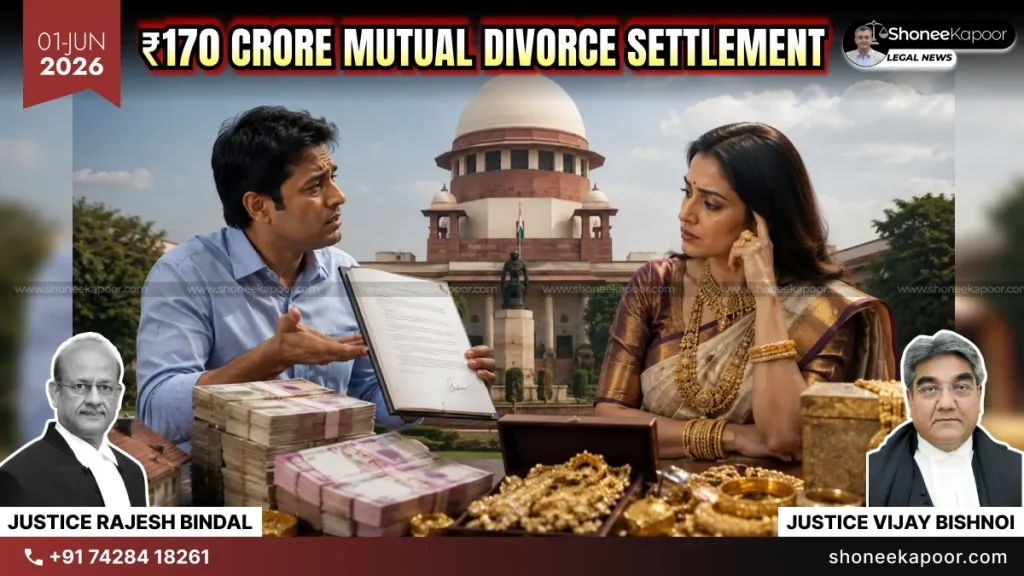
Can Mediation Settlements Be Ignored After Receiving The Benefits In Divorce Cases? The Supreme Court held that parties cannot accept the benefits of a settlement and later refuse to honour its terms. Such conduct undermines the very foundation of the mediation process.
NEW DELHI: In a DV case, a Bench of Justice Rajesh Bindal and Justice Vijay Bishnoi of the Supreme Court held that parties cannot accept the benefits of a court-approved mediation settlement and later refuse to honour its terms merely because they have changed their mind.
The Court also quashed Domestic Violence proceedings filed after the settlement, finding that the complaint lacked specific allegations and appeared to be an afterthought.
The dispute arose from a marriage that had broken down after years of differences. After living separately, the couple decided to settle all their disputes through mediation. A detailed settlement was signed under which both sides agreed to seek divorce by mutual consent and resolve all financial and property-related claims. Acting on the settlement, substantial payments were made, jewellery was returned, and several obligations were performed by both parties.
After the first motion for mutual divorce was allowed and major parts of the settlement were implemented, the wife withdrew her consent for divorce and later filed a complaint under the Domestic Violence Act against the husband and his mother. She claimed that she had been promised jewellery worth ₹120 crore and gold biscuits worth ₹50 crore, though these alleged promises were not recorded anywhere in the settlement agreement.
Before the High Court, the husband argued that the wife had already accepted the benefits of the settlement and therefore could not be allowed to initiate fresh proceedings relating to the same matrimonial dispute. The High Court passed an interim order directing the wife to deposit ₹89 lakh while allowing the Domestic Violence proceedings to continue.
While examining the matter, the Supreme Court considered the settlement terms and noted that both parties had expressly agreed to end all disputes between themselves and their family members.
Stressing the sanctity of mediation, the Court observed:
“Any deviation from the terms of the settlement arrived in mediation and later confirmed by the Court should be dealt with strictly as such deviation harbors an attack to the foundational basis of the entire process of mediation.”
The Court clarified that although a spouse may legally withdraw consent for mutual divorce before the final decree, that does not automatically permit the spouse to ignore obligations arising from a settlement unless there is proof of force, fraud, undue influence, or non-compliance by the other side.
While examining the Domestic Violence complaint, the Court found no specific allegations describing actual acts of domestic violence. It observed:
“A criminal complaint regarding domestic violence, with mere reference to the names of the family members or the husband without any specific allegation that points towards their active involvement in commission of such an act of violence, shall be nipped in the bud.”
According to the Court, the allegations largely consisted of ordinary marital disagreements that had been exaggerated after the settlement fell apart. The Court also noted that the parties had been living separately for years and that the Domestic Violence complaint was filed only after disputes arose regarding implementation of the settlement.
Holding that continuation of the proceedings would amount to misuse of the legal process, the Supreme Court concluded:
“Therefore, we are of the view that the proceedings under the DV Act as initiated by the Respondent-Wife are liable to be quashed, the continuance of which would be an abuse of the process of law.”
The Court ultimately found that the marriage had irretrievably broken down, dissolved the marriage by exercising its powers under Article 142 of the Constitution, quashed the Domestic Violence proceedings, and directed that all matrimonial disputes between the parties be brought to a complete end.
Explanatory Table: Laws And Sections Involved
| Law / Section | Purpose | How It Was Used In This Case |
| Section 13(1)(i-a), Hindu Marriage Act, 1955 | Divorce on ground of cruelty | Original divorce petition filed before mediation |
| Section 13(1)(i), Hindu Marriage Act, 1955 | Divorce on ground of adultery | Husband’s original divorce case |
| Section 13B(1), Hindu Marriage Act, 1955 | First Motion Mutual Divorce | Parties filed joint mutual divorce petition |
| Section 13B(2), Hindu Marriage Act, 1955 | Second Motion Mutual Divorce | Wife withdrew consent before this stage |
| Section 12, Protection of Women from Domestic Violence Act, 2005 | Filing of Domestic Violence Complaint | Wife later filed DV proceedings against husband and mother-in-law |
| Section 3, Protection of Women from Domestic Violence Act, 2005 | Defines Domestic Violence including economic abuse | Relied upon by wife to justify DV complaint |
| Section 528, Bharatiya Nagarik Suraksha Sanhita, 2023 | Inherent powers of High Court (similar to old Section 482 CrPC) | Husband sought quashing of DV proceedings |
| Article 142(1), Constitution of India | Supreme Court’s power to do complete justice | Marriage dissolved by Supreme Court despite failure of mutual consent divorce |
| Section 138, Negotiable Instruments Act | Mentioned in precedent cited by Court | Referred while discussing binding nature of settlements |
| Section 498A IPC | Cruelty by husband or relatives | Discussed in precedents relied upon by Supreme Court |
| Sections 3 & 4, Dowry Prohibition Act | Dowry-related offences | Mentioned in precedent cases discussed by Court |
| Section 125 CrPC | Maintenance proceedings | Referred in precedent relied upon by Court |
Case Details
- Case Title: Dhananjay Rathi v. Ruchika Rathi
- Court: Supreme Court of India
- Neutral Citation: 2026 INSC 360
- Case Number: Cr. Appeal No. 1924 of 2026 (Arising out of SLP (Crl.) No. 1878 of 2026)
- Date of Judgment: 13 April 2026
- Bench: Hon’ble Mr. Justice Rajesh Bindal | Hon’ble Mr. Justice Vijay Bishnoi
- Counsels:
- For Appellant: Mr. Prabhjit Jauhar, Advocate
- For Respondent: Mr. Prashant Mendiratta, Advocate
Key Takeaways
- Taking the benefits of a settlement and then starting fresh litigation should never be rewarded by the legal system.
- A promise made before a mediator and accepted by both sides is not a temporary arrangement—it carries legal responsibility.
- Allegations without specific facts should not become a tool to drag families into years of litigation.
- Mediation can work only when parties are held accountable for the commitments they voluntarily make.
- Matrimonial laws are meant to provide justice, not to create leverage for renegotiating a settlement after accepting its benefits.
This Could Change Your Case-Get FREE Legal Advice-Click Here!
Disclaimer: The views and opinions expressed in this article are those of the Indian courts and do not necessarily reflect the official policy or position of “ShoneeKapoor.com” or its affiliates. This article is intended for informational and educational purposes only. The content provided is not legal advice, and viewers should not act upon this information without seeking professional counsel. Viewer discretion is advised.