
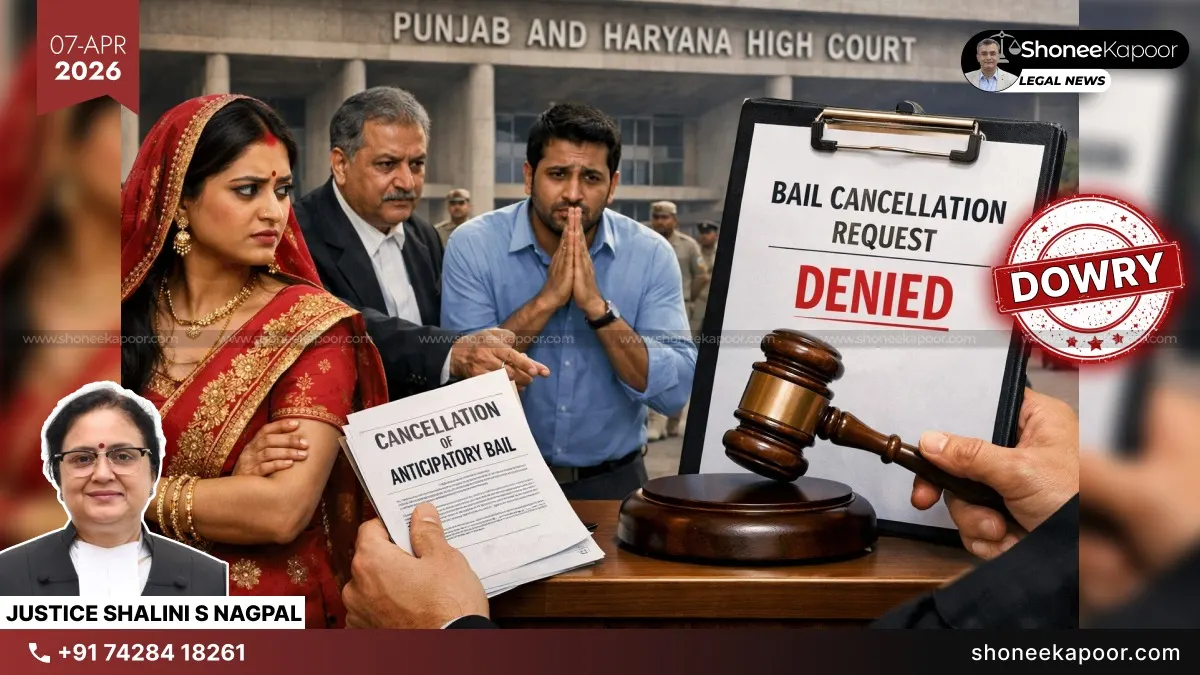
No Dowry Recovery Can’t Be A Ground To Deny Anticipatory Bail To Husband: Punjab & Haryana High Court Says Liberty Cannot Be Used As Pressure Tool

Curated by NEWS DESK
Editorial DeskCan a man’s freedom be cancelled just because recovery hasn’t happened yet? Punjab & Haryana High Court says NO – trial decides facts, not pressure tactics disguised as legal arguments.
CHANDIGARH: In a recent order, Justice Shalini Singh Nagpal of the Punjab & Haryana High Court dismissed a petition filed by a wife seeking cancellation of anticipatory bail granted to her husband in a dowry harassment case.
The case arose from an FIR alleging cruelty, dowry demand, and matrimonial harassment. The husband had already been granted anticipatory bail by the Sessions Court, with conditions such as joining the investigation, not leaving the country without permission, and not tampering with evidence.
The wife approached the High Court, arguing that bail should be cancelled because dowry articles were not recovered from the husband. However, the Court refused to accept this argument and clarified the legal boundaries of cancelling bail.
The Court explained that once bail is granted, it cannot be cancelled casually or on weak grounds. It stressed that there must be strong and compelling reasons, clearly observing that:
“Bail to an individual once granted, cannot be cancelled on mere asking, unless very strong and compelling reasons are made out to interfere with the order granting bail.”
Importantly, the Court noted that there was no allegation of violation of bail conditions. The husband had complied with the terms of bail, and even the prosecution had not sought cancellation on grounds like misuse of liberty or interference with investigation.
On the issue of dowry recovery, the judge clarified that this cannot be used as a shortcut to cancel bail. The Court categorically held that:
“Law does not permit cancellation of anticipatory bail for non-recovery of dowry articles,”
And further explained that whether such articles were actually entrusted will only be determined during the trial based on evidence.
The Court also pointed out that bail cancellation is a serious step affecting personal liberty and cannot be used as a pressure tool during investigation or recovery proceedings.
Finally, the High Court found no merit in the wife’s plea and dismissed the petition, thereby upholding the anticipatory bail granted to the husband.
Explanatory Table: Laws And Provisions Involved
| Law / Provision | Purpose | How Applied In This Case |
| Section 483(3), Bharatiya Nagarik Suraksha Sanhita, 2023 | Provision relating to cancellation of bail | Petition filed under this section |
| Sections 85, 316(2), Bharatiya Nyaya Sanhita, 2023 | Offences relating to cruelty, dowry, and related allegations | Basis of FIR against husband |
| Section 482 BNSS, 2023 | Provision for anticipatory bail | Husband was granted bail under this |
| Section 439(2) CrPC (referenced) | Cancellation of bail principles | Court relied on settled law principles |
| Case Laws (SC & others) | Raghubir Singh, Dolat Ram, etc. | Defined when bail can be cancelled |
Case Details
- Case Title: Lovepreet Kaur vs State of Punjab and Another
- Court: Punjab & Haryana High Court, Chandigarh
- Case Number: CRM-M-5848-2026 (O&M)
- Bench: Hon’ble Ms. Justice Shalini Singh Nagpal
- Neutral Citation: 2026:PHHC:051365
- Date of Decision: 02.04.2026
- Counsels:
- For Petitioner (Wife): Mr. Naresh Kumar, Advocate
- For State: Mr. Sukhbeer Singh, DAG Punjab
Key Takeaways
- Bail is not a bargaining tool—once granted, it cannot be taken away without strong and proven reasons.
- Allegations alone are not evidence; recovery issues or claims cannot justify cancelling someone’s liberty.
- Legal process must rely on proof, not pressure—trial is where truth is decided, not during bail stage.
- Misuse of law fails when there is no violation of conditions or interference with investigation.
- Personal liberty cannot be casually disturbed just because one side demands it; the system still requires legal thresholds to be met.
This Could Change Your Case-Get FREE Legal Advice-Click Here!
Disclaimer: The views and opinions expressed in this article are those of the Indian courts and do not necessarily reflect the official policy or position of “ShoneeKapoor.com” or its affiliates. This article is intended for informational and educational purposes only. The content provided is not legal advice, and viewers should not act upon this information without seeking professional counsel. Viewer discretion is advised.
Related Articles

Can a Section 498A IPC Case Be Filed If the Husband Lives in Canada? The Real Indian Legal Position for NRIs
Can a Section 498A IPC case be filed if the husband lives in Canada? Updated 2026 legal guide for NRI husbands on Ind...
False 498A – 85 BNS Fear And Need Legal Help? The Law Changed, The Risk Remains, The Defence Must Change Too
If arrest is “not automatic” now, why are families still rushing for bail and protection? Is Section 85 BNS just a ne...
Anticipatory Bail Application Format Under Section 482 BNSS: PDF & Affidavit
Download anticipatory bail application format under Section 482 BNSS with affidavit, grounds, court procedure, condit...
Share Your Thoughts
Comments are moderated before publication.