
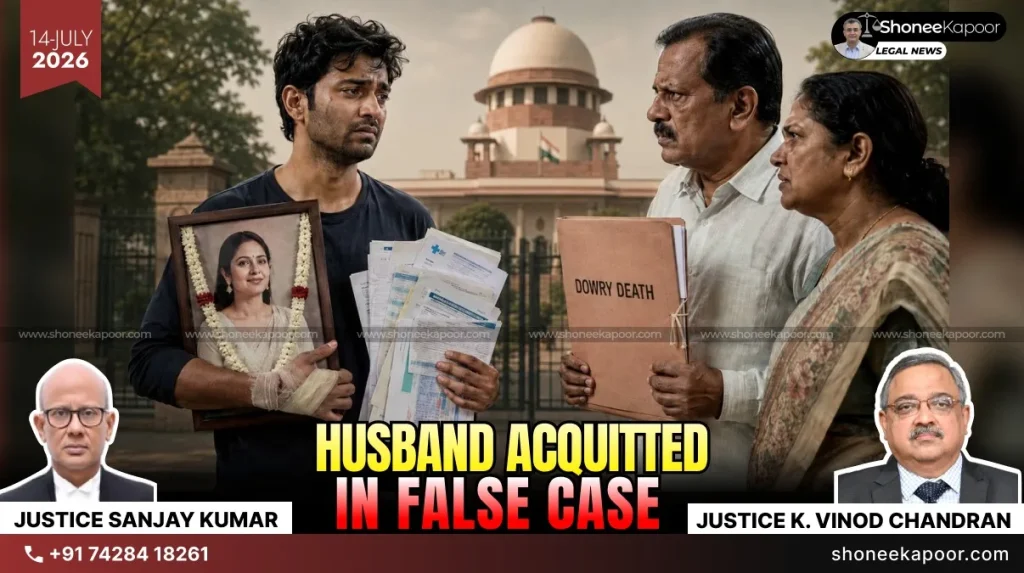
Does a dowry death allegation automatically prove a husband’s guilt? The Supreme Court clarified that every allegation must be established through evidence, and a husband cannot be convicted merely because he was the spouse.
NEW DELHI: The Supreme Court has acquitted a husband who was convicted in a dowry death case involving the death of his wife due to burn injuries at their matrimonial home in 2000. The Court found major shortcomings in the investigation and held that the prosecution failed to prove the allegations of cruelty and dowry harassment beyond reasonable doubt.
A bench of Justice K. Vinod Chandran and Justice Sanjay Kumar observed that the case had continued for nearly 25 years and involved serious procedural failures. The Court noted that the husband had remained accused for decades based on allegations of marital cruelty and dowry death, but the evidence presented during the trial was not sufficient to establish his guilt.
The case arose after the wife suffered burn injuries at her matrimonial home in April 2000 and later died during treatment. The prosecution alleged that she was harassed for dowry and that continuous demands led to her death. The husband and several members of his family were initially accused, but most of them were later acquitted.
The Supreme Court highlighted that the investigation suffered from several serious lapses. No postmortem examination was conducted, important medical evidence was not collected, and the prosecution failed to properly investigate the circumstances in which the burn injuries occurred.
The Court also noted that the allegations of dowry demand were mainly repeated by family members of the deceased, while there was no independent evidence from neighbours or other persons to prove cruelty or harassment. The husband’s defence produced documents showing medical treatment expenses, financial investments made jointly with his wife, and evidence suggesting that he tried to save her after the incident.
The Court examined the dying declaration of the deceased, in which she stated that the incident happened accidentally while she was boiling milk and that her husband and in-laws were not responsible. Although the Court approached the declaration with caution, it observed that the surrounding circumstances created reasonable doubt about the prosecution case.
The Supreme Court criticised the manner in which the investigation and trial were conducted and observed that putting seventeen persons on trial merely because they had marital relations with the deceased resulted in a serious miscarriage of justice.
The Court further stated:
“The accused is not obliged to prove his/her innocence and if a reasonable doubt is raised either from the unsatisfactory evidence led by the prosecution or from the evidence led by the defence its benefit should inure to the accused.”
It also observed that a conviction cannot be based on suspicion and that the prosecution evidence must cross the standard of proof beyond reasonable doubt. The Court remarked:
“In travelling from ‘may be true’ to ‘must be true’ the whole of the distance should be paved with ‘legal, reliable and unimpeachable evidence’.”
Allowing the appeal, the Supreme Court set aside the conviction and acquitted the husband. The Court directed that his bail bonds would stand cancelled and ordered his release if he was still in custody and not required in any other case.
EXPLANATORY TABLE: LAWS AND SECTIONS INVOLVED
| Law / Section | Purpose | How It Applied In This Case |
| Section 498A, IPC, 1860 | Punishes cruelty by husband or relatives. | Alleged dowry cruelty was not proved beyond reasonable doubt. |
| Section 304B, IPC, 1860 | Deals with dowry death cases. | Court held prosecution failed to prove dowry death ingredients. |
| Section 34, IPC, 1860 | Fixes joint liability for acts done with common intention. | Several family members were accused, but evidence did not establish collective involvement. |
| Sections 3 & 4, Dowry Prohibition Act, 1961 | Punish giving, taking, or demanding dowry. | Alleged ₹50,000 dowry demand lacked reliable supporting evidence. |
| Section 156(3), CrPC, 1973 | Allows Magistrate to order police investigation. | FIR was registered on complaint forwarded by Magistrate under this section. |
| Section 158, CrPC, 1973 | Deals with submission of police reports. | Court examined legality of investigation procedure followed by police. |
| Section 169, CrPC, 1973 | Allows release when evidence is insufficient. | Court discussed police power when evidence does not support prosecution. |
| Section 170, CrPC, 1973 | Requires forwarding accused for trial when evidence exists. | Court explained procedure when sufficient evidence is found. |
| Section 173, CrPC, 1973 | Covers final police report/charge sheet. | Court examined two final reports arising from the same FIR. |
| Section 190, CrPC, 1973 | Gives Magistrate power to take cognizance. | Court held Magistrate can independently assess police reports. |
| Section 465, CrPC, 1973 | Deals with errors not affecting trial unless justice fails. | Court considered procedural defects and prejudice to accused. |
| Sections 218–223, CrPC, 1973 | Deal with charges and joint trials. | Court examined legality of separate and joint trials. |
| Section 537, CrPC, 1898 | Deals with irregularities in criminal proceedings. | Court referred to effect of investigation defects on trial. |
CASE DETAILS
- Case Title: Brajesh Kumar @ Birjesh Kumar Singh vs The State of Bihar
- Court: Supreme Court of India, Criminal Appellate Jurisdiction
- Case Number: Criminal Appeal No. 3117 of 2026
- Neutral Citation: 2026 INSC 695
- Date of Judgment: 13 July 2026
- Bench: Justice K. Vinod Chandran | Justice Sanjay Kumar
- Counsels:
- For Appellant/Petitioner: Mr. Neeraj Shekhar (AOR), Mrs. Kshama Sharma, Advocate, Mr. Rajesh Maurya, Advocate, Mr. Ritwik Prasad, Advocate, Mr. Rajat Singh Chandel, Advocate, Mr. Ujjwal Ashutosh, Advocate, Ms. Avi Sahai, Advocate
- For Respondent/State of Bihar: Mr. Manish Kumar (AOR), Mr. Divyansh Mishra, Advocate, Mr. Kumar Saurav, Advocate
KEY TAKEAWAYS
- A husband spent 25 years facing a dowry death trial, but the Supreme Court found that weak evidence cannot justify a man’s conviction.
- Serious allegations against a husband and his family must be supported by reliable proof, not only repeated statements from relatives.
- The Court highlighted that investigation failures like missing medical evidence and lack of proper inquiry can destroy the life of an innocent accused.
- A man accused in a matrimonial case also has the right to a fair investigation, equal consideration of defence evidence, and protection from wrongful conviction.
- Criminal laws meant to protect women cannot become a tool for punishing men without proof; justice requires evidence, not assumptions.
This Could Change Your Case-Get FREE Legal Advice-Click Here!
Disclaimer: The views and opinions expressed in this article are those of the Indian courts and do not necessarily reflect the official policy or position of “ShoneeKapoor.com” or its affiliates. This article is intended for informational and educational purposes only. The content provided is not legal advice, and viewers should not act upon this information without seeking professional counsel. Viewer discretion is advised.