
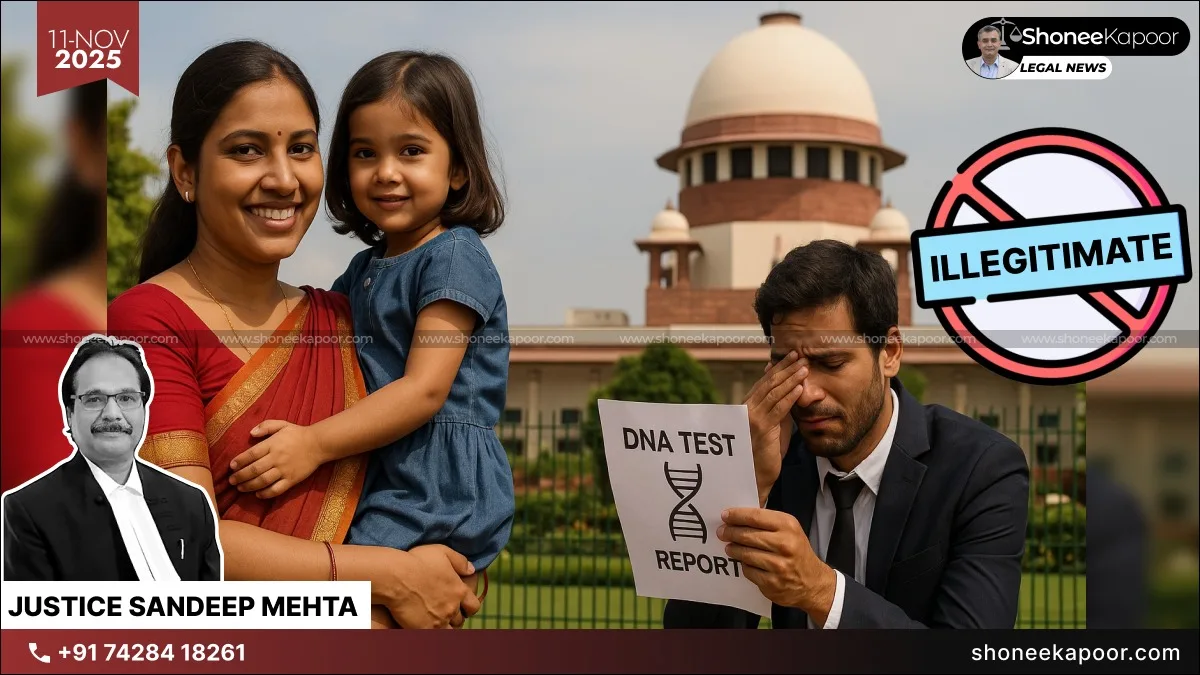
The Supreme Court ruled that a DNA test cannot be ordered casually in paternity disputes, as it invades privacy and risks branding a child illegitimate. The bench stressed that “scientific tools like DNA profiling must never become instruments of speculation.”
NEW DELHI: In a major judgment safeguarding the dignity of children born in wedlock, the Supreme Court of India has ruled that a DNA test cannot be directed as a matter of routine merely to satisfy curiosity or suspicion. The Court said such tests intrude into privacy and can illegitimise a child, which law strongly discourages.
The Bench of Justice Prashant Kumar Mishra and Justice Vipul M. Pancholi set aside the Madras High Court (Madurai Bench) order that had forced a doctor, accused in a paternity dispute, to undergo DNA profiling.
Quoting from the decision, the Court observed:
“Section 112 embodies a legislative policy of profound significance, it stands as a bulwark against the casual illegitimization of children on the strength of unsubstantiated allegations or mere suspicion. The presumption it creates is not a procedural formality to be lightly displaced but a substantive safeguard intended to protect the dignity, social legitimacy, and the legal rights of children born within wedlock.”
The Case Background
The case began when a married woman alleged an extramarital affair with a doctor, claiming her 2007-born child was fathered by him. After she publicly aired her allegations on a TV show, an FIR was registered against the doctor under Sections 417 and 420 IPC and the Tamil Nadu Women Harassment Act.
Police sought to conduct DNA tests on the woman, her child, and the doctor. When the doctor refused, the Madras High Court ordered him to submit for testing — a decision later upheld by a Division Bench. The doctor appealed to the Supreme Court.
What the Supreme Court Held
The Supreme Court examined Section 112 of the Indian Evidence Act, which gives a conclusive presumption of legitimacy to a child born during a valid marriage.
“The presumption under Section 112 of the Evidence Act operates as ‘Conclusive Proof’ of the legitimacy of a child born during the subsistence of a valid marriage… This presumption endures unless it is affirmatively established, by strong and unambiguous evidence, that the parties to the marriage had no access to each other at any time when the child could have been begotten… Since the law favours legitimacy and frowns upon the illegitimacy, the burden is cast upon the person who asserts ‘illegitimacy’ to displace the presumption.”
The Court said that to rebut this presumption, one must prove non-access — that is, show that the husband and wife could not have had physical relations during the relevant period.
Mere allegations of an affair or doubts about paternity do not suffice. In this case, the woman’s husband’s name appeared in the child’s birth and school records, and there was no proof that he had no access to his wife when the child was conceived.
The “Two-Fold Test” for DNA Orders
Referring to Ivan Rathinam vs. Milan Joseph (2025), the Court reiterated that DNA testing can be ordered only when:
- There is insufficient evidence to decide the issue, and
- A positive balance of interests justifies intrusion into privacy.
Here, neither condition was met. The Court said:
“In the present case, this balance weighs decisively against ordering DNA testing. Such a direction would constitute a significant intrusion into the privacy and dignity of both, the appellant and the child, implicating the fundamental right to privacy guaranteed under Article 21 of the Constitution of India.”
On Right to Privacy
The bench made a strong statement protecting personal autonomy:
“Forcefully subjecting an individual to DNA testing constitutes a grave intrusion upon privacy and personal liberty. Such an encroachment can be justified only if it satisfies the threefold test of legality, legitimate State aim, and proportionality.”
Even if the mother agrees to undergo the test, the Court said, her consent cannot waive the privacy rights of others, including the alleged father and the child:
“The mother’s willingness to waive her own privacy does not extend to waiving the privacy of others.”
The judges also noted that the child, now an adult, was not a party to the case, and her dignity could not be compromised merely for a criminal investigation.
DNA Testing Not Always Necessary in Criminal Cases
The Supreme Court emphasized that the offences alleged — cheating and harassment — do not require proof of paternity.
“A direction for DNA testing must have a direct and demonstrable nexus with the offences under investigation. In the absence of such nexus, compelling a person to undergo DNA profiling amounts to unwarranted intrusion into bodily autonomy and privacy, contrary to the safeguards implicit in Articles 20(3) and 21 of the Constitution of India.”
The Court criticized the Madras High Court for wrongly invoking Sections 53 and 53A of the CrPC, which allow medical examination of accused persons only when it directly helps prove the alleged crime.
“Scientific procedures, however advanced, cannot be employed as instruments of speculation; they must be anchored in demonstrable relevance to the charge and justified by compelling investigative need.”
On Adverse Inference
The Court rejected the plea that refusal to take a DNA test should be treated as guilt:
“A party cannot jump to seek an adverse inference without first establishing that a DNA test was necessary and lawfully ordered.”
It cited Aparna Ajinkya Firodia v. Ajinkya Arun Firodia (2023), explaining that adverse inference applies only after a court has already justified and ordered such a test — not before.
Protecting Children from Stigma
The Court cautioned that DNA tests could psychologically and socially harm the child:
“Judicial and ethical prudence both require that autonomy, dignity and emotional well-being of the individual, especially of a minor, be safeguarded. A direction for DNA testing without considering the ramifications causes risks inflicting an irreversible psychological and social harm.”

Final Verdict
The Supreme Court concluded:
“In summation, the direction for DNA testing, as affirmed by the Division Bench, rests upon the fundamental misapprehension of both statutory framework and constitutional safeguards. The offences alleged… are neither of nature nor of a circumstance that warrant recourse to DNA analysis… Absent that nexus, compulsion of a DNA test transforms a lawful investigative power into an intrusive measure devoid of necessity, trenching upon the individual’s bodily autonomy, privacy.”
Accordingly, the appeal was allowed, and the Madras High Court’s order was set aside.
Table of Laws & Sections Referred in the Case
| Law / Statute | Section | Provision Title / Scope | Purpose & Application in This Case |
| Indian Evidence Act, 1872 | Section 112 | Birth during marriage – conclusive proof of legitimacy | The core provision. Court held that a child born during a valid marriage is conclusively presumed legitimate unless “non-access” between spouses is proven. Used to protect legitimacy of child. |
| Indian Evidence Act, 1872 | Section 114(g) & (h) | Presumption regarding adverse inference | Respondent sought adverse inference for appellant’s refusal to take DNA test. Court rejected — inference can arise only after lawful direction for test, not before. |
| Indian Penal Code, 1860 (IPC) | Section 417 | Punishment for cheating | FIR alleged the doctor cheated respondent; however, SC held DNA test not necessary to prove offence. |
| Indian Penal Code, 1860 (IPC) | Section 420 | Cheating and dishonestly inducing delivery of property | Same reasoning; paternity not essential to prove charge. |
| Tamil Nadu Prohibition of Harassment of Women Act, 1998 | Section 4(1) | Penalty for harassment of women | Part of FIR; again, Court ruled paternity proof through DNA unnecessary. |
| Code of Criminal Procedure, 1973 (CrPC) | Section 53 | Examination of accused by medical practitioner at request of police officer | Invoked wrongly by High Court to compel DNA test. SC clarified it applies only when medical exam yields direct evidence of alleged offence. |
| Code of Criminal Procedure, 1973 (CrPC) | Section 53A | Examination of person accused of rape | Misapplied by High Court; not relevant to offences of cheating or harassment. |
| Constitution of India | Article 20(3) | Protection against self-incrimination | Used to underline that forced DNA tests may violate protection against compelled testimony. |
| Constitution of India | Article 21 | Right to life and personal liberty (includes right to privacy) | Central to verdict — Court said compulsory DNA testing intrudes on privacy and bodily autonomy. |
| Case Precedent: Ivan Rathinam vs Milan Joseph (2025 LiveLaw SC 118) | — | Two-fold test for DNA testing | Referred for “insufficiency of evidence” and “balance of interests” criteria before ordering any DNA test. |
| Case Precedent: Bhabani Prasad Jena vs Convenor Secretary, Orissa State Commission for Women (2010) 8 SCC 633 | — | Eminent need test for DNA orders | Court cited this to emphasize that DNA testing must be used only when indispensable to justice. |
| Case Precedent: Goutam Kundu vs State of West Bengal (1993) 3 SCC 418 | — | Guidelines against casual DNA testing | Quoted to reaffirm that courts cannot order blood/DNA tests as a matter of course. |
| Case Precedent: Aparna Ajinkya Firodia vs Ajinkya Arun Firodia (2023 INSC 146) | — | Adverse inference only after lawful DNA order | Used to reject complainant’s plea for adverse inference. |
| Case Precedent: Nandlal Wasudeo Badwaik vs Lata Badwaik (2014) 2 SCC 576 | — | DNA vs presumption of legitimacy | Distinguished — consented test already conducted there; here, test resisted. |
| Case Precedent: Kamti Devi vs Poshi Ram (2001) 5 SCC 311 | — | Standard of proof for non-access | Reiterated that burden to prove non-access is heavy and cannot rest on mere suspicion. |
| Case Precedent: Inayath Ali vs State of Telangana (2024) 7 SCC 822 | — | Paternity as collateral in criminal cases | Cited to say DNA testing can’t be used in unrelated criminal offences. |
| Constitutional Case: K.S. Puttaswamy (Privacy 9J.) (2017) 10 SCC 1 | — | Right to Privacy Judgment | Basis for holding that DNA testing without justification violates privacy and proportionality principles. |
Case Details
| Field | Details |
| Case Title | R. Rajendran vs Kamar Nisha and Others |
| Citation | 2025 INSC 1304 |
| Court | Supreme Court of India |
| Jurisdiction | Criminal Appellate Jurisdiction |
| Case No. | Criminal Appeal No. 1013 of 2021 |
| Date of Judgment | 10 November 2025 |
| Bench / Judges | Justice Prashant Kumar Mishra & Justice Vipul M. Pancholi |
| Appellant | Dr. R. Rajendran |
| Respondents | Kamar Nisha and Others |
| Appeal From | Judgment dated 10.05.2017 of the Madras High Court (Madurai Bench) in W.A. (MD) No. 521/2017 |
| Result | Appeal Allowed – Madras High Court Order Set Aside |
| Subject Matter | Direction for DNA profiling to establish paternity in a criminal case under Sections 417, 420 IPC and Section 4(1) of Tamil Nadu Women Harassment Act |
| Key Finding | DNA test cannot be ordered casually; child born within marriage presumed legitimate under Section 112 of Evidence Act; privacy under Article 21 protected. |
Key Takeaways
| Topic | Supreme Court’s Explanation in Simple Terms |
| Child’s legitimacy | If a child is born during a valid marriage, law assumes the husband is the father. To deny it, one must prove husband and wife had no physical contact at that time. |
| DNA tests | DNA tests can’t be ordered just because someone doubts paternity. Courts can allow it only if absolutely needed to find truth — not to satisfy curiosity. |
| Privacy rights | Forcing anyone to give a DNA sample violates privacy and body autonomy under Article 21. |
| Mother’s consent | Even if the mother agrees to test, it doesn’t mean the father or child’s privacy can be ignored. |
| Criminal cases | For cheating or harassment cases, paternity proof isn’t necessary. So, DNA tests don’t apply. |
| High Court’s mistake | Madras High Court wrongly used CrPC sections meant for medical exams in rape or physical offence cases — not for paternity doubts. |
| Supreme Court’s warning | Courts must not let “scientific tools” become tools for speculation or “fishing inquiries.” |
| Final result | Doctor’s appeal allowed. DNA test order quashed. Child continues to be treated as legitimate under law. |
Disclaimer: The views and opinions expressed in this article are those of the Indian courts and do not necessarily reflect the official policy or position of “ShoneeKapoor.com” or its affiliates. This article is intended for informational and educational purposes only. The content provided is not legal advice, and viewers should not act upon this information without seeking professional counsel. Viewer discretion is advised.
