
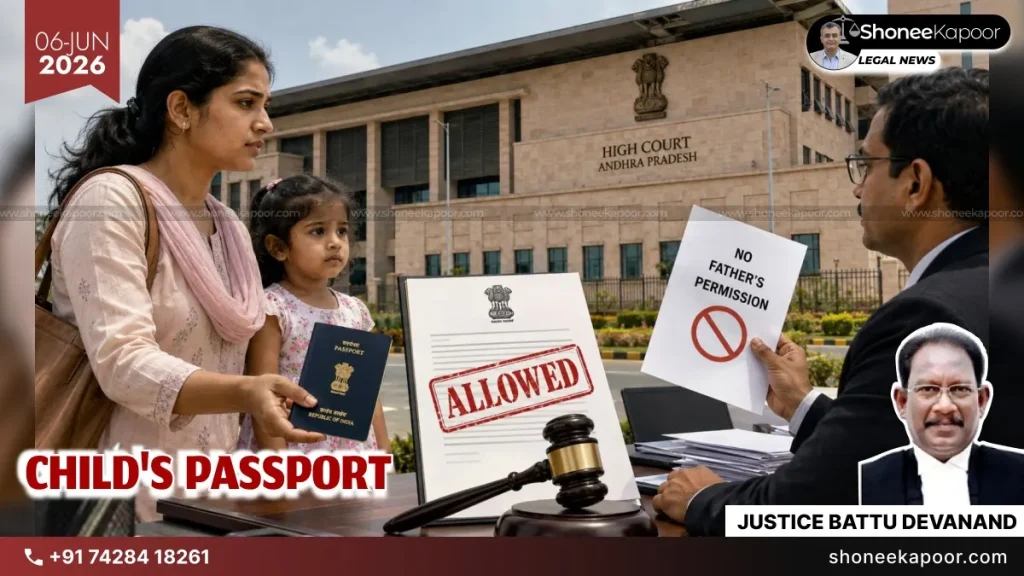
Does a father’s consent have no value in issuing a child’s passport?
Andhra Pradesh High Court says a child’s passport cannot be blocked merely due to the father’s non-consent when the prescribed declarations are filed and no court order prohibits issuance.
DIVORCE AMARAVATI: The Andhra Pradesh High Court, in a judgment delivered by Justice Battu Devanand on May 1, 2026, held that a single mother can obtain a passport for her minor child without the consent or signature of the father, provided she complies with the Passport Rules and there is no court order prohibiting issuance of the passport.
The case arose from a dispute between estranged spouses. The petitioner had been living separately from her husband since 2022 and was taking care of their four-year-old daughter. She applied for a passport for the child and submitted the prescribed declarations stating that she was a single parent.
However, the Passport Authorities allegedly refused to process the application and insisted that she produce divorce proceedings, judicial separation documents, or a court order before the passport could be issued.
The Passport Authorities argued that consent of both parents is ordinarily required for issuance of a minor’s passport. Since the father had not consented and no supporting documents relating to divorce or judicial separation were produced, the application was kept on hold.
While allowing the petition, the High Court relied on several decisions of the Bombay, Telangana, Madhya Pradesh and Madras High Courts which have consistently held that a single parent can apply for a minor child’s passport without the consent of the other parent if the prescribed declarations are furnished.
The Telangana High Court observed:
“It is inconceivable in this day and age that a single parent who is no longer in touch with the other parent of the minor child ‘for whatever reason’, as Column 16 states would be made to suffer a statutory embargo in applying for a passport for the minor child.”
The Court noted that the Passport Act and Passport Rules do not give one parent a veto over a child’s passport merely because matrimonial disputes are pending. It noted that denying a child’s passport solely because one parent refuses consent would unnecessarily affect the child’s rights and future opportunities. Referring to earlier precedents, the Court reiterated that the right to travel abroad forms part of personal liberty protected under Article 21 of the Constitution.
The Andhra Pradesh High Court ultimately held that once the required Annexure-C and Annexure-D declarations are submitted and there is no prohibitory order from a competent court, a passport application cannot be rejected merely because the other parent has not given consent. The Court therefore directed the Regional Passport Officer to process the minor child’s passport application within two weeks.
EXPLANATORY TABLE: LAWS AND SECTIONS INVOLVED
| Law / Provision | Purpose | How It Applied In This Case |
| Article 226, Constitution of India | Gives High Courts power to issue writs against illegal actions of authorities. | The petitioner approached the High Court seeking a writ against the Passport Authorities. |
| Article 21, Constitution of India | Protects life and personal liberty. | The Court relied on precedents holding that the right to travel abroad is part of personal liberty. |
| Article 19, Constitution of India | Protects various freedoms guaranteed to citizens. | The petitioner argued that refusal to process the passport violated her fundamental rights. |
| Section 151 CPC | Gives courts inherent powers to pass necessary orders for justice. | An interim application was filed seeking immediate processing of the passport application. |
| Passports Act, 1967 | Governs issuance, refusal and regulation of passports in India. | The Court found no provision barring a single parent from applying for a minor child’s passport. |
| Passport Rules, 1980 | Prescribe procedures and documentation for passport applications. | The Court relied on provisions permitting single parents to apply through Annexure-C and Annexure-D declarations. |
| Section 6, Passports Act, 1967 | Lists grounds on which a passport may be refused. | Earlier judgments cited by the Court held that lack of consent from one parent is not a ground under Section 6. |
| Section 420 IPC | Punishes cheating and dishonestly inducing delivery of property. | Mentioned as one of the criminal cases filed by the petitioner against her husband. |
| Section 498A IPC | Punishes cruelty by husband or relatives. | Matrimonial proceedings between the parties were pending under this provision. |
| Section 34 IPC | Deals with acts done by several persons in furtherance of common intention. | Invoked along with Sections 420 and 498A IPC in the criminal case. |
| Sections 3 & 4, Dowry Prohibition Act, 1961 | Punish giving, taking and demanding dowry. | The petitioner had initiated proceedings under these provisions against her husband. |
| Domestic Violence Act Proceedings (DVC No.74/2023) | Provides civil remedies to women facing domestic violence. | The petitioner had also initiated domestic violence proceedings which were pending. |
CASE DETAILS
- Case Title: Shaik Shabana v. Union of India & Others
- Case Number: Writ Petition No. 2768 of 2026
- Court: Andhra Pradesh High Court at Amaravati
- Bench: Justice Battu Devanand
- Date of Judgment: 1 May 2026
- Neutral Citation: APHC010047812026
- Counsels:
- For Petitioner: Ms. K. Pallavi
- For Respondents: Mr. Thenepalli Niranjan, Standing Counsel for Central Government
KEY TAKEAWAYS
- A single parent can apply for a minor child’s passport without the consent or signature of the other parent if the prescribed declarations are furnished.
- The Passport Act and Passport Rules do not prohibit issuance of a passport merely because the parents are separated and no divorce decree exists.
- Passport Authorities cannot insist on divorce proceedings, judicial separation orders, or similar documents when the rules do not specifically require them.
- In the absence of a court order prohibiting issuance of a passport, the application must be considered in accordance with the Passport Rules.
- Separated fathers must proactively secure their parental rights through legal proceedings, as the absence of a prohibitory order may allow administrative decisions to proceed without their consent.
This Could Change Your Case-Get FREE Legal Advice-Click Here!
Disclaimer: The views and opinions expressed in this article are those of the Indian courts and do not necessarily reflect the official policy or position of “ShoneeKapoor.com” or its affiliates. This article is intended for informational and educational purposes only. The content provided is not legal advice, and viewers should not act upon this information without seeking professional counsel. Viewer discretion is advised.