
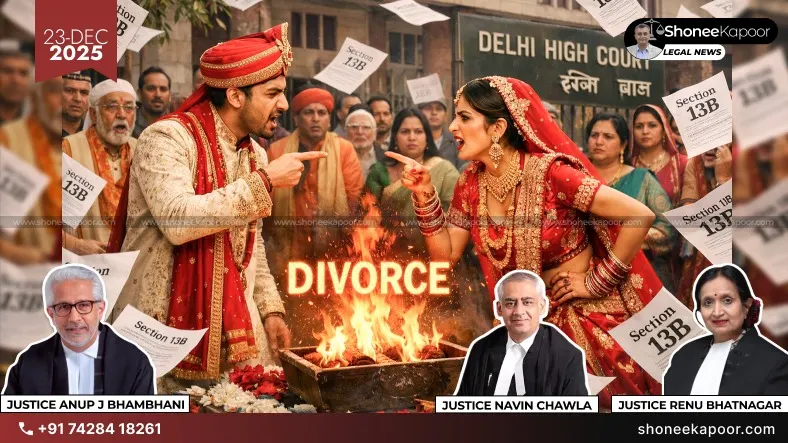
Delhi High Court has ruled that couples need not wait one full year before filing mutual consent divorce. Courts can waive timelines in genuine cases of hardship, dignity, and broken marriages.
NEW DELHI: The Delhi High Court has given a very important ruling on divorce by mutual consent under the Hindu Marriage Act, 1955. The Court has clearly held that the one-year separation period mentioned in Section 13B(1) of the Hindu Marriage Act is not compulsory and can be waived by the court in suitable cases.
A Full Bench of the Delhi High Court consisting of Justices Navin Chawla, Anup Jairam Bhambhani and Renu Bhatnagar examined the legal question in detail and concluded that the one-year separation requirement is directory in nature and not mandatory. This means that courts have the power to relax this condition instead of treating it as a rigid rule.
The Court explained that Section 13B(1) of the Hindu Marriage Act starts with the words “subject to the provisions of this Act”. Because of this wording, the section must be read together with the proviso to Section 14(1) of the Act.
The proviso to Section 14(1) allows courts to permit divorce petitions even before the completion of the statutory waiting period in cases involving “exceptional hardship” or “exceptional depravity”.
The High Court made it clear that if courts have the power to relax timelines even in contested divorce cases, there is no legal reason to deny the same flexibility in cases where both husband and wife mutually agree to dissolve the marriage.
The Court categorically ruled:
“The statutory period of 01-year prescribed under section 13B(1) of the HMA as a pre-requisite for presenting the first motion, can be waived, by applying the proviso to section 14(1) of the HMA”
-thereby settling the legal position on this issue.
The Bench further clarified that waiving the one-year separation period for filing the first motion under Section 13B(1) does not automatically mean that the six-month cooling-off period for the second motion under Section 13B(2) will also be waived. Both these timelines operate independently and must be examined separately by the court based on the facts of each case.
The Court observed:
“Where the court is satisfied that the 01-year period under section 13B(1) and the 06-month period under section 13B(2) of the HMA deserve to be waived, the court is not legally mandated to defer the date from which the divorce decree would take effect, and such decree may be made effective forthwith”
-making it clear that divorce can become effective immediately if circumstances justify such relief.
At the same time, the Court cautioned that such waivers cannot be granted casually. The judges stressed that relaxation of statutory timelines should not be allowed “merely for the asking” and must be granted only when the court is satisfied that there exists “exceptional hardship to the petitioner” and/or “exceptional depravity on the part of the respondent”.
This reference was answered by the Full Bench because there were conflicting judicial opinions on whether couples must compulsorily complete one year of separation before approaching the court for divorce by mutual consent.
While deciding the issue, the High Court reaffirmed and partly modified its earlier ruling in Sankalp Singh v. Prarthana Chandra. The Court held that Family Courts and High Courts do have the discretion to entertain a first motion for divorce even before completion of one year of separation.
In doing so, the Bench expressly overruled earlier judgments which had treated Section 13B of the Hindu Marriage Act as a “complete code” and had insisted that the one-year separation requirement was mandatory and incapable of waiver. According to the Court, such an approach ignores the changing realities of matrimonial relationships and undermines personal freedom.
The judges underlined that the heart of Section 13B is not strict timelines but the free and informed consent of both parties. The Court observed that forcing unwilling spouses to continue in a broken marriage serves no purpose and may amount to an unjustified intrusion into individual liberty, dignity, and autonomy protected under Article 21 of the Constitution of India.
Explanatory Table: Laws & Sections Discussed In The Case
| Law / Section | What It Says | How the Court Interpreted It |
| Section 13B(1), Hindu Marriage Act, 1955 | Allows divorce by mutual consent if parties have lived separately for one year and mutually agree to dissolve marriage | Held to be directory, not mandatory; one-year separation can be waived in exceptional cases |
| Section 13B(2), Hindu Marriage Act, 1955 | Requires six-month cooling-off period between first and second motion | Already held waivable by Supreme Court; waiver is independent of Section 13B(1) |
| Section 14(1), Hindu Marriage Act, 1955 | Bars filing of divorce petition within one year of marriage | Proviso allows waiver in cases of exceptional hardship or exceptional depravity |
| Proviso to Section 14(1), HMA | Court may allow early filing before one year | Applied to mutual consent divorce under Section 13B |
| Article 21, Constitution of India | Protects life, personal liberty, dignity, autonomy | Forcing parties to remain in broken marriage violates dignity and autonomy |
| Order 32-A Rule 3 CPC | Mandates reconciliation efforts in family disputes | Considered while assessing whether reconciliation has failed |
| Section 23(2), Hindu Marriage Act | Duty of court to attempt reconciliation | Relevant but not absolute where marriage is irretrievably broken |
| Section 9, Family Courts Act | Obligation to promote settlement | Cannot be used to prolong dead marriages |
| Article 142, Constitution of India | Supreme Court’s power to do complete justice | Referred for context in prior SC rulings on waiver |
| Section 13, Hindu Marriage Act | Contested divorce grounds | Compared to show waiver is allowed even in contested cases |
Case Sumary
- Case Title: ABC vs XYZ MAT.APP.(F.C.) 111/2025
- Court: Delhi High Court
- Date of Judgment: 17 December 2025
- Date Reserved: 19 September 2025
- Coram / Bench: Justice Navin Chawla, Justice Anup Jairam Bhambhani and Justice Renu Bhatnagar
Counsels Appearing
- Amicus Curiae: Mr. Rajsekhar Rao, Senior Advocate
- Assisting Advocates (Amicus):
- Ms. Aashna Chawla
- Mr. Ajay Sabharwal
- Mr. Wamic Wasim Nargal
- Mr. Zahid Laiq Ahmed
- For the Husband:
- Mr. Saurabh Kansal, Advocate
- Mr. Raghav Vij
- Mr. Suraj Kumar
- Ms. Ritul Sharma
- Mr. Pratham Malik
Key Takeaways
- Courts cannot legally force two adults, including men trapped in dead marriages, to wait arbitrarily when mutual consent to divorce is clear and genuine.
- The one-year separation rule under Section 13B(1) is not absolute; it can be waived to prevent unnecessary mental, emotional, and financial suffering of men.
- Timelines in matrimonial law exist for reconciliation, not to become tools of coercion, pressure, or prolonged legal harassment against husbands.
- Mutual consent and personal autonomy matter more than rigid procedures, and denying timely exit from a broken marriage violates dignity under Article 21.
- This judgment strengthens men’s rights by limiting misuse of delay tactics and ensuring courts focus on justice, consent, and real hardship rather than formalities.
This Could Change Your Case-Get FREE Legal Advice-Click Here!
Disclaimer: The views and opinions expressed in this article are those of the Indian courts and do not necessarily reflect the official policy or position of “ShoneeKapoor.com” or its affiliates. This article is intended for informational and educational purposes only. The content provided is not legal advice, and viewers should not act upon this information without seeking professional counsel. Viewer discretion is advised.