
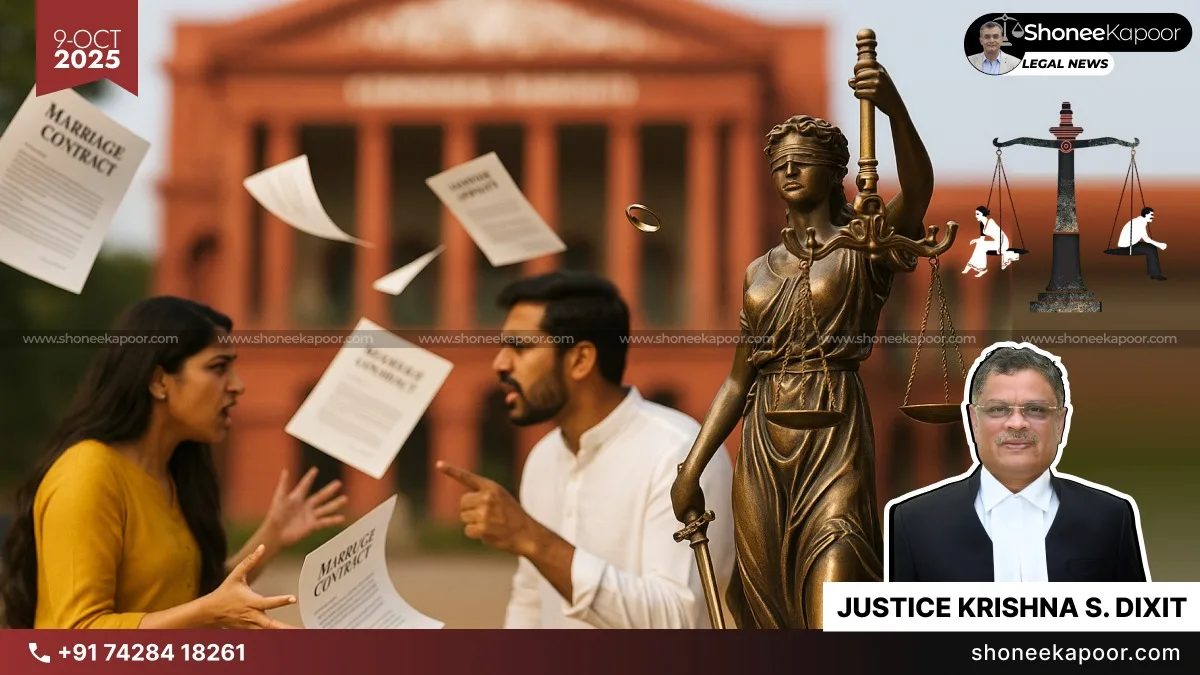
The Karnataka High Court directed that divorce cases or marriage nullity cases must be completed within one year, emphasizing that delays destroy lives. Justice Krishna S Dixit said, “Life is too short to be little,” urging family courts to act swiftly.
Bengaluru: The Karnataka High Court has strongly emphasized that matrimonial disputes, especially those seeking divorce cases or nullity, should not drag on for years. Justice Krishna S Dixit, while hearing Writ Petition No. 14769 of 2023 filed by N. Rajeev, stated that prolonged cases affect human life and dignity.
The petitioner had filed the case under Article 227 of the Constitution, seeking a direction to the Family Court to expedite proceedings in M.C. No. 2514/2016 pending for over seven years. His counsel, Advocate Basavaraj R Bannur, argued that the right to speedy justice is a constitutional guarantee under Article 21, and the delay violated this fundamental right.
Justice Dixit observed that when a matrimonial case involves a prayer for dissolution or nullity of marriage, courts must make all possible efforts to dispose of it within an outer limit of one year, so that the parties can move forward in life.
The Court beautifully remarked,
“When a matrimonial case involves the prayer for the dissolution/nullity of marriage, courts should make all efforts to try & dispose of the same within an outer limit of one year, so that in the event of granting such a decree, the parties may restructure their lives. It hardly needs to be stated ‘life is lost in living’. Delay in disposal of such cases very badly affects the parties thereto, needs no deliberation.”
The Judge quoted the famous British historian Thomas Carlyle (1795–1881) saying,
“Life is too short to be little.”
Justice Dixit further noted that courts must handle matrimonial cases “on a war footing”, considering the brevity of human life and the emotional trauma caused by long-pending cases:
“Having heard the learned counsel for the petitioner and having perused the Petition Papers, this Court is broadly in agreement with the proposition that the matrimonial causes should be tried & disposed off on a war footing, at least as a concession to the shortness of human life.”
He then directed the Family Court to dispose of the case within three months, keeping all contentions open.
The order stated:
“Learned Family Court Judge is requested to accomplish the trial & disposal of the subject seven-year-old case preferably within an outer limit of three months, all contentions having been kept open.”
Justice Dixit also ordered that the Registrar General circulate this judgment to all family courts in Karnataka to ensure uniform compliance:
“The Registrar General of this Court is instructed to circulate this judgment in all the concerned circles so that other similarly circumstanced litigants may not unnecessarily knock at the doors of this Court seeking a direction for the expeditious disposal of their cases.”
Finally, the Registry was directed to send a copy of this order to the respondent wife by Speed Post.

Explanatory Table: Laws & Sections
| Law / Provision | Full Name & Origin | Purpose / Scope | How It Was Applied in This Case | Key Legal Point Highlighted by the Court |
| Article 227 of the Constitution of India | Constitutional power of High Courts to supervise and control lower courts and tribunals. | Enables the High Court to direct subordinate courts to act within their jurisdiction or expedite proceedings. | The petitioner invoked this article to request the High Court to direct the Family Court to speed up his long-pending divorce case (M.C. No. 2514/2016). | The High Court used Article 227 to issue supervisory directions— ordering the Family Court to dispose of the case within three months. |
| Article 21 of the Constitution of India | Guarantees Right to Life and Personal Liberty, interpreted to include Right to Speedy Justice. | Protects every individual’s right to live with dignity and receive timely justice. | The petitioner argued that prolonged delay in his matrimonial case violated his fundamental right under Article 21. | The Court recognized speedy justice as a constitutional guarantee under Article 21. |
| Section 13(1)(ia) of the Hindu Marriage Act, 1955 | Provides grounds for divorce where one spouse has treated the other with cruelty. | Allows either husband or wife to seek divorce if cruelty (mental or physical) is proved. | The petitioner had filed a divorce petition under this section before the Family Court in 2016. | The High Court did not go into merits but directed speedy disposal of this divorce petition. |
| Section 13 of the Hindu Marriage Act, 1955 | General section dealing with dissolution of marriage (divorce) and nullity of marriage on various grounds like adultery, cruelty, desertion, etc. | Lays down the entire legal framework for divorce among Hindus. | The main matrimonial case (M.C. No. 2514/2016) was filed under this section. | The Court stated that when cases involve dissolution or nullity of marriage, they should be decided within one year so that parties can rebuild their lives. |
| Family Courts Act, 1984 (implied reference) | Establishes Family Courts for the expeditious settlement of family disputes. | Aims to provide specialized and speedy justice in matrimonial and family matters. | The directions were issued to the Family Court Judge to conclude the pending trial quickly. | The High Court emphasized that Family Courts must act “on a war footing” to resolve matrimonial cases promptly. |
| Registrar General’s Administrative Power (court direction) | Internal judicial mechanism within the High Court to circulate binding directions. | Ensures uniform compliance of High Court orders across subordinate courts. | Justice Dixit directed the Registrar General to circulate this judgment to all Family Courts. | The Court ensured that other litigants wouldn’t need to approach the High Court for similar delays. |
Case Summary
- Court: High Court of Karnataka at Bengaluru
- Case Title: Sri N. Rajeev v. Smt. C. Deepa
- Case Number: Writ Petition No. 14769 of 2023 (GM-FC)
- Date of Judgment: 26 July 2023
- Neutral Citation: 2023:KHC:25910
- Judge / Bench: Hon’ble Mr. Justice Krishna S. Dixit
- Petitioner: Sri N. Rajeev, S/o Late Y.C. Narayanappa, Aged about 41 years, Residing at No. 16/13, 2nd Main, Govindaraja Nagar, Bangalore – 560 040
- Respondent: Smt. C. Deepa, W/o Rajeev, D/o Shri Chandrashekar, Aged about 36 years, Residing at No. K-9, 3rd Main, Lakshminarayanapura, Above Nithya Jewelers, Bangalore – 560 021
- Counsel for Petitioner: Sri Basavaraj R. Bannur, Advocate
- Counsel for Respondent: Notice dispensed with (no appearance recorded)
- Provision Invoked: Article 227 of the Constitution of India
- Underlying Case: M.C. No. 2514/2016 filed under Section 13(1)(ia) of the Hindu Marriage Act, 1955 (for divorce on grounds of cruelty)
- Prayer in Petition: Direction to the V Additional Judge, Family Court, Bengaluru, to dispose of M.C. No. 2514/2016 within three months
- Key Observations: – “Life is too short to be little.” — Thomas Carlyle quoted by the Court. – “Life is lost in living.” – “Matrimonial causes should be tried & disposed of on a war footing, at least as a concession to the shortness of human life.”
- Core Holding: When a matrimonial case involves dissolution/nullity of marriage, courts should make all efforts to decide it within an outer limit of one year, so that parties can rebuild their lives.
- Direction Issued: – The Family Court to complete trial and dispose of the seven-year-old case within three months. – Registrar General to circulate this judgment to all concerned courts for uniform compliance. – Registry to send a copy to the respondent-wife by Speed Post.
- Legal Principle Reinforced: The Right to Speedy Justice under Article 21 extends to matrimonial disputes; justice delayed in marriage is justice denied.
Disclaimer: The views and opinions expressed in this article are those of the Indian courts and do not necessarily reflect the official policy or position of “ShoneeKapoor.com” or its affiliates. This article is intended for informational and educational purposes only. The content provided is not legal advice, and viewers should not act upon this information without seeking professional counsel. Viewer discretion is advised
