
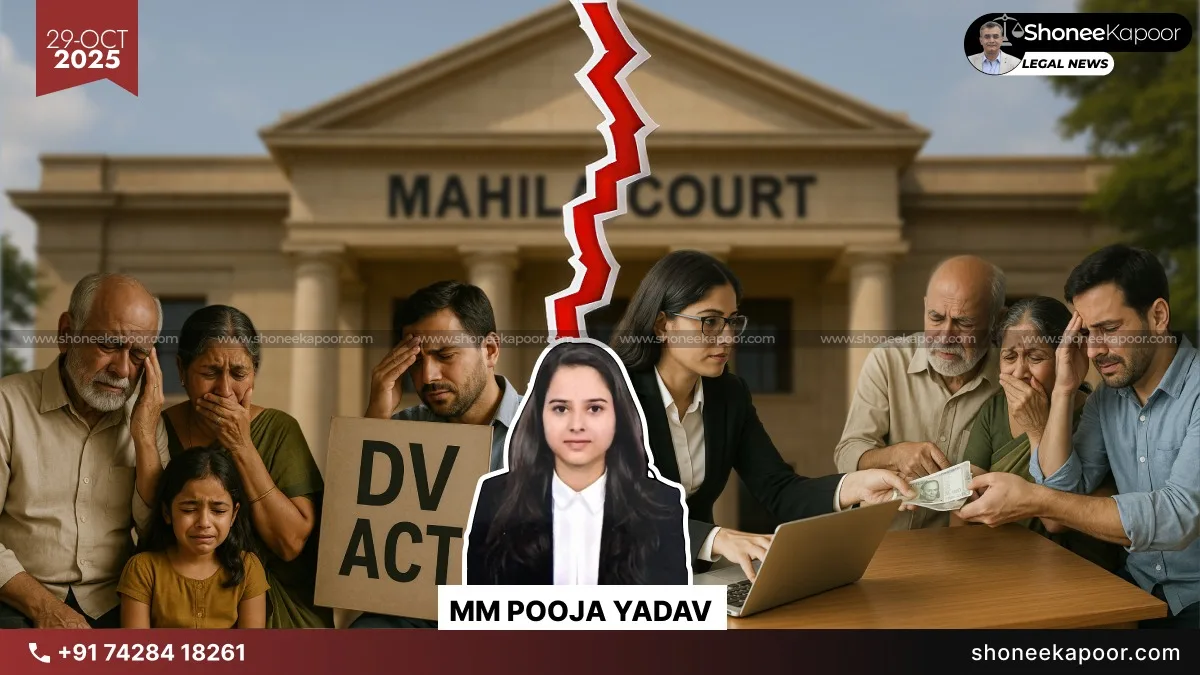
“Capable of Sustaining Herself”: Court Denies Maintenance to Law-Graduate Wife Under DV Act

Written and analysed by Shonee Kapoor
Legal Consultant, Author & Men's Rights ActivistIn a recent DV Act case, a Delhi court denies maintenance to an educated woman, holding that she is qualified, employable, and “capable of sustaining herself at this stage.” And ruled that no interim relief can be granted when the applicant has not proved any genuine obstacle to employment.
Court Denies Maintenance: A Delhi court denied a woman’s request for temporary maintenance under the Domestic Violence Act in a firm and reasonable decision, concluding that she is “capable of earning her livelihood,” well-qualified, and has prior work experience. The court stated that the judiciary must adopt a fair, fact-based stance because there is frequently a propensity for wives to overstate their financial need and for husbands to conceal their income in matrimonial disputes.
In response to an application filed under Section 23 of the Protection of Women from Domestic Violence Act, 2005, seeking financial relief from her estranged husband, a Metropolitan Magistrate (Mahila Court) issued this order.
Background of the Case
The woman, a law graduate, had requested temporary maintenance and rent under the Domestic Violence Act, arguing that she was unemployed and reliant on her brother following the termination of her contract with a government women’s commission as an advocate. She claimed that her husband, a B.Tech professional, made about ₹40,000 a month, with extra money coming from investments and ancestral property, and that she was subjected to mental and emotional abuse by her in-laws and husband over the dowry. Her advocate made the case that even a qualified woman is entitled to support once domestic violence is demonstrated, citing Rajnesh v. Neha (2020) and other precedents.
However, the husband painted a completely different picture, claiming that she had previously earned close to ₹50,000 a month, was a law graduate, and was a licenced advocate. He asserted that she was now practicing law, hiding her income, and choosing not to work on her own volition. He insisted that his ailing mother, age 66, was dependent on him and produced contracts that demonstrated his own erratic contractual income.
After reviewing the case law, bank statements, and income affidavits, the court concluded that the woman had failed to provide any evidence of financial hardship, had not provided any supporting documentation for her claimed expenses, and had multiple unexplained credit entries in her bank account despite her claims of unemployment. The court came to the conclusion that she is “capable of sustaining herself at this stage” and is not eligible for interim maintenance under Section 23 of the DV Act because of her credentials, work history, and overall health.
Court’s Observations
The court made several significant observations in regard to:
- Qualified & Employable: “The petitioner is a law graduate who previously earned approximately ₹50,000 per month. No material has been placed on record to show she is unable to work now or faces any genuine obstacle in seeking employment.”
- No Child or Dependents: “There is no child from the marriage or any responsibility that prevents her from earning.”
- Exaggerated Claims: The petitioner claimed ₹30,000 as monthly expenses and rent but produced no supporting evidence.
- Unexplained Bank Credits: “Several credit entries are seen in her bank account post-March 2024, which remain unexplained and cast doubt on her assertion that she is presently without any source of income.”
- Judicial Balance: “In matrimonial disputes, there is a tendency for wives to exaggerate their needs and husbands to understate their income. The court must therefore estimate a fair and reasonable earning capacity.”
final order:
The court concluded that, given her education, work experience, and lack of genuine financial hardship, the petitioner is capable of sustaining herself. Accordingly, her plea for interim monetary relief was dismissed at this stage. The court clarified that the final decision on her main petition under Section 12 DV Act will be made after evidence and trial.
“The petitioner’s claim for interim maintenance is disallowed. Relief under Section 12 shall be decided on merits upon conclusion of trial.”
Legal Significance
This order strengthens the growing judicial approach that maintenance is meant for survival, not convenience. When an educated and employable spouse deliberately chooses not to work, courts are justified in denying interim maintenance.

The judgment re-centres the DV Act’s monetary relief on genuine financial need rather than entitlement. By recognizing that wives often inflate expenses while husbands understate earnings, the court underlines the importance of honest financial disclosure; echoing the Supreme Court’s Rajnesh v. Neha guidelines.
The order discourages the misuse of interim-relief provisions as quick-money tactics. It reminds litigants that Section 23 is meant for urgent protection, not to weaponize litigation during trial. It sets a persuasive precedent for magistrates handling maintenance claims: education, employability, and access to opportunities must be considered before granting relief. This promotes consistency, accountability, and judicial efficiency in DV proceedings.
Explanatory Table Of All Laws And Sections Mentioned
| Case / Provision | Citation / Section | Explanation / Relevance in the Case |
| Protection of Women from Domestic Violence Act, 2005 | Section 23 | Provides the right of appeal from a Family Court judgment to the High Court. |
| Protection of Women from Domestic Violence Act, 2005 | Section 12 | Ground for divorce based on cruelty — includes mental, emotional, and psychological cruelty. |
| Rajnesh v. Neha & Anr. | Section 28 | Provides for appeals in matrimonial cases. |
| Niharika Ghosh @ Kundu v. Shankar Ghosh | Section 21B | Mandates speedy trial and disposal of matrimonial petitions. The Court cited this to criticize delay. |
| Sudhanshu Jaggi v. State (Govt. of NCT Delhi) & Anr. | Section 151 | Empowers courts to act in the interest of justice when delay or misuse of process occurs. |
Case Summary
| Category | Details |
| Case Title | XYZ v. ABC |
| Court | Metropolitan Magistrate (Mahila Court), Delhi |
| Judge | Metropolitan Magistrate (Pooja Yadav) |
| Type of Order | Interim Application under Section 23 DV Act |
| Statutory Grounds | Protection of Women from Domestic Violence Act, 2005 – section 12 and 23 |
| Result | Application dismissed |
| Key Observation | Qualified, employable women cannot claim maintenance without genuine incapacity. |
| Core Quote of Judgment | “The petitioner is capable of sustaining herself at this stage.” |
When Empowerment Meets Accountability: A Judgment Everyone Should Read
Education is more than just a degree to show off in a maintenance petition, as a court had to remind everyone once more. It is not patriarchy when a law graduate tells the court she is powerless; rather, it is performance.
Men have long been taught that being chivalrous entails covering someone else’s expenses when she is more than capable of doing so herself. This order reverses that logic: you cannot claim poverty on paper if you are eligible. When a man demands justice, it’s sanity, not cruelty. Playing the victim in spite of opportunities is not empowerment; rather, it is entitlement. The ruling subtly states what many people are afraid to state aloud: The Domestic Violence Act is a safety net, not a pay plan.
This Could Change Your Case-Get FREE Legal Advice-Click Here!
Disclaimer: The views and opinions expressed in this article are those of the Indian courts and do not necessarily reflect the official policy or position of “ShoneeKapoor.com” or its affiliates. This article is intended for informational and educational purposes only. The content provided is not legal advice, and viewers should not act upon this information without seeking professional counsel. Viewer discretion is advised.
Related Articles
Can an Educated Wife Claim Maintenance from Her Husband? The Legal Reality No One Explains
Indian courts recognise education and earning capacity, yet husbands are still routinely ordered to pay maintenance.I...
Alimony vs Maintenance in India: The Real Legal Difference Every Man Must Know Before Divorce
Alimony and maintenance are not the same, but Indian courts often blur the line, creating lifelong financial pressure...

Why More Men Are Afraid Of Marriage Today: Law, False Cases, Maintenance Fear & The Indian Courtroom Reality
Indian men are not afraid of marriage. They are afraid of one-sided legal risk, false 498A/85 BNS cases, maintenance ...
Relevant Judgements
Can an NRI Husband Be Forced to Pay Maintenance in India? Supreme Court Rules Explained for Overseas Indian Men
Living abroad does not automatically protect an NRI husband from maintenance claims in India.But can Indian courts pa...
Share Your Thoughts
Comments are moderated before publication.