
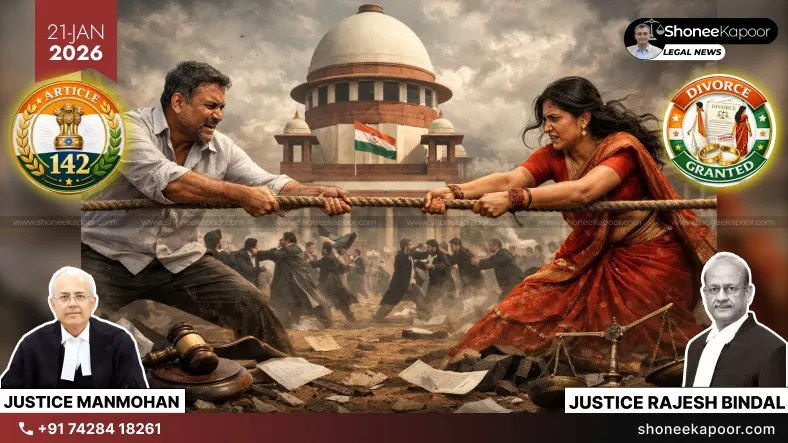
Dead Marriages Should Not Be Kept Alive Artificially: Supreme Court Ends Husband-Wife Litigation, Perjury Continues Against Wife

Written and analysed by Shonee Kapoor
Legal Consultant, Author & Men's Rights ActivistThe Supreme Court ended a husband-wife legal battle where the couple lived together for only 65 days but fought 40+ cases for over 13 years, turning courts into a battlefield. While granting divorce and closing all matrimonial disputes, the Court allowed perjury proceedings to continue against the wife for false affidavits. The judgment sends a clear warning that misuse of law will face accountability even after marital closure.
NEW DELHI: The Supreme Court dissolved a dead marriages where the couple lived together for only 65 days and fought more than 40 cases for over a decade. While bringing an end to all matrimonial disputes, the Court allowed perjury proceedings to continue against wife, clearly warning that misuse of law and false statements before courts will not be tolerated.
The long and bitter legal battle between Neha Lal and Abhishek Kumar finally came to an end in the Supreme Court. Their marriage was solemnised on 28 January 2012, but the relationship collapsed within just 65 days. By 2 April 2012, the couple had separated and never lived together again. What should have been a private marital issue soon turned into a prolonged legal war stretching across more than 13 years.
Soon after separation, both sides began filing cases against each other in different courts. Criminal complaints, maintenance proceedings, domestic violence cases, divorce petitions, execution matters, revisions, and writ petitions kept multiplying. The litigation spread across family courts, district courts, High Courts, and eventually reached the Supreme Court. Instead of resolving the conflict, each new case deepened hostility and hardened positions.
The dispute reached the Supreme Court through a transfer petition filed by the wife. During hearings, both parties placed detailed lists of cases on record. When the Court verified these details from concerned courts, it found that the volume of litigation was unusually high. The judges observed that the parties were no longer seeking justice or reconciliation but had turned courts into a battlefield for personal revenge.
The Bench noted that reconciliation efforts had completely failed. Even mediation referred by the Supreme Court could not begin meaningfully. The judges observed that the bitterness between the parties had crossed the point of no return and there was no emotional bond left to preserve.
The Court made it clear that forcing such a marriage to continue would serve no purpose. When parties remain separated for more than a decade and keep fighting case after case, the marriage cannot be treated as alive in any meaningful sense. Continuing a formal legal relationship in such circumstances only increases mental, financial, and emotional suffering.
The Supreme Court therefore applied a simple and practical test. The long separation, repeated litigation, failure of mediation, absence of emotional connection, and complete impossibility of reunion clearly showed that the marriage had completely broken down. The judges found no chance of rehabilitation or cohabitation between the parties.
While dealing with the manner in which the litigation was conducted, the Court made a strong observation:
“Warring couples cannot be allowed to settle their scores by treating Courts as their battlefield and choke the system.”
The judges also expressed concern over the growing tendency to criminalise matrimonial disputes at the very first instance. They cautioned that once criminal law is set in motion, the chances of reconciliation are almost destroyed, and the conflict only becomes more bitter and irreversible.
The Court issued a clear warning against false cases and dishonest pleadings: “No one can be permitted to pollute the stream of justice.”
Taking all these factors into account, the Supreme Court exercised its extraordinary power and dissolved the marriage. The Court noted that the wife had not claimed any alimony, and therefore all monetary claims stood settled.
At the same time, the Court carefully separated matrimonial closure from legal accountability. All pending cases arising purely out of the matrimonial dispute were ordered to be closed to bring finality and peace to the matter.
However, proceedings related to perjury and false statements against wife were specifically allowed to continue. The Court made it clear that allegations of false affidavits, fabrication of records, and misleading the courts must be examined on merits and cannot be wiped out simply because the marriage has ended.
The Court also imposed costs of ₹10,000 on each party, observing that both sides had contributed to prolonged and unnecessary litigation that consumed valuable judicial time.
Through this judgment, the Supreme Court sent a strong message. Dead marriages should not be kept alive artificially through endless litigation. At the same time, misuse of law, false cases, and dishonest conduct before courts will not be protected. Justice is not only about closing disputes but also about preserving the credibility and purity of the justice system.
Explanatory Table – Laws & Sections Involved
| Law / Section | Meaning in Simple Language | How It Was Used in This Case |
| Article 142 – Constitution of India | Gives Supreme Court special power to pass any order to do complete justice. | Used by the Supreme Court to dissolve the marriage despite opposition and multiple pending cases. |
| Section 340 CrPC | Allows court to start criminal action for lying on oath, false affidavit, or fake evidence (perjury). | Husband filed perjury cases against wife for alleged false affidavits and concealment. These cases were allowed to continue. |
| Section 379 BNSS (New Criminal Code) | New provision replacing old perjury-related procedure under criminal law. | Applied in perjury proceedings related to false statements and documents. |
| Section 215 BNSS | Procedural provision linked with criminal trial defects and errors. | Tagged along with Section 379 BNSS in perjury applications. |
| Section 125 CrPC (Old Code) | Maintenance law for wife, children, parents. | Maintenance case was part of earlier litigation history. |
| Section 127 CrPC | Modification or cancellation of maintenance order. | Husband filed proceedings seeking modification of maintenance. |
| Section 144 BNSS (Earlier Section 125 CrPC equivalent) | New maintenance provision under BNSS. | Maintenance-related proceedings pending earlier. |
| Section 24 Hindu Marriage Act (HMA) | Interim maintenance and litigation expenses during divorce. | Application was filed and dismissed. |
| Section 13 Hindu Marriage Act | Divorce provision under Hindu law. | Divorce cases were filed in multiple courts earlier. |
| Domestic Violence Act (PWDV Act) | Protection law for domestic violence complaints. | DV cases were filed and disposed. |
| Section 498A IPC | Cruelty by husband or relatives. | FIR registered earlier; husband was acquitted. |
| Sections 406, 323, 504, 506 IPC | Criminal breach of trust, assault, abuse, criminal intimidation. | Various criminal cases filed between parties. |
| Section 156(3) CrPC | Court direction to police to register FIR. | Application was filed seeking fresh FIR. |
| Section 482 CrPC (Old Code) | High Court power to quash criminal cases. | Used in multiple petitions before High Courts. |
| Family Courts Act, Section 10 | Procedure for family court trials. | Application filed and dismissed earlier. |
Case Details
- Case Title: Neha Lal vs Abhishek Kumar
- Court: Supreme Court of India
- Jurisdiction: Criminal Original Jurisdiction
- Case Number: Transfer Petition (Crl.) No. 338 of 2025, Along with I.A. No. 200539 of 2025
- Date of Judgment: 20 January 2026
- Bench: Justice Rajesh Bindal & Justice Manmohan
- Counsels / Appearance
- Petitioner (Wife): Represented by Counsel
- Respondent (Husband): Appeared In-Person
Key Takeaways
- A marriage that survived only 65 days but dragged courts for 13+ years proves how matrimonial laws are routinely misused to harass men through endless litigation.
- The Supreme Court clearly exposed that couples cannot convert courts into personal battlegrounds, reinforcing that legal systems are not tools for revenge or pressure tactics.
- Perjury cases against the wife were deliberately kept alive, sending a strong warning that filing false affidavits and lying in court will attract criminal consequences.
- This judgment validates what men’s rights activists have been saying for years — false cases collapse families, destroy careers, and clog courts while real justice suffers.
- The ruling strengthens the demand for strict action against fake cases, accountability for misuse of gender laws, and urgent reforms for gender-neutral matrimonial justice.
This Could Change Your Case-Get FREE Legal Advice-Click Here!
Disclaimer: The views and opinions expressed in this article are those of the Indian courts and do not necessarily reflect the official policy or position of “ShoneeKapoor.com” or its affiliates. This article is intended for informational and educational purposes only. The content provided is not legal advice, and viewers should not act upon this information without seeking professional counsel. Viewer discretion is advised.
Related Articles
Alimony vs Maintenance in India: The Real Legal Difference Every Man Must Know Before Divorce
Alimony and maintenance are not the same, but Indian courts often blur the line, creating lifelong financial pressure...
Can an Educated Wife Claim Maintenance from Her Husband? The Legal Reality No One Explains
Indian courts recognise education and earning capacity, yet husbands are still routinely ordered to pay maintenance.I...
NRI Divorce Litigation in India: Step By Step Legal Guide, Real Cases, Real Data, Real Struggles
The article explores how cross-border marriages turn into complex legal battles when love meets the limits of jurisdi...
Relevant Judgements
Can an NRI Husband Be Forced to Pay Maintenance in India? Supreme Court Rules Explained for Overseas Indian Men
Living abroad does not automatically protect an NRI husband from maintenance claims in India.But can Indian courts pa...
Share Your Thoughts
Comments are moderated before publication.