
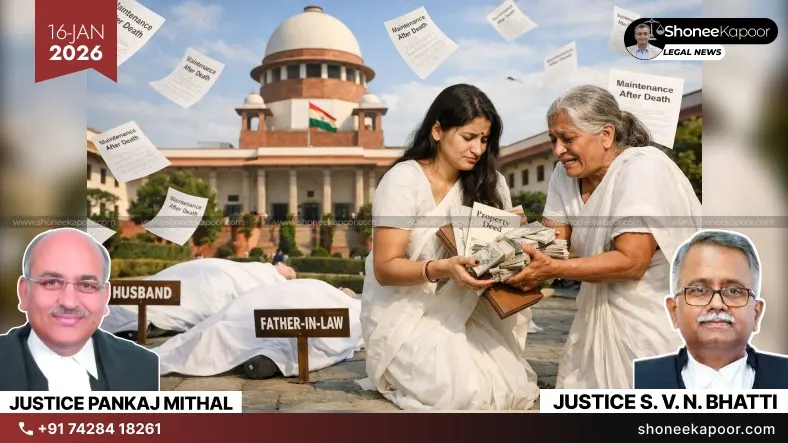
The Supreme Court has ruled that a widowed daughter-in-law can seek maintenance from her father-in-law’s estate even if she became a widow after his death. The judgment clarifies Hindu maintenance law while placing financial responsibility on heirs who inherit property.
NEW DELHI: In a judgment affecting Hindu family property and maintenance laws, the Supreme Court of India has held that a widowed daughter-in-law is legally entitled to claim maintenance from her father-in-law’s estate even if her husband died after the father-in-law’s death. The Court made it clear that the timing of widowhood does not cancel a woman’s status as a dependant under Hindu law.
The case was decided by a Bench of Justices Pankaj Mithal and S.V.N. Bhatti. While interpreting the Hindu Adoptions and Maintenance Act, 1956 (HAMA), the Court also referred to traditional Hindu law and quoted Manusmriti to explain the moral foundation behind maintenance obligations within a family.
Quoting Chapter 8, Verse 389 of Manusmriti, the Court recorded:
“No mother, no father, no wife, and no son deserves to be forsaken. A person who abandons these blameless (relatives) should be fined six hundred (units) by the king. This verse emphasizes duty of the family head to support female family members.”
The Court observed that even in modern law, the idea behind maintenance remains the same. Those who inherit the property of a deceased person must also take responsibility for family members who were dependent on him.
The dispute arose after the death of Mahendra Prasad in December 2021. He was survived by three sons — Ranjit Sharma, Devinder Rai and Rajeev Sharma. Ranjit Sharma died later in March 2023. After his death, his widow Geeta Sharma approached the Family Court seeking maintenance from her father-in-law’s estate under HAMA, stating that she had no sufficient means to maintain herself from her husband’s property or any other source.
The Family Court rejected her claim, holding that since she was not a widow on the date her father-in-law died, she could not be treated as his “dependant.” According to the Family Court, her legal status on the date of death alone was relevant.
Geeta Sharma challenged this order before the High Court. The High Court reversed the Family Court’s decision and held that what matters is whether she is a widow of the deceased person’s son, not the exact date on which she became a widow. The High Court held her petition to be maintainable and sent the case back to the Family Court to decide the amount of maintenance.
Two appeals were then filed before the Supreme Court. One appeal was filed by Kanchana Rai, the wife of Devinder Rai, who argued that the maintenance case itself was not maintainable. The second appeal was filed by Uma Devi, who claimed to be in a long-term live-in relationship with Mahendra Prasad and argued that Geeta Sharma had no right to claim maintenance from his estate.
The Supreme Court framed the core legal question as whether a daughter-in-law who becomes a widow after her father-in-law’s death can still be treated as a “dependant” and claim maintenance from his estate.
While answering this, the Court closely examined Chapter III of the Hindu Adoptions and Maintenance Act. Section 21 of the Act defines “dependants” and includes “any widow of his son” subject to certain conditions. The Court pointed out that the law does not use the words “widow of a predeceased son.” It simply says “any widow of his son.”
The Bench made it clear that when the language of a statute is clear and unambiguous, courts cannot add or subtract words. The judges’ said courts are not allowed to rewrite laws based on assumptions or personal notions of fairness.
Referring to earlier judgments on statutory interpretation, the Court noted that judges cannot “repair” or “correct” a law by inserting words which the legislature deliberately did not use.
The Court further held that even otherwise, denying maintenance only because a woman became a widow after her father-in-law’s death would be unfair and unconstitutional. The judges explained that such an interpretation would create two classes of widows based only on timing — something completely beyond their control.
The Court observed that both categories of widows suffer the same loss of spousal support and face similar financial vulnerability. Treating them differently would be arbitrary and would violate Article 14 of the Constitution, which guarantees equality before law. The Court also said that such denial could violate Article 21, as it could push a woman into poverty and strip her of a dignified life.
After analysing the statute and constitutional principles, the Court once again referred to traditional Hindu law to explain the social duty behind maintenance. While HAMA overrides old Hindu law, the Court said ancient principles can still guide the understanding of moral responsibility within families.
The Court explained that under Section 22 of HAMA, all heirs who inherit the estate of a deceased Hindu are legally bound to maintain the dependants from that estate. Even if a dependant does not receive any share in the property, she can still claim maintenance from those who inherited it.
The Bench also clarified the difference between Section 19 and Section 22 of HAMA. It stated that Section 19 applies during the lifetime of the father-in-law, while Section 22 applies after his death. Therefore, a widowed daughter-in-law can claim maintenance from the father-in-law when he is alive under Section 19, and from his estate after his death under Section 22, provided she qualifies as a dependant.
The Supreme Court finally held that the words “any widow of his son” clearly include a woman who becomes a widow even after her father-in-law’s death. On this basis, both appeals were dismissed, and the High Court’s order allowing Geeta Sharma’s maintenance case to proceed was upheld.
Explanatory Table: Laws & Sections Involved In This Case
| Law / Provision | Section / Article | Simple Explanation | How It Applied in This Case |
| Hindu Adoptions and Maintenance Act, 1956 | Section 21 (vii) | Defines who is a “dependant” under Hindu law, including “any widow of his son” if she cannot maintain herself | The Court held that this wording is clear and includes a widow even if her husband died after the father-in-law |
| Hindu Adoptions and Maintenance Act, 1956 | Section 22 | Makes all heirs who inherit property responsible to maintain dependants from the estate | Used to hold that heirs of Mahendra Prasad must maintain Geeta Sharma from the inherited estate |
| Hindu Adoptions and Maintenance Act, 1956 | Section 19 | Deals with maintenance of widowed daughter-in-law during the lifetime of the father-in-law | Clarified to show the difference between maintenance during lifetime (Section 19) and after death (Section 22) |
| Hindu Adoptions and Maintenance Act, 1956 | Chapter III | Entire chapter dealing with maintenance of dependants | Interpreted to understand the structure and intent of maintenance law |
| Constitution of India | Article 14 | Guarantees equality before law and protection against arbitrary classification | Court held that denying maintenance based on timing of widowhood would be arbitrary |
| Constitution of India | Article 21 | Right to life and dignity, including livelihood and basic sustenance | Court held denial of maintenance could push a widow into destitution and violate dignity |
| Hindu Law (Manusmriti) | Chapter 8, Verse 389 | Moral duty of family members not to abandon close relatives | Quoted to support the ethical basis of maintenance obligations |
| Judicial Precedent | Crawford v. Spooner | Courts cannot add or repair words in a statute | Used to justify strict literal interpretation of Section 21 |
| Judicial Precedent | B. Premanand v. Mohan Koikal | Literal interpretation is the rule, even if hardship results | Reinforced that courts cannot rewrite laws |
| Judicial Precedent | Vinod Kumar v. DM, Mau | Clear statutory language must be followed as written | Supported rejection of restrictive interpretation |
Case Details
- Case Title: Kanchana Rai v. Geeta Sharma & Ors. With Uma Devi v. Geeta Sharma & Ors.
- Neutral Citation: 2026 INSC 54
- Court: Supreme Court of India
- Jurisdiction: Civil Appellate Jurisdiction
- Appeal Numbers: Civil Appeal Nos. of 2026 (Arising out of SLP (C) Nos. 1544–1545 of 2026 and SLP (C) No. 1737 of 2026)
- Date of Judgment: 13 January 2026
- Bench: Justice Pankaj Mithal & Justice S. V. N. Bhatti
Counsels
- For the Appellants:
- Senior Advocate V. Giri
- Senior Advocate Arvind Nayyar
- Senior Advocate Abhishek Manu Singhvi
- Advocate B. Shravanth Shanker
- Advocate Rahul Narang
- Advocate D. Abhinav Rao
- For the Respondents:
- Senior Advocate Vikas Singh
- Advocate Varun Singh
- Advocate Nitin Saluja
- Advocate Deepeika Kalia
- Advocate Alankriti Dwivedi
- Advocate Somesa Gupta
- Advocate Sudeep Chandra
- Advocate Khushi
Key Takeaways
- Property inheritance is no longer just a right; it now carries open-ended financial liability for male heirs who may have had no role in the dispute.
- The timing of events beyond anyone’s control has been declared irrelevant, yet the financial burden is firmly fixed on surviving family members.
- Men inheriting ancestral or family property can face maintenance claims years later, even when personal relationships had already ended.
- The judgment reinforces that statutory wording, once expanded by courts, can convert moral duties into compulsory legal obligations.
- This ruling highlights the growing imbalance where financial responsibility survives death, but legal safeguards for inheriting men remain limited and undefined.
This Could Change Your Case-Get FREE Legal Advice-Click Here!
Disclaimer: The views and opinions expressed in this article are those of the Indian courts and do not necessarily reflect the official policy or position of “ShoneeKapoor.com” or its affiliates. This article is intended for informational and educational purposes only. The content provided is not legal advice, and viewers should not act upon this information without seeking professional counsel. Viewer discretion is advised.
