
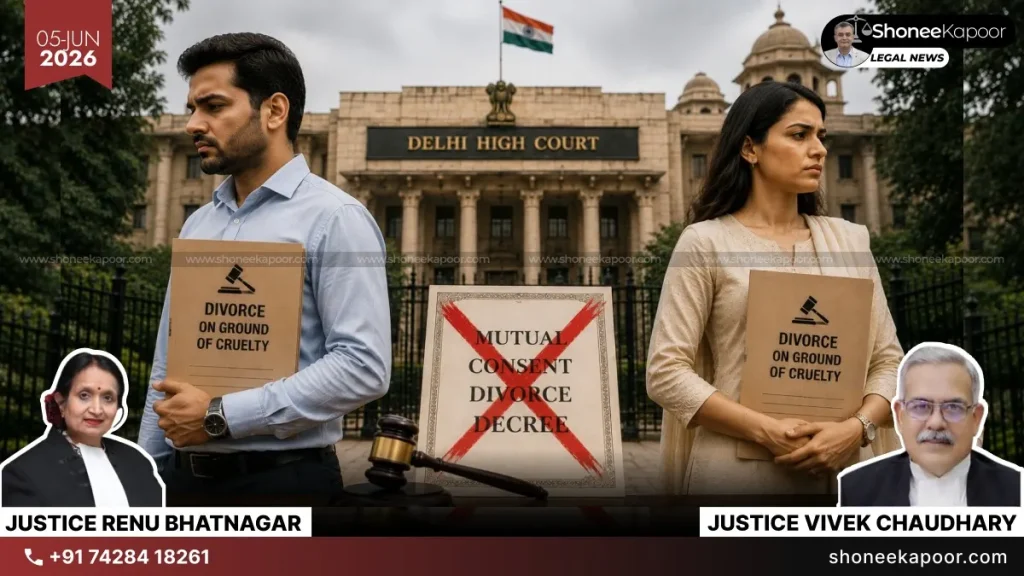
Can courts grant mutual consent divorce when both spouses accuse each other of cruelty?
Delhi High Court says No, separate divorce petitions by husband and wife do not automatically become a mutual-consent divorce case.
NEW DELHI: In a judgment dated 29 May 2026, Justice Vivek Chaudhary and Justice Renu Bhatnagar of the Delhi High Court held that a Family Court cannot grant divorce by mutual consent merely because both spouses have separately sought dissolution of marriage.
The husband had filed a divorce petition under Section 13(1)(ia) of the Hindu Marriage Act alleging cruelty. The wife contested the case and filed a counterclaim seeking divorce on the same ground. However, instead of deciding the allegations through trial, the Family Court dissolved the marriage under Section 13B of the Hindu Marriage Act, which deals with divorce by mutual consent.
The wife challenged the order before the High Court, arguing that the mandatory requirements for mutual consent divorce were never fulfilled.
Agreeing with her, the High Court observed:
“Section 13 permits a petition by either spouse, whereas Section 13B requires a petition to be presented by both parties together.”
The Court explained that a mutual consent divorce is based on a joint decision of both parties and not merely on the fact that each spouse independently wants a divorce.
The Bench stated:
“Separate prayers for divorce may show that the parties no longer wish to continue the marriage, but that is not the same as a joint and mutual decision to seek divorce under Section 13B of the HMA.”
The Court found that there was no joint petition, no first motion, no second motion and no finding regarding continuing mutual consent as required under Section 13B.
Rejecting the Family Court’s reliance on its procedural powers, the High Court observed:
“Section 10 of the Act deals with procedure; it does not empower the Family Court to alter, dilute, or substitute the conditions prescribed under the HMA for grant of a decree of divorce by mutual consent.”
Relying on the Supreme Court’s decision in Anil Kumar Jain v. Maya Jain, the Court reiterated:
“The second proposition is that although the Supreme Court can, in exercise of its extraordinary powers under Article 142 of the Constitution, convert a proceeding under Section 13 of the Hindu Marriage Act, 1955, into one under Section 13-B and pass a decree for mutual divorce, without waiting for the statutory period of six months, none of the other courts can exercise such powers.”
The High Court further observed:
“Mutual consent cannot be inferred from the mere filing of separate divorce petitions, nor can it be substituted by the independent desire of each party to end the marriage in their individual way.”
Setting aside the Family Court’s order, the Court held:
“Where the law prescribes a particular mode for dissolution of marriage by mutual consent, the Court cannot adopt an alternative route merely because it appears to be more practical or expedient.”
Accordingly, the divorce decree was quashed, and the parties’ petitions for cruelty were restored for trial before the Family Court. The High Court clarified that it has not expressed any opinion on the merits of the allegations made by either side.
EXPLANATORY TABLE: LAWS AND SECTIONS INVOLVED
| Law / Section | Purpose | How It Was Used In This Case |
| Section 19, Family Courts Act, 1984 | Provides right to appeal Family Court judgments before the High Court | Wife filed appeal against the Family Court’s divorce decree |
| Section 13(1)(ia), Hindu Marriage Act, 1955 | Allows divorce on the ground of cruelty | Husband filed divorce petition alleging cruelty; wife also alleged cruelty in counterclaim |
| Section 23A, Hindu Marriage Act, 1955 | Allows respondent spouse to seek relief through counterclaim | Wife filed a counterclaim seeking divorce on the ground of cruelty |
| Section 13B(1), Hindu Marriage Act, 1955 | Provides for filing a joint petition for divorce by mutual consent | High Court held that no such joint petition was filed by the parties |
| Section 13B(2), Hindu Marriage Act, 1955 | Requires second motion and continuing consent before decree of divorce | Family Court granted divorce without following this mandatory procedure |
| Section 10(3), Family Courts Act, 1984 | Gives procedural flexibility to Family Courts | Family Court relied upon it; High Court held it cannot override substantive requirements of HMA |
| Article 142, Constitution of India | Gives Supreme Court power to do complete justice in exceptional cases | High Court held only Supreme Court can convert certain proceedings into mutual consent divorce using Article 142 powers |
CASE DETAILS
- Case Title: Ranjana Mittal v. Manish
- Case Number: MAT.APP.(F.C.) 162/2025 & CM APPL. 25766/2025
- Court: Delhi High Court
- Bench: Justice Vivek Chaudhary | Justice Renu Bhatnagar
- Neutral Citation: 2026:DHC:4770-DB
- Date Of Judgment: 29 May 2026
- Counsel:
- For Appellant: Mr. Ankit Gupta, Advocate
- For Respondent: Ms. Annu Sharma, Advocate
KEY TAKEAWAYS
- Wanting a divorce and agreeing to a mutual consent divorce are legally different things. Courts cannot assume consent simply because both spouses seek separation.
- Mutual consent divorce requires a joint petition, continuing consent, and compliance with Section 13B HMA.
- Family Courts cannot bypass statutory requirements in the name of practicality or speedy disposal. Convenience cannot replace due process.
- Contested allegations deserve adjudication. When both sides allege cruelty, evidence must be examined instead of converting the case into a mutual consent divorce.
- Courts must follow the procedure prescribed by Parliament rather than creating alternative routes to dissolve marriages.
This Could Change Your Case-Get FREE Legal Advice-Click Here!
Disclaimer: The views and opinions expressed in this article are those of the Indian courts and do not necessarily reflect the official policy or position of “ShoneeKapoor.com” or its affiliates. This article is intended for informational and educational purposes only. The content provided is not legal advice, and viewers should not act upon this information without seeking professional counsel. Viewer discretion is advised.