
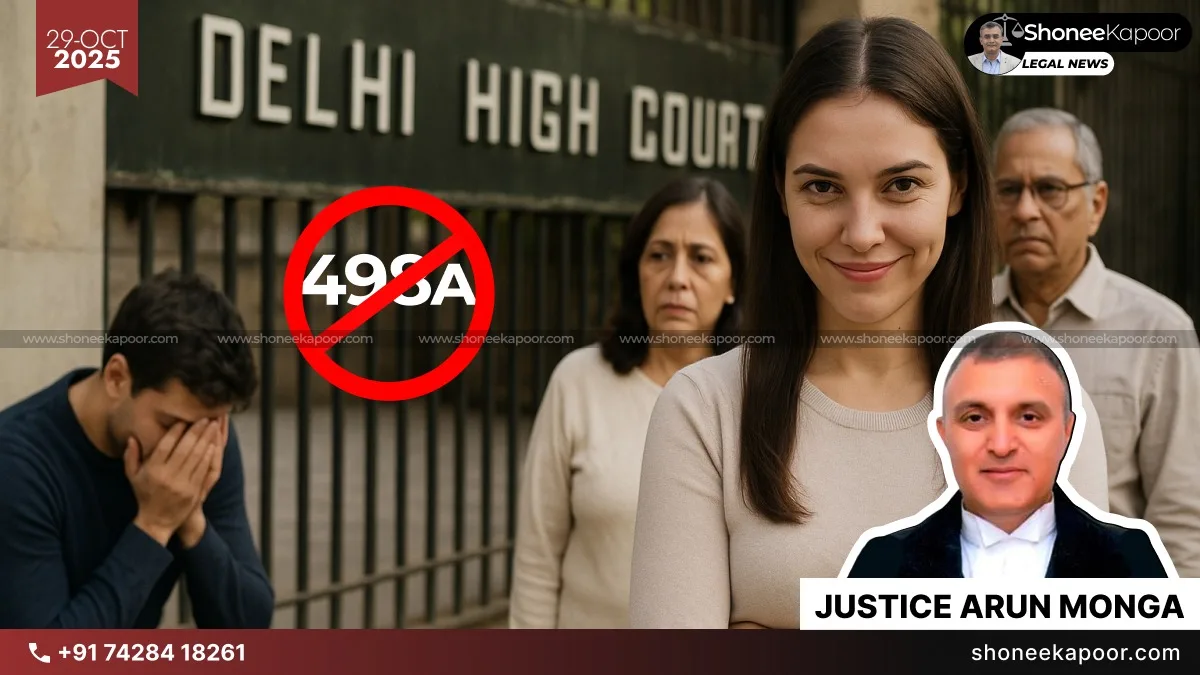
Delhi High Court Warns Against Misuse of 498A IPC: “Maliciously Dragging Husband’s Family is Utter Misuse of Law”

Written and analysed by Vaibhav Ojha
Head Of Legal CommunicationsThe Delhi High Court, while quashing a false dowry harassment case, cautioned against the growing misuse of 498A IPC. The Court emphasized that innocent relatives of the husband must not suffer due to vague and baseless allegations.
NEW DELHI: The Delhi High Court has strongly flagged the increasing misuse of 498A of the Indian Penal Code (IPC), which was originally meant to protect women from dowry-related cruelty.
The Court noted that there is a growing “tendency to maliciously implicate a man’s relatives” in matrimonial disputes, which amounts to an “utter misuse” of the law.
Section 498A IPC was enacted to safeguard married women against cruelty by their husbands and in-laws, prescribing punishment of up to three years in prison.
However, in recent years, courts across India have raised concerns about its misuse through false or exaggerated complaints targeting the husband’s entire family.
Justice Arun Monga of the Delhi High Court made this observation while quashing criminal proceedings against a woman’s sister-in-law who had been wrongly accused under Section 498A IPC.
“No doubt, section 498-A of the IPC was introduced to protect women from dowry related harassment and cruelty by their husbands and in-laws. However, an increased tendency to implicate the husband’s relatives in matrimonial disputes, without proper scrutiny, for extraneous and malicious reasons, would be its utter misuse,”
the Court remarked, stressing that the misuse of this legal protection must be stopped to “prevent the harassment of innocent individuals.”
Further, the Court highlighted that while Section 498A IPC is crucial for protecting genuine victims, its exploitation through vague and unverified complaints weakens the system and causes unnecessary distress.
“While Section 498A IPC is crucial for protecting women from matrimonial cruelty and dowry harassment, its misuse through broad and unsubstantiated allegations against the husband’s relatives must be checked. Only if the allegations stand the legal scrutiny and prima facie exist, that proceedings in trial should then continue. For, such an approach protects innocent individuals from facing unnecessary litigation and consequential hardships, harassment and humiliation in the matrimonial crossfire,”
-the Court said in its detailed judgment.
Justice Monga also pointed out that frivolous and concocted complaints not only harm the accused but also put pressure on the judiciary and dilute the law’s credibility.
“Long-term ramifications of proceeding with patently unbelievable allegations and baseless cases causes unnecessary additional burden on judicial system, miscarriage of justice and has a detrimental impact on the personal life of the accused person. It also risks discrediting the genuine purpose of Section 498A IPC, which is, to provide protection and justice to victims of dowry harassment and matrimonial cruelty.”
In the specific case before the Court, the wife had made general and vague allegations of cruelty against her husband’s sister without any specific instances or supporting evidence.
“General and omnibus allegations, which are broad and non-specific cannot and, as in the present case do not withstand legal scrutiny. Such allegations, if unchecked, can lead to the misuse of the process of law. This misuse could result in unnecessary trials that can have long-term ramifications for all parties involved.”
The Court further remarked that such false allegations not only cause emotional distress and social stigma to innocent people but also undermine genuine cases of abuse.
“It is the duty of the court to prevent harassment of individuals have no substantial involvement in the alleged matrimonial cruelty.”
In conclusion, the Delhi High Court quashed the criminal case against the sister-in-law and clarified that the trial may continue only against other co-accused if the allegations against them are substantiated.

This judgment once again reinforces the judiciary’s consistent stance that Section 498A must protect the genuine, not persecute the innocent.
Explanatory Table – All Laws & Sections Mentioned
| Statute / Section | Provision Title | Purpose / Explanation (Simplified) | Court’s Observation in this Case |
| Section 498A IPC | Cruelty by husband or relatives of husband | Protects married women from cruelty or harassment for dowry or any unlawful demand; punishable with up to 3 years’ imprisonment + fine. | “No doubt, Section 498A IPC was introduced to protect women from dowry related harassment … However, an increased tendency to implicate the husband’s relatives … would be its utter misuse.” |
| Section 482 CrPC | Inherent powers of High Court | Empowers the High Court to quash criminal proceedings to prevent abuse of process and secure ends of justice. | Used by the petitioner to seek quashing of false 498A case; Court allowed the petition. |
| Dowry Prohibition Act, 1961 (referred implicitly) | Prohibits demand, giving, or taking of dowry | Read with 498A in dowry-harassment matters. | Court reiterated that the genuine intent of dowry laws must not be diluted by false cases. |
| Indian Penal Code (General) | Penal Code – criminal offences framework | Defines and punishes offences, including cruelty under 498A. | Court stressed balance – law must protect victims but not punish innocents. |
| Criminal Procedure Code (CrPC) | Procedure in criminal cases | Section 482 used to intervene when legal process is abused. | Court used inherent powers to prevent misuse and harassment. |
Case Summary
| Field | Details |
| Case Title | Pooja Rasne v. State of NCT of Delhi and Others |
| Case No. | CRL.M.C. 2561 of 2023 |
| Court | High Court of Delhi |
| Bench | Hon’ble Mr. Justice Arun Monga |
| Date of Judgment | 29 August 2025 |
| Petitioner | Pooja Rasne (wife’s sister-in-law / accused) |
| Respondents | State (NCT of Delhi) and Complainant (Wife) |
| Type of Petition | Petition under Section 482 CrPC – quashing of criminal proceedings under Section 498A IPC |
| Counsel for Petitioner | Mr. Amit Kumar Yadav, Advocate |
| Counsel for Respondent No. 1 (State) | Mr. Ashish Dutta, APP for the State with SI Dinesh Kumar |
| Counsel for Respondent No. 2 (Complainant Wife) | Mr. Rohit Kumar, Advocate |
| Result | Criminal proceedings against petitioner (sister-in-law) quashed; trial to continue only against other co-accused if evidence exists. |
Disclaimer: The views and opinions expressed in this article are those of the Indian courts and do not necessarily reflect the official policy or position of “ShoneeKapoor.com” or its affiliates. This article is intended for informational and educational purposes only. The content provided is not legal advice, and viewers should not act upon this information without seeking professional counsel. Viewer discretion is advise.
Related Articles
Karisma Kapoor – Sunjay Kapur Case Explained: Marriage, Divorce, 498A, Death & the Delhi High Court Property War
From a celebrity wedding to IPC 498A allegations, a Supreme Court-linked divorce settlement, and now a Delhi High Cou...

The Law That Forgot Its Sons: How India’s Gender Laws Turn Protection into Persecution
India’s gender laws were designed to protect women — but today, countless innocent men are being destroyed by false c...
498A FIR in India While Husband Is in Canada: What an NRI Husband Must Do Immediately Before Police, LOC or NBW Pressure Begins
An NRI husband in Canada facing 498A IPC or Section 85 BNS FIR in India must preserve evidence, check jurisdiction, a...
Share Your Thoughts
Comments are moderated before publication.