
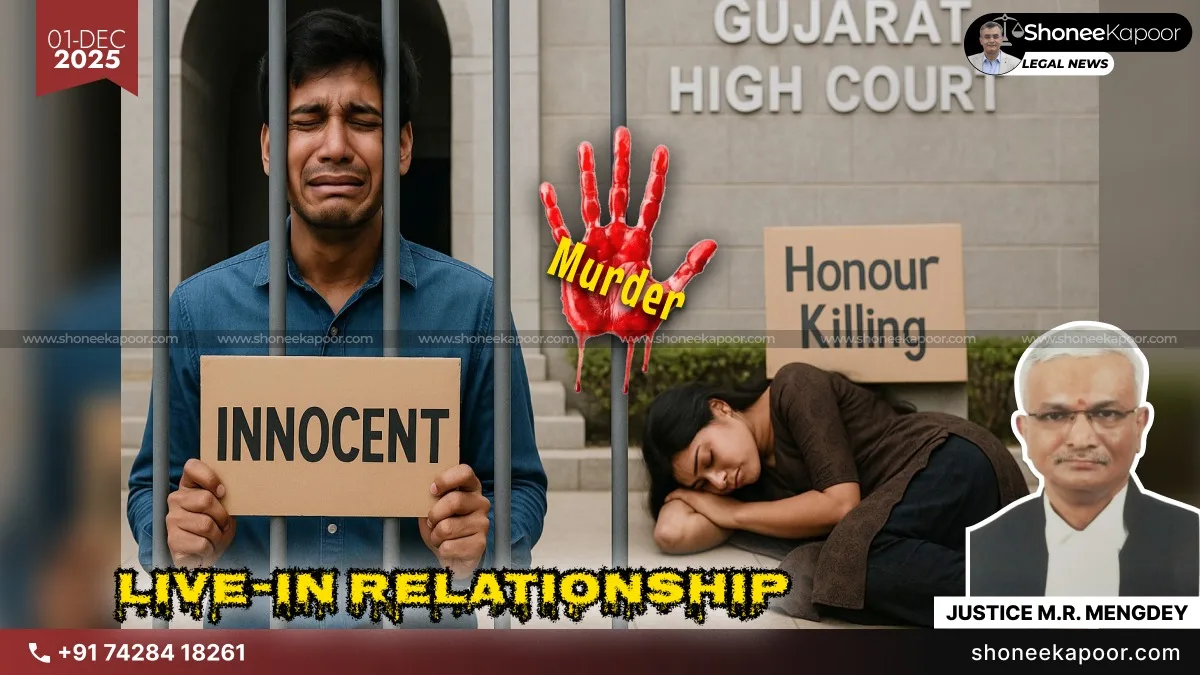
The Gujarat High Court has temporarily stopped the investigation ordered against a man who himself was the complainant in an alleged honour killing case. The court said that the trial court’s remarks needed deeper examination before allowing further action.
Court Stops Probe Against Man: In a major relief, the Gujarat High Court stayed the investigation ordered by the Tharad Sessions Court against a man who had filed an FIR regarding the alleged honour killing of his “live-in” partner.
Justice M.R. Mengdey passed an interim order noting that the petitioner was actually the complainant in the FIR registered at Tharad Police Station, and yet the trial court had made observations suggesting that he could also be treated as an accused.
The High Court noted from the record that the petitioner was the complainant in FIR C.R.No.11195050250670/2025. The sessions court, while granting bail to one of the co-accused, had made strong remarks.
The order stated:
“10. It appears from the record that the complainant was very well aware about the fact that in environment and society from which the he and the deceased belongs, act committed by the complainant, is not acceptable by the society or family of the deceased and the complainant also knew the mentality and customs of his society very well, had committed such a serious act, which resulted in owner killing.”
The trial court further stated that:
“Hence, the offence punishable under Section 46 of the BNS may be made out against the applicant and he may be considered as Abettor of the present crime. From the perusal fo the complaint and record available on record, the complainant of the present case can be considered as an accused who committed the offence regarding culpable homicide which describes in Section 100 of the BNS and the act done by the complainant may be considered the offence punishable under Section 101(d) of the BNS. Therefore, the Investigating Officer should conduct the investigation keeping this aspect in mind and submit a detailed report in the context of the investigation.”
The sessions court had then directed the police:
“11) Hence, the I.O./P.I., Tharad Police Station is directed to take appropriate action keeping in mind the facts mentioned in the complaint and Para 7 to 10 of this order and submit the report of the action to this Court on or before 01.12.2025. The situation should be come to the knowledge of the the Superintendent of Police, Vav-Tharad District, hence a copy of this order also be sent the the Superintendent of Police Vav-Tharad District.”
The trial court also discussed the bail of the co-accused and said that the applicant’s role was lesser than that of the main accused, adding that he had been in custody since August 2025 and deserved bail.
It said:
“12. Now, come to the present application, I have considered the nature and gravity of the present case, role attributed to the present applicant and considering the fact that the role of the applicant is not directly committing the murder of the deceased, his role is lesser than the main accused persons who had committed the murder of the deceased and the applicant has been in custody since 09.08.2025 and the trial of the case may taken some more time, this Court is of the opinion that the present applicant should be released on regular bail…”
The trial court then passed this order:
“ORDER
The Criminal Misc. Application No. 467/2025 is hereby allowed.
The applicant Naranbhai Savabhai Patel is ordered to be released on bail…
The applicant shall not take undue advantage…
The applicant shall not contact the complainant…
The applicant is directed to download E-Courts App…
The applicant shall not leave India…
The surety…
The Investigating Officer is directed to verify the permanent addresses…
A copy of this order be sent to the DSP…
A yadi of this order be sent to the concerned Police Station.”
After reading these remarks, the complainant approached the Gujarat High Court seeking quashing of the directions issued by the sessions court, as those remarks indirectly turned the complainant into an accused.
The High Court, after hearing the matter briefly, issued notice and granted interim protection.
The court stated:
“Ad-interim relief in terms of Para-12(D) is granted till the next date of hearing.”
The next hearing before the Gujarat High Court is scheduled for March 6, 2026.
According to the FIR, the deceased was an 18-year-old girl who had entered into a “mutual friendship (live-in) agreement” with the 23-year-old complainant, who was already married. The sessions court had stated:
“Environment and society from which the complainant and the deceased belongs, such acts are not acceptable by the society and that the complainant knew very well that when a young daughter of a family runs away with a married boy and lives in a ‘live-in relationship’, then the respect of the family gets tarnished in the society…. yet he still did so, which according to the court could have provoked the family into committing a serious crime.”
The FIR alleges that four accused strangled the girl with a dupatta and later tried to pass the incident off as suicide by hanging the body.
The High Court has now halted further proceedings against the complainant until the next hearing, making it clear that the trial court’s approach needs judicial review.
Explanatory Table Of All Laws & Sections Mentioned
| Section / Law | Law (BNS / Code) | Meaning in Simple English | How Court Referred to It |
| Section 46, BNS | Bharatiya Nyaya Sanhita | Abetment of a crime – encouraging or provoking someone to commit a crime. | Sessions Court said offence under this may be made out against the complainant as abettor. |
| Section 100, BNS | BNS | Culpable homicide – killing a person without the intention of murder but with knowledge that the act can cause death. | Court said complainant “can be considered as an accused who committed the offence regarding culpable homicide”. |
| Section 101(d), BNS | BNS | Certain forms of homicide punishable under specific circumstances. | Court said complainant’s act “may be considered the offence punishable under Section 101(d)”. |
| Section 103(1), BNS | BNS | Relates to murder / causing death with intention. | Mentioned as one of the offences against the bail applicant (co-accused). |
| Section 123, BNS | BNS | Possibly connected with wrongful restraint / kidnapping / confinement (depending on classification). | Added in FIR to show multiple serious offences. |
| Section 238, BNS | BNS | Tampering with evidence / destroying evidence after crime. | FIR included it since body was allegedly hung to show suicide. |
| Section 61(2), BNS | BNS | Relates to common intention or group liability. | Applied because multiple accused acted together. |
| Section 54, BNS | BNS | Act likely to cause harm / endanger life. | Added due to strangulation allegation. |
| Live-In Relationship Agreement | Not a statute; contractual understanding | Means both partners agree to live together voluntarily. | Court noted they had “executed a mutual friendship (live-in) agreement.” |
| Bail Principles (Sanjay Chandra v. CBI, SC Judgment) | Supreme Court | Bail should not be punitive; custody not needed if trial will take long. | Used by Sessions Court to grant bail to co-accused. |
- Case Title: Hareshbhai Hirjibhai Chaudhari Vs State Of Gujarat & Anr.
- Court & Bench: High Court of Gujarat at Ahmedabad
- Single Judge Bench: Hon’ble Mr. Justice M.R. Mengdey
- Case Type & Number: R/Special Criminal Application (Quashing) No. 15647 of 2025
- Order Date: 27 November 2025
- Petitioner: Hareshbhai Hirjibhai Chaudhari (Complainant in the FIR)
Respondent: State of Gujarat
Appearance / Counsels
- For Petitioner:
- Mr. Divyaraj J. Dodiya
- Rafik Lokhandwala
- For State: Mr. Himanshu Patel, APP
Relief Granted by High Court
- Notice issued, returnable on 06.03.2026
- Ad-interim relief granted in terms of Para-12(D)
Key Takeaways
- A man who was the complainant in an alleged honour killing was almost turned into an accused, showing how easily systems shift blame onto men.
- The Gujarat High Court had to step in because the trial court’s observations unfairly stretched the man’s responsibility for choices made by adults.
- The narrative again tried to paint the man as an abettor simply because of societal pressure, proving how men become soft targets in sensitive cases.
- Even in a situation where the girl’s own family is accused of murder, the complainant man was dragged into criminal suspicion without direct involvement.
- The case exposes how men in relationships, especially live-in arrangements, face disproportionate legal and social blame for acts committed by others.
This Could Change Your Case-Get FREE Legal Advice-Click Here!
Disclaimer: The views and opinions expressed in this article are those of the Indian courts and do not necessarily reflect the official policy or position of “ShoneeKapoor.com” or its affiliates. This article is intended for informational and educational purposes only. The content provided is not legal advice, and viewers should not act upon this information without seeking professional counsel. Viewer discretion is advised.
