
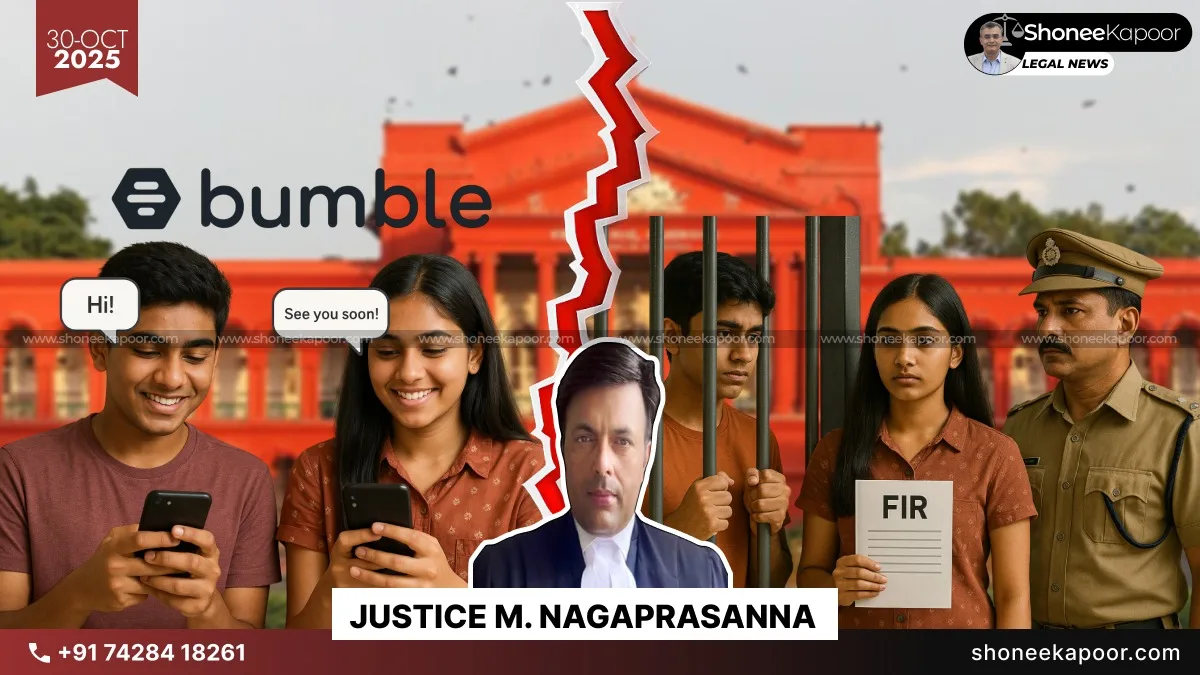
Bumble Date, Consensual Intimacy, and a Rape FIR | Karnataka High Court Slams False Rape Case Against a 23-year-old

Written and analysed by Shonee Kapoor
Legal Consultant, Author & Men's Rights ActivistIn a bold judgment, Karnataka HC quashed a false rape case FIR arising from a dating-app relationship, calling it an abuse of criminal law against men.
BENGALURU: The Karnataka High Court dismissed a false rape case against a 23-year-old Bengaluru youth in a matter, decided on October 25, 2025, stating that the evidence presented showed a voluntary and reciprocal relationship. The petitioner and the complainant first connected on the dating app Bumble, then continued to communicate on Instagram before meeting in person at “Plan B Restaurant on BEL Road”.
From there, they went to a hotel room where they had an intimate encounter. Later, the woman claimed to have withdrawn her consent in the middle of sexual intercourse, which resulted in the filing of FIR under Section 64 of the Bharatiya Nyaya Sanhita (BNS) at the Konanakunte Police Station in Bengaluru.
Facts of the case
In what the Court referred to as “the virtual corridors of modern social media,” the dating app Bumble is where the petitioner, Mr. Sampras Anthony, and the complainant first connected. Through Instagram, where they regularly exchanged pictures, videos, and chats, they maintained their friendship for more than a year.
Both agreed to have their first face-to-face meeting on the morning of August 11, 2024. They met at a restaurant called “Plan B, BEL Road, Bengaluru”, and had a meal together. Around 7:30 p.m. that same evening, the petitioner brought the woman to a Bengaluru’s hotel room. The woman alleged that once inside the hotel, the petitioner “began to seduce her into sexual intercourse”, to which she initially consented but then “instantly withdrew consent”.
On 13th august, 2024 she went to file a written police complaint at the Konanakunte Police Station, Bengaluru, where she addressed that “Despite my repeated objections and clear instructions to not proceed further, Sampras refused to listen.He continued to engage in sexual intercourse disregarding my express withdrawal of consent.”
She also added that: “I repeatedly requested him to stop and continuously questioned his motives despite which he persisted in having sex against my will.”
The next morning, 12 August 2024, Sampras dropped the complainant back at her apartment at around 7:30 a.m. She reportedly had stomach pain later that day and the following day, so on August 13, 2024, she went to Ramaiah Hospital for a checkup. Based on her discomfort and her claim that “she had been assaulted, she lodged a formal complaint the same day, demanding “appropriate action against the perpetrator.”
Police investigation:
The police registered the case under Section 64 of the Bharatiya Nyaya Sanhita (BNS), former Section 376 IPC (rape). The petitioner was arrested, investigated, and later charge-sheeted before the Additional Chief Metropolitan Magistrate, Bengaluru. The charge sheet summarized that the accused and complainant met on Bumble, stayed in the hotel on 11 August 2024, and that the accused “had sexual intercourse despite her objections.”
Petitioner’s Defence:
The petitioner contended that every aspect of the interaction, including the physical intimacy and online conversations, was voluntary.Even though the conversations and images were “personal,” they amply refuted the claim of coercion or force.The investigating officer had deliberately omitted this digital evidence from the charge sheet The case was an abuse of process born out of regret or emotional fallout after a voluntary encounter.
State’s Stand:
The Additional State Public Prosecutor, opposed quashing, arguing that the woman’s statement that she withdrew consent mid-act sufficed to constitute rape under Section 64 BNS. Whether the relationship was consensual or not should be decided during trial, not at the quashing stage. The High Court should therefore dismiss the writ and let the case proceed to evidence.
Although, the Court noted that the complainant was served notice but did not appear or contest the proceedings, which left only the State’s arguments to oppose quashing.
Background of the Procedure:
In order to quash the FIR, complaint, and charge sheet as an abuse of the criminal process, the petition was filed in accordance with Article 226 of the Constitution read with Section 528 of the Bharatiya Nagarik Suraksha Sanhita (BNSS), 2023. Justice M. Nagaprasanna heard the case on September 18, 2025, and rendered a decision on October 25, 2025.
Court’s Findings
Justice M. Nagaprasanna, after examining the FIR, the complaint, and the investigation papers, made a series of pointed legal and factual findings:
The Court acknowledged that relationships born out of dating apps and social media must be assessed within the realities of modern consent, and not through moral assumptions: “The petitioner and the 2nd respondent are drawn together in the labyrinth of modern social media, become acquainted through the virtual corridors of the dating application ‘Bumble’ and thereafter, nurtured their acquaintance for over years through the exchange of images and conversations upon the platform of Instagram.”
Justice Nagaprasanna summarized the allegation succinctly, noting that the core accusation was the alleged withdrawal of consent during intimacy, an assertion unsupported by corroborative evidence: “The factual canvass is narrow, the entire issue being rooted in the complaint dated 13-08-2024. The complainant avers that she withdrew her consent midway, but the petitioner nevertheless proceeded.”
The Judge emphasized that courts must “guard against the criminalization of private, consensual conduct” and that criminal law “cannot be a tool to punish emotional failure.”
Citing the Supreme Court’s rulings in the following, the Judge reiterated that “consensual acts between adults, even if followed by regret or disappointment, cannot attract criminal liability under Section 64 of the BNS.”
- Dr. Dhruvaram Murlidhar Sonar v. State of Maharashtra (2019 18 SCC 191),
- Tilak Raj v. State of Himachal Pradesh (2016 4 SCC 140), and
- Deepak Gulati v. State of Haryana (2013 7 SCC 675),
Court’s Final Order:
For the aforesaid reasons, the following:
- Writ Petition is allowed.
- FIR before the XXX Additional Chief Metropolitan Magistrate, Bengaluru, stand quashed.
Thus, Court quashed the FIR and criminal Compliant holding that the proceedings were “an abuse of process of law” and “a ritualistic procession towards miscarriage of justice.”
Legal Significance of this judgement
Considering India’s new criminal codes, this ruling marks a sea change in the jurisprudence surrounding men’s rights. The Karnataka High Court has established a landmark distinction between consent and criminalization by dismissing the rape FIR against a 23-year-old man for a consensual dating app encounter.
A clear message is conveyed by Justice M. Nagaprasanna’s decision: the law cannot be used as a tool for emotional revenge. The Court acknowledged that consent must be interpreted as reciprocal, contextual, and ongoing rather than as a means of punishing regret in the era of contemporary relationships, where intimacy frequently develops through social media and dating apps.
The Court has reiterated, for the first time under the Bhartiya Nyaya Sanhita (BNS), that Section 64 (rape) cannot be used when the evidence demonstrates that both adults participated voluntarily. It provides a legal buffer for men who, after a relationship ends badly, are the targets of unfounded or inflated accusations.
The ruling supports the ideas that a broken relationship is not illegal and that judges should avoid using personal grievances as grounds for criminal charges. It brings gender-neutral justice back into balance by serving as a reminder to the public, prosecutors, and investigators that false accusations have the same devastating power as actual crimes.
Explanatory Table Of Laws, Cases & Sections Referenced
| Law / Case Name | Section / Citation | Explanation / Relevance in our case |
|---|---|---|
| Bharatiya Nyaya Sanhita (BNS), 2023 | Section 64 | Defines the offence of rape under the new criminal code. The FIR was registered under this section. The Court found that the evidence reflected a consensual act, not a violation of this section. |
| Bharatiya Nagarik Suraksha Sanhita (BNSS), 2023 | Section 528 | Gives the High Court authority to quash criminal proceedings to prevent misuse of process. The petition was filed under this section along with Article 226 of the Constitution. |
| Constitution of India | Article 226 | Empowers High Courts to issue writs to protect citizens’ rights and prevent abuse of process. Invoked here to quash the FIR and charge sheet. |
| Dr. Dhruvaram Murlidhar Sonar v. State of Maharashtra | (2019) 18 SCC 191 | Supreme Court held that consensual sex arising from mutual relationship or affection cannot later be termed “rape.” Cited to show that absence of coercion equals absence of criminality. |
| Tilak Raj v. State of Himachal Pradesh | (2016) 4 SCC 140 | Clarified that physical intimacy in a mature, consensual relationship does not amount to rape merely because the relationship ends. Applied to the dating-app context in this case. |
| Deepak Gulati v. State of Haryana | (2013) 7 SCC 675 | Stated that a relationship born out of love and mutual will cannot, on failure, lead to prosecution for rape. Reinforced that consent given voluntarily cannot be retracted as an afterthought. |
| High Court’s Observation | _ | Justice M. Nagaprasanna ruled that “a relationship born of mutual volition, even if it founders in disappointment, cannot, save in the clearest of cases, be transmuted into an offence under the criminal law.” This line captures the essence of the case. |
Case Details
| Case Title: | ABC vs XYZ |
| Court: | High Court of Karnataka, Bengaluru |
| Bench: | Justice M. Nagaprasanna |
| Counsels: | Counsel for Petitioner: Sri Athreya C. Shekar, AdvocateCounsel for Respondent (State): Sri B. N. Jagadeesha, Additional State Public Prosecutor |
| Date of judgment: | Date of Reservation: 18 September 2025Date of Judgment: 25 October 2025 |
| Statutory provisions involved: | Section 64 of the Bharatiya Nyaya Sanhita (BNS), 2023 – RapeSection 528 of the Bharatiya Nagarik Suraksha Sanhita (BNSS), 2023 – Quashing powerArticle 226 of the Constitution of India – Writ jurisdiction |
| Question in issue: | Can it be treated as rape when one party claims to have withdrawn consent midway, despite prior mutual willingness and continued communication? |
| Result: | The Karnataka High Court allowed the writ petition and quashed the FIR and charge sheet. |
When Law Meets Modern Dating: The Judgment Every Man Should Know
This ruling touches on the essence of justice in contemporary India and goes far beyond the acquittal of a single man. The distinctions between consent, regret, and accusation are frequently hazy in a time when dating, relationships, and emotions have all moved online.
The remarks made by Justice M. Nagaprasanna serve as a reminder that heartbreak cannot be punished by the law and that freely given consent cannot be used as a weapon in the past. Every citizen, male or female, ought to read this ruling to comprehend how the courts are clearly separating legitimate crimes from abuses of the criminal justice system motivated by retaliation or regret.
It restores faith that the courts will not allow emotional accusations to crush innocent men and that, in the age of contemporary relationships, justice must be guided by the truth rather than outrage.
Disclaimer: The views and opinions expressed in this article are those of the Indian courts and do not necessarily reflect the official policy or position of “ShoneeKapoor.com” or its affiliates. This article is intended for informational and educational purposes only. The content provided is not legal advice, and viewers should not act upon this information without seeking professional counsel. Viewer discretion is advise.
Related Articles
Settlement Pressure on Men in 69 BNS Cases: Marriage or Jail, Police Arrest Threats, and FIR-Based Extortion
Can Section 69 BNS be used to force marriage or money settlements? A deep legal analysis of arrest powers, extortion ...
Delhi’s Crime Drop Didn’t Happen by Chance: How Our Men’s Rights Legal Activism Challenging Misuse, Forced Policing Reform (2024–2025)
Delhi’s improved crime metrics followed sustained legal pressure through RTIs, police engagement, and strategic litig...
Legal Mistakes Men Make During Divorce: Costly Errors That Destroy Cases
Costly legal mistakes Indian men make during divorce, maintenance, custody, 498A/BNS cruelty cases and evidence colle...
Share Your Thoughts
Comments are moderated before publication.