
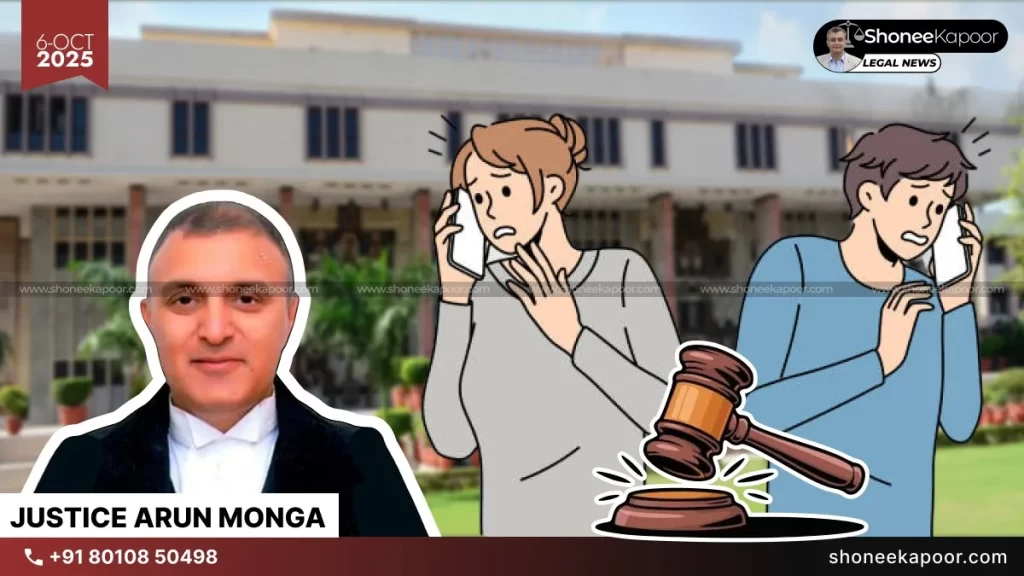
Justice Arun Monga grants bail to Naveen Yadav, accused under Section 69 BNS, observing that a failed relationship cannot be treated as rape. The Court noted the woman’s own WhatsApp messages denying intimacy and called the misuse of such cases “unfortunate.”
Slams Misuse of Promise-to-Marry: In a major relief for men facing criminal cases (Promise-to-Marry) after failed relationships, the Delhi High Court has held that calling off marriage after courtship does not amount to cheating or rape, but is a legitimate exercise of personal choice. Justice Arun Monga made these observations while granting bail to Naveen Yadav, who had been in custody for over a month in a case registered under Section 69 of the Bharatiya Nyaya Sanhita (BNS), 2023, sexual intercourse by deceitful means.
The Court emphasized that “to suggest that a person cannot change their mind after courtship would defeat the very purpose of the concept itself.”
The case stemmed from a complaint lodged at Maurya Enclave Police Station, Delhi. According to the FIR, the complainant met the accused Naveen Yadav on the matrimonial website Shaadi.com in April 2025.
Yadav, a Dubai-based professional, expressed his desire to marry and allegedly developed a relationship with her through regular calls and WhatsApp chats. She alleged that he induced her into a physical relationship on the promise of marriage and later, along with his family, demanded a flat worth ₹2–3 crores in Dubai, a luxury car, and cash, threatening not to marry her if the demands weren’t met. Feeling cheated, she approached the police, leading to his arrest on August 12, 2025. He was booked under Section 69 of BNS and the Dowry Prohibition Act, 1961.
The petitioner argued that the FIR was false, vindictive, and exaggerated, lodged only after he decided not to proceed with marriage. The complainant had herself admitted in a WhatsApp message that no physical intimacy ever occurred, contradicting her later FIR claims. The relationship was consensual, born out of genuine intent to marry, which later failed due to incompatibility not deceit. His arrest cost him his job in Dubai, got him blacklisted from employment in the UAE for three years, and destroyed his livelihood. Supreme Court precedents; Pramod Suryabhan Pawar (2019), Mahesh Damu Khare (2024), and Prithvirajan (2025) — all hold that “failed relationships cannot be criminalized as rape”.
Justice Arun Monga observed that the case was being wrongly construed as criminal deceit when it was, in fact, a matter of mutual incompatibility:
“It seems to be an unfortunate case where two consenting adults entered into a relationship with the intention of exploring marriage. However, after getting to know each other better, one party chose not to proceed. This legitimate exercise of choice has been misconstrued as a breach of promise.”
The Court further held:
“A physical relationship based on a failed genuine intent to marry does not constitute rape.”
On the allegations of dowry demand, Justice Monga stated:
“Even if assumed to be true, they do not attract Section 69 of the BNS. They are distinct offences under the Dowry Prohibition Act, which are bailable in nature. No dowry was given only a claim of demand.”
The Decision of the Court came out as to be: Bail was Granted, the Court ordered Naveen Yadav’s release on furnishing a personal bond with solvent surety, noting that bail is the rule and jail is the exception, Justice Monga reiterated that criminal law must not be misused to settle personal scores or emotional fallout from failed relationships.
Explanatory Table of All Laws and Sections in This Case
| Law / Section | Provision / Meaning | Relevance in the Case |
| Section 69, BNS 2023 | Sexual intercourse by deceitful means | Main charge; Court held failed intent ≠ deceit |
| Sections 3 & 4, Dowry Prohibition Act, 1961 | Dowry demand & penalty | Held bailable; no actual dowry given |
| Pramod Suryabhan Pawar v. State of Maharashtra (2019) | Consensual sex ≠ rape if intent was genuine | Applied directly |
| Mahesh Damu Khare v. State of Maharashtra (2024) | Failed engagement ≠ false promise | Relied upon |
| Prithvirajan v. State (2025) | Clarified meaning of deceit under BNS | Cited as guiding precedent |
| Samar Ghosh v. Jaya Ghosh (2007) | Mental cruelty concept | Referred in context of emotional harm from false allegations |
Case Title: Naveen Yadav v. State (NCT of Delhi)
Bench: Hon’ble Mr. Justice Arun Monga
Details
- Court: Delhi High Court
- FIR NO: 341/2025, PS Maurya Enclave
- Case Number: BAIL APPLN. 3776/2025
- Date of Judgment: 26 September 2025
- Statutory References:
- Section 69, Bharatiya Nyaya Sanhita, 2023
- Sections 3 & 4, Dowry Prohibition Act, 1961
- High Court Judgment:
- Courtship is not Crime: Withdrawing from marriage after courtship is a legitimate personal choice, not deceit or cheating.
- If a relationship begins with genuine intent to marry but later fails, it cannot be treated as rape or “sexual intercourse by deceitful means” under Section 69 (BNS) Bharatiya Nyaya Sanhita, 2023.
- The complainant’s own WhatsApp message admitted no physical intimacy took place, contradicting her FIR – creating serious doubt.
- Even if the alleged dowry demand is true, no actual dowry was given.
- Offences under Sections 3 & 4 of the Dowry Prohibition Act are bailable and separate from Section 69 Section 69 of the Bharatiya Nyaya Sanhita (BNS), 2023.
- Arrest led to loss of employment in Dubai and a three-year work ban in UAE – showing the grave damage caused by premature criminalization.
- Continued custody would amount to pre-trial punishment, which the law forbids.
- Allegations of blackmail or dowry are distinct and triable separately; they don’t justify denial of bail under Section 69 of the Bharatiya Nyaya Sanhita (BNS), 2023.
- Judicial Observation on Liberty: “To suggest that a person cannot change their mind after such interaction would defeat the very essence of courtship.”
- Regular bail granted to Naveen Yadav.

Disclaimer: The views and opinions expressed in this article are those of the Indian courts and do not necessarily reflect the official policy or position of “ShoneeKapoor.com” or its affiliates. This article is intended for informational and educational purposes only. The content provided is not legal advice, and viewers should not act upon this information without seeking professional counsel. Viewer discretion is advised