
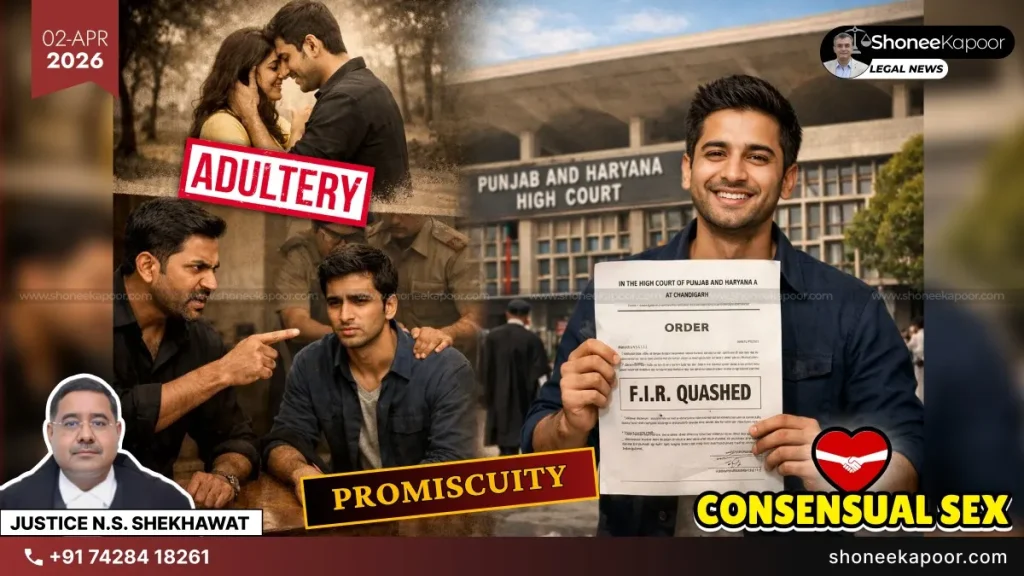
The Punjab & Haryana High Court highlighted that a prolonged relationship without immediate complaint raises serious doubts about allegations of lack of consent.
When both parties are educated adults, can continued participation in a relationship still be treated as lack of consent later?
CHANDIGARH: The Punjab & Haryana High Court, presided over by Justice N.S. Shekhawat quashed a rape FIR filed against a man, holding that the relationship in question was consensual and not a result of force, coercion, or deception.
The case arose from allegations made by a husband, who claimed that the accused had developed relations with his wife and later forced himself upon her while also blackmailing her. However, during the proceedings, it emerged that both individuals were adults, educated, and had known each other for a long time, with both families being on visiting terms.
The Court carefully examined the facts and noted that the woman was a qualified professional, married for several years, and fully capable of understanding her actions. It was also observed that the relationship between the two continued over a considerable period, which raised serious doubts about the allegations of force or coercion.
Importantly, the prosecution could not produce any audio, video, or digital evidence to support claims of blackmail. The Court noted that despite serious allegations, there was no material to show that the woman was threatened or forced at any point.
Referring to the legal position on consent, the Court reiterated the principle that consent must involve a clear and conscious decision. It quoted:
“Consent with respect to Section 375 of the IPC involves an active understanding of the circumstances, actions and consequences of the proposed act.”
While evaluating the material, the Court observed that even the surrounding circumstances, such as regular communication between the parties and normal social interactions between families, did not support the claim of coercion. The absence of any immediate resistance or complaint further weakened the prosecution’s version.
After analyzing the entire record, the Court concluded that the relationship between the parties was voluntary and based on mutual consent. It made a strong observation, stating:
“If a fully grown-up lady consents to the act of sexual intercourse and continues to indulge in such activity, it is an act of promiscuity on her part and not an act induced by misconception of fact.”
The Court ultimately held that the essential ingredients required to establish the offence of rape were not made out in the present case. It further observed that allowing such proceedings to continue in the absence of credible evidence would amount to misuse of the legal process. Accordingly, the FIR and all consequential proceedings arising from it were quashed.
Explanatory Table: Laws & Provisions Involved
| Section / Law | What It Covers | Court’s Interpretation in This Case |
| Section 482 CrPC | Inherent powers of High Court to prevent abuse of process and secure justice | Invoked to quash the FIR as continuation of proceedings would be misuse of law |
| Section 376(2) IPC | Punishment for rape (aggravated forms) | FIR registered under this section was quashed due to absence of ingredients of rape |
| Section 375 IPC | Definition of rape and circumstances where consent is invalid | Court held that facts did not satisfy conditions of rape as relationship appeared consensual |
| Section 90 IPC | Consent given under fear or misconception is not valid consent | No evidence of fear, threat, or misconception affecting consent was found |
| Indian Evidence Act (General Principles) | Evaluation of oral, documentary, and electronic evidence | Court noted absence of corroborative evidence such as audio/video proof of blackmail |
| Medical Evidence Principles | Role of medical examination in sexual offence cases | No incriminating medical evidence was found; prosecutrix even refused internal examination |
| Digital Evidence (Electronic Records) | Admissibility of electronic communication as proof | No emails, messages, or digital data indicating threat or coercion were found |
Case Details
- Case Title: Anil Sharma vs State of U.T., Chandigarh and Others
- Court: High Court of Punjab & Haryana at Chandigarh
- Case Number: CRMM-1885 of 2021 (O&M)
- Bench: Hon’ble Mr. Justice N.S. Shekhawat
- Date of Judgment: 20.03.2026
- Neutral Citation: 2026:PHHC:044912
- Counsels:
- For Petitioner: Mr. R.S. Bains, Senior Advocate, Mr. Sumeet Singh, Advocate, and Mr. Utsav Singh Bains, Advocate
- For State (U.T. Chandigarh): Ms. Sharmila Sharma, A.P.P
- For Respondents: Mr. Charanpreet Singh, Advocate
Key Takeaways
- Courts are increasingly recognising that consensual relationships cannot be weaponised later as rape allegations when disputes arise.
- Allegations of blackmail or coercion must be backed by solid proof — without evidence, such claims cannot sustain criminal prosecution.
- A long-term voluntary relationship between adults weakens claims of forced consent, especially when there is delay in complaint.
- Criminal law is not a tool for settling personal or marital disputes after relationships break down.
- False or exaggerated allegations can destroy lives, and courts must intervene to prevent abuse of process.
This Could Change Your Case-Get FREE Legal Advice-Click Here!
Disclaimer: The views and opinions expressed in this article are those of the Indian courts and do not necessarily reflect the official policy or position of “ShoneeKapoor.com” or its affiliates. This article is intended for informational and educational purposes only. The content provided is not legal advice, and viewers should not act upon this information without seeking professional counsel. Viewer discretion is advised.