
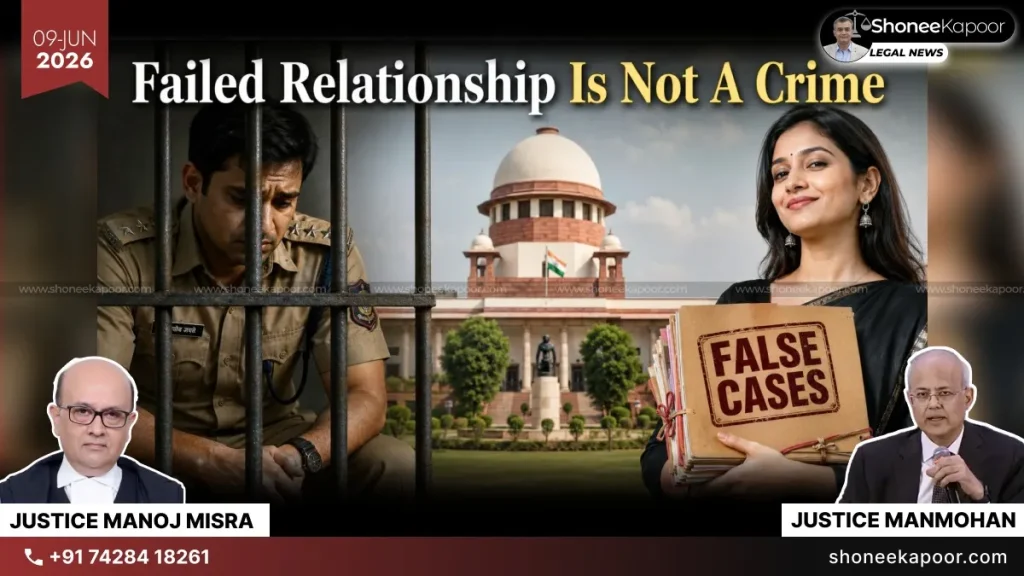
A rape-on-promise-of-marriage case was settled years ago. Can an employer still treat a man as guilty and deny him a government job? The Supreme Court has now clarified when past allegations can—and cannot—be used to destroy a person’s career.
NEW DELHI: The Supreme Court has ruled that a consensual physical relationship between two unmarried adults cannot, by itself, be treated as a reflection of bad character. The Court also observed that not every relationship ends in marriage and merely because a relationship fails does not mean that one person has cheated the other.
A Bench of Justice Manmohan and Justice Manoj Misra made these observations while granting relief to a Telangana police constable candidate whose selection had been cancelled because of a criminal case arising out of a past relationship.
The Court said:
“Physical relationship between two consenting unmarried adults cannot and should not by itself be a ground to draw an adverse impression about the character of the person in that relationship. There is no law which prohibits two consenting unmarried adults to have a relationship of their choice.”
The Court further clarified that a compromise in a rape-on-promise-of-marriage case before a Lok Adalat cannot automatically be treated as an admission of guilt. It held that authorities cannot draw negative conclusions from such settlements unless there is material on record showing that the compromise was forced upon the complainant.
The judgment stated:
“Not every relationship culminates in marriage. Therefore, merely because the relationship did not culminate in marriage is no ground to believe that one party has cheated the other.”
The case involved Gajula Thirupathi, who was provisionally selected for the post of Stipendiary Cadet Trainee Police Constable in Telangana. His selection was later cancelled by the Telangana State Level Police Recruitment Board because a 2014 criminal case arising out of a relationship with his neighbour was considered to involve moral turpitude.
Importantly, Thirupathi had voluntarily disclosed the case in his application form. The dispute had already been settled before a Lok Adalat in 2015, and no charge under Section 376 IPC was ever pursued.
When the recruitment board first cancelled his selection, a Single Judge of the Telangana High Court set aside the decision and directed reconsideration. However, after reconsideration, the board again cancelled his selection. The Single Judge once more ruled in his favour and directed his appointment. Later, a Division Bench of the High Court reversed that decision, observing that compounding of the offence was not equivalent to a clean acquittal and that the employer was best placed to assess suitability for a disciplined force.
Thirupathi then approached the Supreme Court.
While examining the issue, the Supreme Court noted that society has changed and authorities must be sensitive to contemporary realities. The Bench observed that pre-marital relationships between consenting adults are not uncommon in present times and cannot automatically be viewed with suspicion.
The Court said:
“Further, where such a relationship spans a considerable period, say a few years, time and again this Court has quashed criminal proceedings initiated by one party against the other on a complaint that the victim was lured into physical relationship by a false promise of marriage, because in such a case there would be a presumption that such relationship is based on a valid consent.”
The Bench noted that Thirupathi and the complainant were neighbours who had known each other for several years. It further observed that there was no evidence suggesting force, coercion, threats, or pressure to obtain the compromise. Had there been such evidence, the recruitment board could have legitimately examined his suitability for service in a disciplined force. However, no such material existed.
The Court also highlighted that the allegation involved cheating, where deception is a key ingredient. In such cases, only the complainant herself could establish whether she had actually been deceived.
The Court held:
“Whether prosecutrix was deceived into entering a relationship, the prosecutrix alone could have disclosed. The public at large cannot tell whether she was deceived by the appellant. In such circumstances, when the prosecutrix chose not to pursue and had led no evidence, rather had expressed her consent to compound the case, there was no occasion for the respondents to read in between lines and draw an adverse inference regarding the character of the appellant.”
The Supreme Court further laid down an important principle for employers dealing with candidates who were previously involved in criminal proceedings. It held that before forming an adverse opinion, the employer must have material indicating that the offence was committed and material linking the candidate to that offence.
In this case, the Court found serious doubts regarding whether the alleged offence of cheating had occurred at all, particularly because the complainant had chosen not to pursue the matter and no evidence had been led.
Setting aside the Division Bench judgment of the Telangana High Court, the Supreme Court restored the order directing Thirupathi’s appointment.
EXPLANATORY TABLE OF LAWS AND SECTIONS INVOLVED
| LAW / SECTION | PURPOSE | HOW IT WAS USED IN THIS CASE |
| Section 417 IPC | Punishment for cheating | Allegation that the complainant was deceived through a promise of marriage. |
| Section 420 IPC | Cheating and dishonestly inducing delivery of property | Included in the FIR and charge sheet against the appellant. |
| Section 506 IPC | Criminal intimidation | Allegation that threats were extended to the complainant. |
| Section 34 IPC | Common intention | Used to allege that the accused persons acted together. |
| Section 376 IPC | Rape | No charge under Section 376 IPC was ultimately pressed or included in the charge sheet. |
| Section 320 CrPC | Compounding of offences | The dispute was settled and compounded before a Lok Adalat. |
| Section 320(8) CrPC | Effect of compounding | Appellant argued that compounding resulted in acquittal under law. |
| SCT Rule 3(G)(vi) (Telangana Police Recruitment Rules) | Disqualification for offences involving moral turpitude | Recruitment Board relied on this rule to cancel the appointment. |
CASE DETAILS
| PARTICULARS | DETAILS |
| Case Title | Gajula Thirupathi v. The Telangana State Level Police Recruitment Board and Others |
| Court | Supreme Court of India |
| Case Number | Civil Appeal No. 8059 of 2026 (Arising out of SLP (C) No. 018626 of 2026 @ Diary No. 46777 of 2025) |
| Judgment Date | 21 May 2026 |
| Neutral Citation | 2026 INSC 493 |
| Bench | Justice Manoj Misra and Justice Manmohan |
| Appellant | Gajula Thirupathi |
| Respondents | Telangana State Level Police Recruitment Board and Others |
| Originating High Court | High Court for the State of Telangana at Hyderabad |
| High Court Appeal | W.A. No. 1274 of 2024 |
| Original Writ Petition | W.P. No. 20833 of 2021 |
| Earlier Writ Petition | W.P. No. 20812 of 2020 |
| Crime Number | Crime No. 190 of 2014 |
| Police Station | Dharmaram Police Station |
| Result | Appeal Allowed; Division Bench Judgment Set Aside; Single Judge’s Order Restored; Appointment Directed |
KEY TAKEAWAYS
- A failed relationship cannot automatically be converted into proof of cheating, misconduct, or bad character.
- Men cannot be branded guilty merely because an allegation was made against them and never tested in court.
- A compromise or settlement does not mean a man has admitted guilt, despite authorities often treating it that way.
- Careers and livelihoods cannot be destroyed on assumptions, social stigma, or moral judgments unsupported by evidence.
- The judgment reinforces a fundamental principle: allegations may start a case, but only evidence can prove guilt. A man’s future cannot be sacrificed to suspicion alone.
This Could Change Your Case-Get FREE Legal Advice-Click Here!
Disclaimer: The views and opinions expressed in this article are those of the Indian courts and do not necessarily reflect the official policy or position of “ShoneeKapoor.com” or its affiliates. This article is intended for informational and educational purposes only. The content provided is not legal advice, and viewers should not act upon this information without seeking professional counsel. Viewer discretion is advised.