
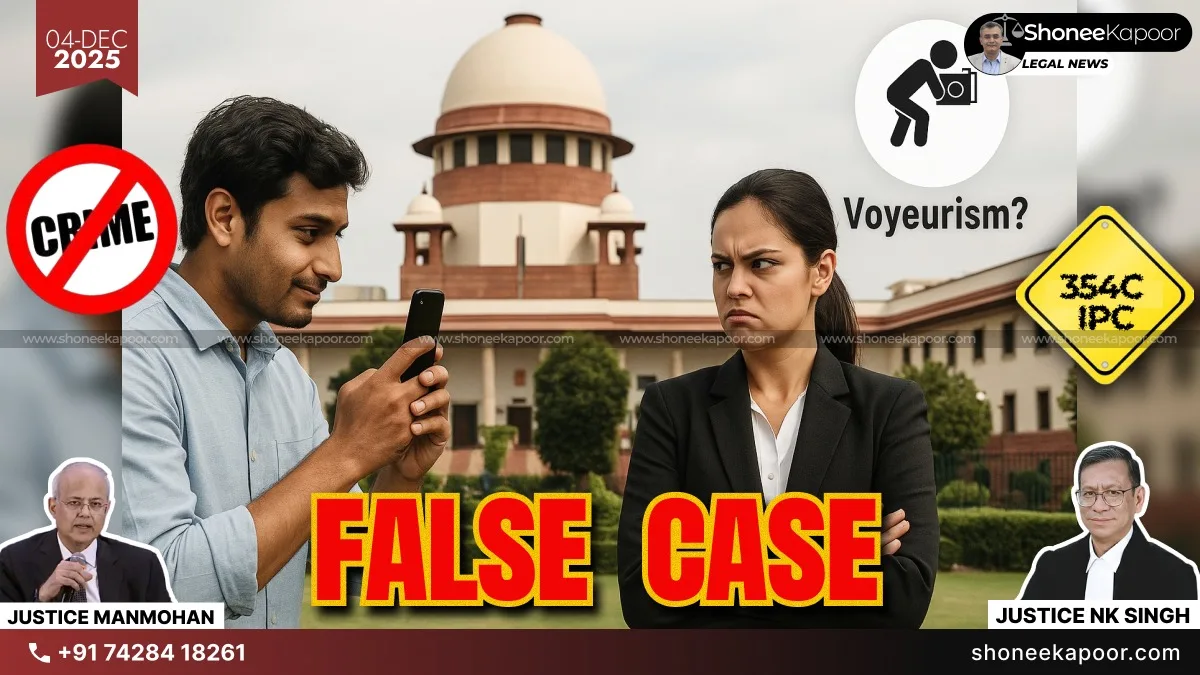
Supreme Court: Clicking Photos or Videos of Women Without Consent When She’s Not Engaged In Private Acts Won’t Amount To Voyeurism – 354C IPC

Written and analysed by Vaibhav Ojha
Head Of Legal CommunicationsThe Supreme Court ruled that taking photos or videos of a woman in public or non-private situations does not amount to voyeurism under Section 354C IPC. The Court discharged the accused, calling the case a misuse of criminal law arising out of a family property dispute.
NEW DELHI: The Supreme Court of India has clearly held that taking photos or making videos of a woman without her permission, when she is not doing a private act, cannot be treated as voyeurism under Section 354C of the Indian Penal Code.
This major clarification came while the Court was hearing a criminal case arising out of a long property dispute in Salt Lake, Kolkata.
A bench of Justices NK Singh and Manmohan closed the criminal case against Tuhin Kumar Biswas, who had been accused only because he recorded a video of a woman while she was entering a disputed property. The Court said the police and the trial court were expected to act more responsibly.
They should not file a chargesheet or frame charges for voyeurism without proper material. The bench observed that running cases forward “only clogs the criminal justice system” and wastes time that should be used for more serious matters.
The case was linked to a family dispute between two brothers over a house in Salt Lake. Tuhin Biswas is the son of one of the co-owners. His father had already filed a civil suit in 2018, and on 29 November 2018, a civil court had given an injunction ordering both sides to maintain joint possession and preventing any third-party rights. This order was active when complainant Mamta Agarwal visited the property in March 2020.
Later, she filed an FIR on the instructions of the uncle of the accused. She alleged that he stopped her, intimidated her, and clicked her photos and videos without her consent. The police filed a chargesheet on 16 August 2020 under Sections 341 (wrongful restraint), 354C (voyeurism), and 506 (criminal intimidation), even though the complainant refused to give a judicial statement.
After both the trial court and the Calcutta High Court refused to discharge him, the accused approached the Supreme Court.
The Court first explained the law on discharge. It stated that criminal courts must act as a filter and a case can only go to trial if the material placed by the prosecution creates a strong suspicion of guilt. A weak case should not continue.
The bench then analysed the FIR and chargesheet to check whether voyeurism was made out. It explained that voyeurism applies only when a woman is watched or photographed during a private act, like undressing, using a toilet, or doing a sexual act. In this case, there was no private act involved at all, and the Court found nothing in the FIR to support a voyeurism charge.
The Court pointed out that even the High Court had admitted that voyeurism was not made out, but still refused to discharge the accused. This was incorrect.
Next, the Court looked at the charge of criminal intimidation under Section 506 IPC. It said there was no mention of any threat of injury to person, property, or reputation. No specific threatening words were recorded. This meant the basic requirement of criminal intimidation was missing.
The Court then examined the allegation of wrongful restraint. The FIR showed that the complainant tried to enter the property, claiming she was a tenant. But the chargesheet contained no proof of tenancy. Even her own supporting witnesses gave no statements. Interestingly, the uncle (Amalendu Biswas) himself stated that the complainant had only come to “see” the property, which meant she was only a prospective tenant.
The Court said that bringing in a tenant would violate the existing injunction. Therefore, the accused acted under a bona fide belief that he had the right to stop entry into the property under the civil court’s order. The Court observed that even if the allegations were taken at face value, the matter was purely civil in nature, and at most, required civil remedies like injunction applications—not criminal prosecution.
The bench strongly criticised routine filing of criminal charges in such cases.
It said:
“The tendency of filing chargesheets in matters where no strong suspicion is made out clogs the judicial system. It forces Judges, court staff, and prosecutors to spend time on trials that are likely to result in an acquittal. This diverts limited judicial resources from handling stronger, more serious cases, contributing to massive case backlogs.”
“Undoubtedly, there can be no analysis at the charge framing stage as to whether the case would end in conviction or acquittal, but the fundamental principle is that the State should not prosecute citizens without a reasonable prospect of conviction, as it compromises the right to a fair process.”
The Court further said that in this case the police and the trial court ignored the fact that there was already a civil dispute and an injunction, and also that the complainant refused to give a judicial statement.
Therefore, no strong suspicion existed against the accused.
Accordingly, the Supreme Court allowed the appeal and discharged the accused from all charges.
Explanatory Table Of All Laws & Sections Used In This Case
| Section / Law | Meaning in Simple English | Why It Was Mentioned Here | Supreme Court’s Observation |
| Section 341 IPC – Wrongful Restraint | Stopping someone from going where they have a legal right to go. | The woman claimed the accused stopped her from entering the property. | She was not a tenant, only a prospective visitor. Under the injunction, the accused had a bona fide belief he had a right to stop entry. No offence made out. |
| Section 354C IPC – Voyeurism | Watching or recording a woman during a private act (undressing, bathroom use, sexual act). | She claimed he clicked photos/videos without consent. | No private act involved. Accused only recorded her entering the property. “Allegation… did not disclose any offence under Section 354C.” |
| Section 506 IPC – Criminal Intimidation | Threatening someone with injury to body, property, reputation. | FIR vaguely accused him of “intimidation”. | No specific threat mentioned. FIR silent on words used. No statements recorded. Ingredients of Section 506 not satisfied. |
| Section 161 CrPC – Police Statements | Police records witness statements here. | No supporting witnesses gave statements. | Absence of statements shows weak, unsubstantiated case. |
| Section 164 CrPC – Judicial Statement | Complainant gives statement before a magistrate. | Woman refused to give this statement. | Indicates doubt and made the prosecution case weaker. |
| Section 227 CrPC – Discharge | Court checks if enough material exists to continue trial. | The accused sought discharge. Lower courts refused. | Supreme Court said no strong suspicion, so accused must be discharged. Courts should not act as “post offices”. |
| Civil Injunction Order (29 Nov 2018) | Order said both brothers must maintain joint possession; no tenant/third party can be inducted. | Complainant entering property violated the injunction. | Accused had lawful reason to prevent entry. Makes criminal allegations civil in nature. |
| Principle of Strong Suspicion (Case Law) | Only when material creates strong suspicion, a case should go to trial. | Court applied this rule. | Said weak cases “clog the judicial system”. |
Case Summary
| Category | Information |
| Case Title | Tuhin Kumar Biswas @ Bumba vs The State of West Bengal |
| Court | Supreme Court of India |
| Citation | 2025 INSC 1373 |
| Case Type | Criminal Appeal No. 5146 of 2025 (Arising out of SLP (Crl.) No. 3002/2024) |
| Date of Judgment | 02 December 2025 |
| Bench | Justice Nongmeikapam Kotiswar Singh & Justice Manmohan |
| Appellant | Tuhin Kumar Biswas @ Bumba |
| Respondent | State of West Bengal |
| Originating FIR | FIR No. 50/2020 dated 19 March 2020, Bidhannagar North Police Station |
| Trial Court Case | G.R. Case No. 223 of 2020 |
| Incident Date | 18 March 2020 |
| Location of Dispute | CF-231, Sector I, Salt Lake, Kolkata-700064 |
| Core Issue | Property dispute between two brothers leading to false criminal allegations |
| Civil Suit Mentioned | Title Suit No. 20 of 2018 (joint possession injunction order dated 29 Nov 2018) |
| Final Outcome | Supreme Court discharged the accused from all charges under Sections 341, 354C, 506 IPC |
Counsels Appearing
- For the Appellant (Tuhin Kumar Biswas)
- Somnath Ghoshal
- Sahid Uddin Ahmed
- Towseef Ahmad Dar
- Anupam Bar
- Zinat Sultana
- For the Respondent (State of West Bengal)
- Prashant Alai
- Kunal Mimani
Key Takeaways
- Supreme Court made it clear that every time a woman complains about being recorded, it does not become voyeurism; only “private acts” are covered.
- The complainant refused to give a judicial statement, yet police still filed a chargesheet—showing how easily men get dragged into false criminal cases.
- A simple property dispute was converted into criminal allegations, proving how criminal law is routinely misused to pressure men.
- Court held there was no threat, no wrongful restraint, no private act—yet the man had to fight for years to prove his innocence.
- Supreme Court warned police and trial courts not to push weak cases, because prosecuting men without strong suspicion destroys fairness and clogs the justice system.
This Could Change Your Case-Get FREE Legal Advice-Click Here!
Disclaimer: The views and opinions expressed in this article are those of the Indian courts and do not necessarily reflect the official policy or position of “ShoneeKapoor.com” or its affiliates. This article is intended for informational and educational purposes only. The content provided is not legal advice, and viewers should not act upon this information without seeking professional counsel. Viewer discretion is advised.
Related Articles

Legal Risks Men Face In Modern Relationships In India: 498A, Maintenance, False Promise To Marry, Live-In Cases & DV Act
Modern relationships can expose Indian men to criminal cases, maintenance claims, DV Act proceedings, false promise t...
Real Court Cases Where False Allegations Backfired On Wife
Real Indian court cases where false 498A, dowry, cruelty and defamatory allegations against husbands backfired, leadi...
Section 69 BNS: Legal Protection or Weapon Against Men?
A new criminal provision was supposed to punish deception. In practice, it is already raising an older question in a ...
Share Your Thoughts
Comments are moderated before publication.