
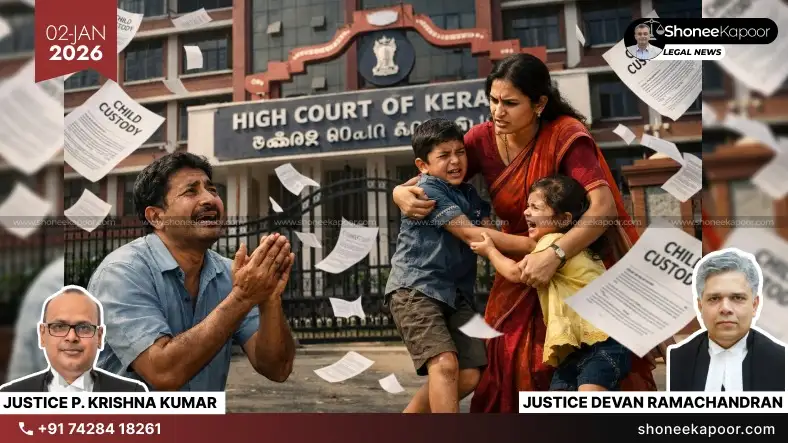
The Kerala High Court ruled that child custody decisions must focus only on the child’s best interests, not the gender of the parent. The Court stressed that children need equal emotional and physical support from both parents.
KOCHI: The Kerala High Court has clearly stated that child custody disputes should never be decided based on whether the parent is a mother or a father. The Court held that children involved in matrimonial custody cases need the presence, care, and support of both parents for their proper mental and physical development and for growing up as responsible citizens of society.
The observation came from a vacation bench comprising Justice Devan Ramachandran and Justice P. Krishna Kumar, which was hearing a batch of petitions challenging custody arrangements of minor children between parents.
Justice Devan Ramachandran, while leading the bench, emphasized that children cannot be treated as trophies in legal battles between parents. He pointed out that in the rush to win custody cases, parents often forget the basic truth that children have an equal right to the love and presence of both their mother and father.
The Court strongly remarked,
“In fight for custody of children, parents forget that children have the right to be with both of them equally…Courts are neither Feminist or masculinist, nor will we tolerate patriarchism. We will enforce judicial orders with constitutional will”
The bench further explained that courts are unfairly labelled depending on which parent gets custody. Addressing this growing narrative, the Court observed:
“If a court is to grant custody to a mother, they would brand it feminist and if it should give to the father, then it is accused to be anti-woman. Every case has different facts and circumstances which cannot be compared with each other. Courts will have to analyze them on a case to case basis and take decisions, fundamentally keeping the best interests of the child in mind. Rumours are spread by interested persons, occasionally even by lawyers, whose intentions are malafide and without knowing the facts involved.”
The High Court underlined that parents must always remain parents first, even if their marriage has failed. Continuous conflict between them directly affects the child’s emotional health and may make the child intolerant and disturbed in the future.
Highlighting the correct approach to custody matters, the Court added:
“In matters of custody, the choice should not be as to which parent, but to ensure that the children are able to spend maximum time with each of them. But, this most important requirement is often lost in the heat and din of litigation, mostly fueled by ego and anger.”
Before ending the proceedings, the bench made a deeply emotional observation reflecting concern for children trapped in parental conflicts, stating:
“Where has humanism gone? It deeply pains us to see children crying caught between the strife of their parents for no reason they understand.”
The Bench observed that when there is no indication that the child’s welfare is in danger, continued litigation only prolongs conflict and does not serve the child’s interest. In such circumstances, the Court found that the appropriate course for the petitioner was to withdraw the proceedings rather than continue with adversarial litigation.
Accordingly, the Kerala High Court accepted the request of the petitioner and dismissed the original petition as withdrawn, while reiterating that the child’s welfare remained protected under the existing custody arrangement.

Explanatory Table: Laws / Legal Principles Referred
| Law / Principle | Explanation | How Applied in This Case |
| Best Interests of the Child (Paramount Consideration) | A settled principle in custody jurisprudence that the child’s welfare overrides parental rights, ego, or gender | The Court held that custody decisions must focus only on the child’s mental, emotional, and physical well-being |
| Constitutional Equality | Courts must act without gender bias and enforce equality before law | The bench rejected labels like “feminist” or “anti-woman” and stressed gender neutrality |
| Parens Patriae Jurisdiction | Courts act as guardians of minors when deciding custody | The Court intervened to protect children from parental conflict and litigation-driven harm |
| Right of Child to Parental Care | A child has a right to love, care, and presence of both parents | The Court stressed maximum involvement of both parents rather than exclusive custody |
| Judicial Discipline & Case-by-Case Analysis | Each custody case depends on its own facts | The Court rejected comparisons and generalisations across custody cases |
Case Summary
- Court: Kerala High Court, Ernakulam
- Case Title: Reshma T.R. vs Anish M. & Ors.
- Case Number: O.P. (FC) No. 783 of 2025
- Impugned Matter: Against the order/judgment dated in O.P.G.W. No. 254 of 2025 of the Family Court, Thodupuzha
- Date of Judgment: 26 December 2025
- Neutral Citation: 2025:KER:98856
- Bench: Hon’ble Mr. Justice Devan Ramachandran & Hon’ble Mr. Justice P. Krishna Kumar
- Petitioner: Reshma T.R., aged 35 years, wife of Anish M., resident of Thodupuzha, Idukki District
- Respondents:
- Anish M. (Father of the minor child)
- Maniyan (Father of Anish M.)
- Thankamma (Mother of Anish M.)
- Counsel for Petitioner: Sri. A. K. Haridas, Advocate
Key Takeaways
- Child custody is not a reward for gender; it is a responsibility decided only by the child’s welfare.
- Courts have clearly rejected the myth that custody laws are pro-mother or anti-father.
- Fathers are equally important for a child’s emotional, moral, and psychological growth.
- Turning custody battles into ego wars harms children and destroys families.
- Gender-neutral justice in custody matters is not optional; it is a constitutional duty.
This Could Change Your Case-Get FREE Legal Advice-Click Here!
Disclaimer: The views and opinions expressed in this article are those of the Indian courts and do not necessarily reflect the official policy or position of “ShoneeKapoor.com” or its affiliates. This article is intended for informational and educational purposes only. The content provided is not legal advice, and viewers should not act upon this information without seeking professional counsel. Viewer discretion is advised.
